Abraham Facsimile 2
Kolob and the Governing Ones
A round plate whose explanation names Kolob, the measuring of time, and things that “cannot be revealed unto the world.”
Last revised
About this facsimile
The explanation of this plate speaks of Kolob and of the reckoning of time, as the Lord does to Abraham in chapter 3. There “the name of the great one is Kolob” (Abr. 3:3), one of its revolutions is a day to the Lord and a thousand years where Abraham stands (Abr. 3:4), and it “is set nigh unto the throne of God” (Abr. 3:9). The Church’s footnote to “Kolob” in verse 3 sends the reader to figures 1 to 5 of this plate.
The plate is a kind of Egyptian object called a hypocephalus: a disc of funerary equipment from the Late Period and Ptolemaic times (about 664–30 BC), laid with the dead, of which 158 are known today.
Some of the explanations are withheld: figure 8 “is to be had in the Holy Temple of God,” and figures 12 to 20 “will be given in the own due time of the Lord.”
Like the other two facsimiles, this one was printed with the book in 1842 with Joseph Smith’s explanation of it. Most of the explanations differ from what Egyptologists say of the figures, though some parallels have been noted, and how the plates relate to Abraham’s text is not known; the page for Facsimile 1 gives the Church’s words.
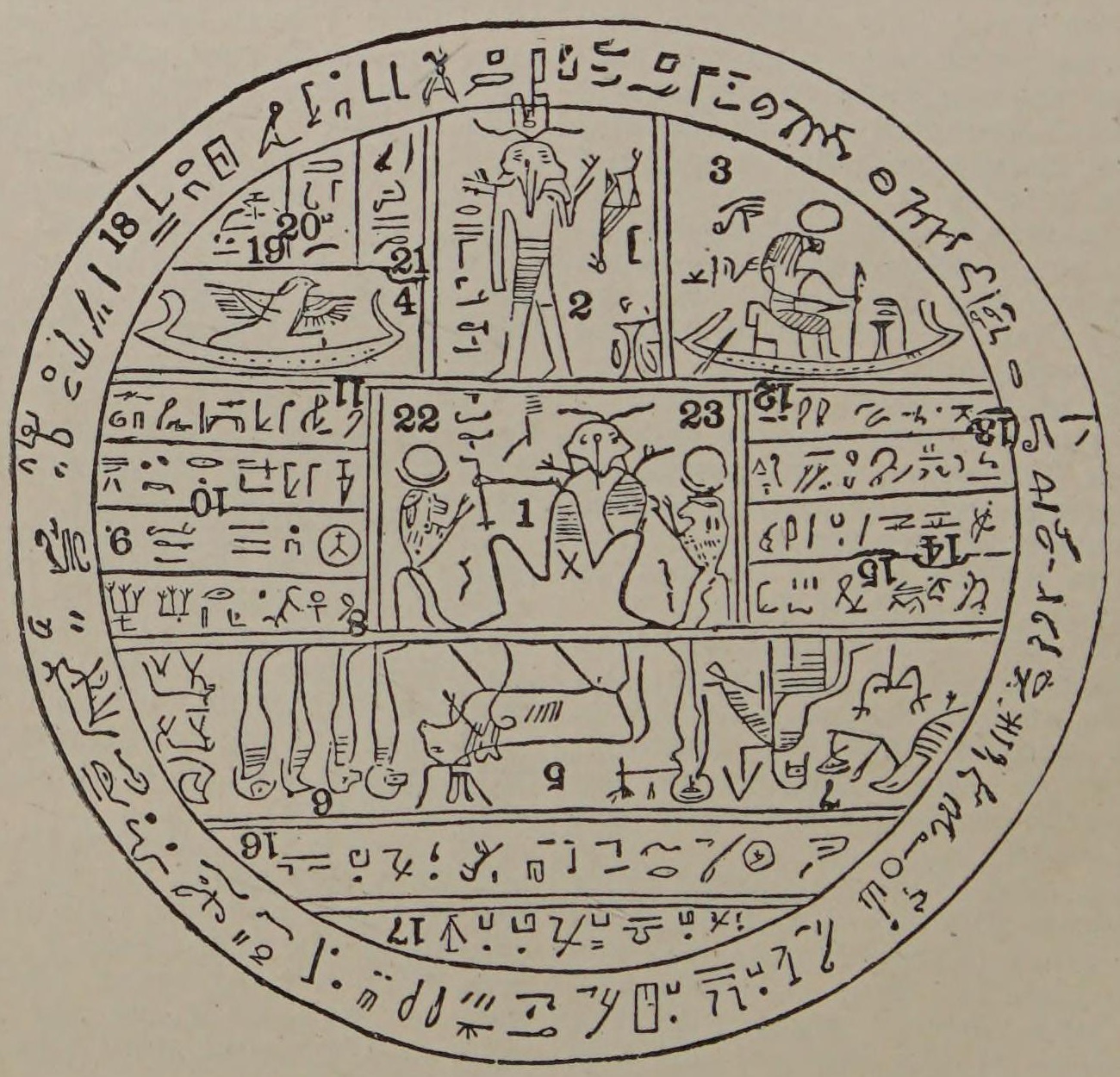
Tap any highlighted phrase to open a note beneath its figurein the margin.
Explanation of the Foregoing Cut
1 Kolob, signifying the first creation, nearest to the celestial, or the residence of God. First in government, the last pertaining to the measurement of time. The measurement according to celestial time, which celestial time signifies one day to a cubit. One day in Kolob is equal to a thousand years according to the measurement of this earth, which is called by the Egyptians Jah-oh-eh.
2 Stands next to Kolob, called by the Egyptians Oliblish, which is the next grand governing creation near to the celestial or the place where God resides; holding the key of power also, pertaining to other planets; as revealed from God to Abraham, as he offered sacrifice upon an altar, which he had built unto the Lord.
3 Is made to represent God, sitting upon his throne, clothed with power and authority; with a crown of eternal light upon his head; representing also the grand Key-words of the Holy Priesthood, as revealed to Adam in the Garden of Eden, as also to Seth, Noah, Melchizedek, Abraham, and all to whom the Priesthood was revealed.
4 Answers to the Hebrew word Raukeeyang, signifying expanse, or the firmament of the heavens; also a numerical figure, in Egyptian signifying one thousand; answering to the measuring of the time of Oliblish, which is equal with Kolob in its revolution and in its measuring of time.
5 Is called in Egyptian Enish-go-on-dosh; this is one of the governing planets also, and is said by the Egyptians to be the Sun, and to borrow its light from Kolob through the medium of Kae-e-vanrash, which is the grand Key, or, in other words, the governing power, which governs fifteen other fixed planets or stars, as also Floeese or the Moon, the Earth and the Sun in their annual revolutions. This planet receives its power through the medium of Kli-flos-is-es, or Hah-ko-kau-beam, the stars represented by numbers 22 and 23, receiving light from the revolutions of Kolob.
6 Represents this earth in its four quarters.
7 Represents God sitting upon his throne, revealing through the heavens the grand Key-words of the Priesthood; as, also, the sign of the Holy Ghost unto Abraham, in the form of a dove.
8 Contains writing that cannot be revealed unto the world; but is to be had in the Holy Temple of God.
The current edition reads “Contains writings.”
9 Ought not to be revealed at the present time.
10 Also.
11 Also. If the world can find out these numbers, so let it be. Amen.
12–20 Figures 12, 13, 14, 15, 16, 17, 18, 19, and 20, will be given in the own due time of the Lord.
The current edition adds “and 21.”
The above translation is given as far as we have any right to give at the present time.
Sources & further reading
- The Holy Scriptures (Latter-day Saint editions), text and chapter headings, The Church of Jesus Christ of Latter-day Saints.
- “Origins of the Book of Abraham”, Topics and Questions, Gospel Library.
- Stephen O. Smoot, John Gee, Kerry Muhlestein, and John S. Thompson, “Kolob, the Governing One”, BYU Studies Quarterly 61, no. 4 (2022): 142.
- Stephen O. Smoot, John Gee, Kerry Muhlestein, and John S. Thompson, “One Day to a Cubit (Facsimile 2, Figure 1)”, BYU Studies Quarterly 61, no. 4 (2022): 247.
- Stephen O. Smoot, John Gee, Kerry Muhlestein, and John S. Thompson, “The Purpose and Function of the Egyptian Hypocephalus”, BYU Studies Quarterly 61, no. 4 (2022): 234.
- Stephen O. Smoot, John Gee, Kerry Muhlestein, and John S. Thompson, “A Semitic View of the Facsimiles”, BYU Studies Quarterly 61, no. 4 (2022): 215.
- Stephen O. Smoot, John Gee, Kerry Muhlestein, and John S. Thompson, “God Sitting upon His Throne (Facsimile 2, Figure 7)”, BYU Studies Quarterly 61, no. 4 (2022): 259.