Malachi
“Behold, I will send my messenger, and he shall prepare the way before me.” The Lord, Mal. 3:1
Malachi is the last book of the Old Testament. His name means “my messenger” in Hebrew, and he preached to the Jews in Jerusalem after they returned from the Babylonian exile. The Bible Dictionary says his prophecy was spoken about 430 B.C.; Scripture Helps says the timing of his ministry is uncertain. The Savior quoted all of chapters 3 and 4 to the Nephites (3 Ne. 24–25), and Moroni quoted from them to Joseph Smith (JS—H 1:36–39).
The book is short. This companion goes through all four chapters and tries to anticipate the questions a careful reader asks: Who is speaking, and to whom? What had the people done? What did that word or custom mean? Where is Christ in this?
For the return from exile and its place in the wider history, see A Timeline of the Old Testament.
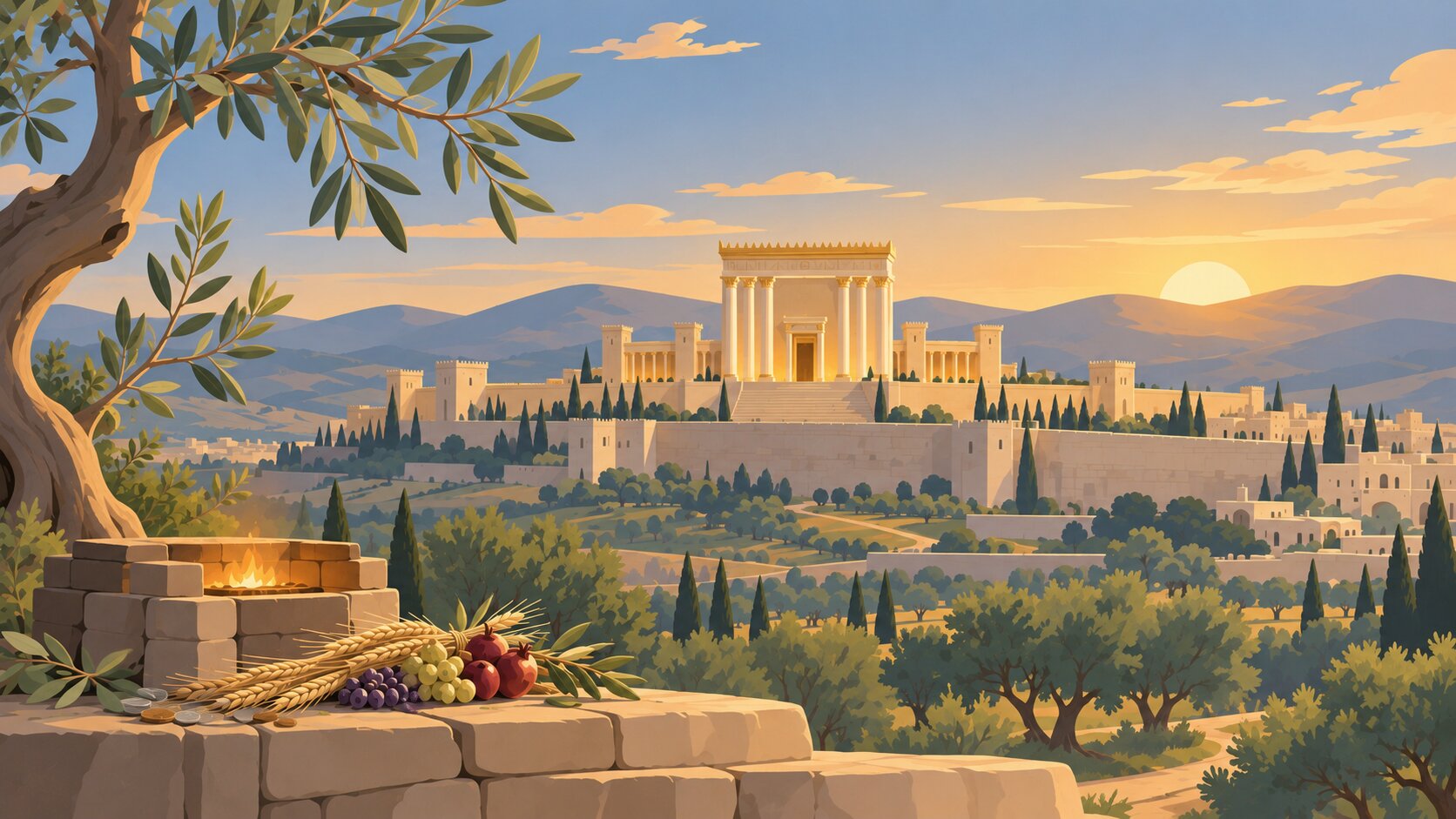
What's in this picture
- The temple on the hill is the Lord’s promise: “the Lord, whom ye seek, shall suddenly come to his temple” (Mal. 3:1).
- The small fire in the stone hearth is the refiner: “he is like a refiner’s fire,” and “he shall sit as a refiner and purifier of silver” (Mal. 3:2–3).
- The grain, fruit and coins on the wall are the offerings the Lord asks of His people: “Bring ye all the tithes into the storehouse” (Mal. 3:10).
The chapters
Malachi is a book of questions and answers. The Lord speaks, the people ask “Wherein?”, and the Lord answers, moving from the priests’ failures to the day that is coming.
The Lord’s Love and the Priests’ Failure
The people ask how the Lord has loved them. He answers with Jacob and Esau. He then reproves the priests for polluted offerings and for forsaking the covenant of Levi, and condemns Judah for dealing treacherously with one another and with the wives of their youth.
- 1 The Lord’s Love and the Polluted Offerings The Lord tells His people that He has loved them, and when they ask how, He points to Jacob and Esau. Then He turns on the priests, who despise His name by laying blind and lame animals on His altar, and says that His name will be great among the nations.
- 2 The Priests Reproved; Judah Deals Treacherously The Lord warns the priests that He will curse their blessings because they have corrupted the covenant of Levi, then charges the people with treachery against one another and against the wives of their youth. The chapter ends with the people asking where the God of judgment is.
The Messenger, the Tithe, and the Book of Remembrance
The Lord’s messenger will prepare the way for the Lord, who will come to His temple and purify the sons of Levi. The people are told to return and to bring tithes and offerings, and a book of remembrance is written for those who feared the Lord.
The Day That Burns and the Return of Elijah
The day comes that burns as an oven, and the Sun of righteousness rises with healing for those who fear the Lord’s name. Before that great and dreadful day He will send Elijah.
Beloved passages
- “my name shall be great among the Gentiles”Malachi 1:11
- “he shall prepare the way before me”Malachi 3:1
- “Will a man rob God?”Malachi 3:8
- “open you the windows of heaven”Malachi 3:10
- “when I make up my jewels”Malachi 3:17
- “neither root nor branch”Malachi 4:1
- “the Sun of righteousness arise with healing in his wings”Malachi 4:2
- “turn the heart of the fathers to the children”Malachi 4:6
Most-used sources
Every note cites its sources. These are the ones this commentary leans on most.
- “Malachi”, Bible Dictionary.
- “Malachi”, Guide to the Scriptures.
- Chapter 34: “Behold, I Will Send You Elijah the Prophet” (Malachi), Old Testament Student Manual: 1 Kings–Malachi (1982), 351–56.
- Malachi, Scripture Helps: Old Testament (2025).