Luke
“For the Son of man is come to seek and to save that which was lost.” Jesus at Zacchaeus’s house, Luke 19:10
Luke was “the beloved physician” (Col. 4:14), born, the Bible Dictionary says, of gentile parents. He travelled with Paul, and the passages of Acts that say “we” are taken to be his; he was with Paul at Rome to the last (2 Tim. 4:11). He wrote this Gospel and the book of Acts, its continuation, and his Gospel was “specially intended for gentile readers.” In the Joseph Smith Translation he calls himself “a messenger of Jesus Christ.”
Luke writes, he says, “in order,” so that his reader may “know the certainty of those things” (Luke 1:3–4). His Gospel opens and closes in the temple, and from the day Jesus “steadfastly set his face to go to Jerusalem” (Luke 9:51) its long middle is the journey there, with parables found in no other Gospel: the good Samaritan, the prodigal son, the Pharisee and the publican. This companion goes through all twenty-four chapters and tries to anticipate the questions a careful reader asks: Why does only Luke tell this? What does the Joseph Smith Translation add? Who were the Samaritans, the publicans, the lawyers? Where is this in my life?
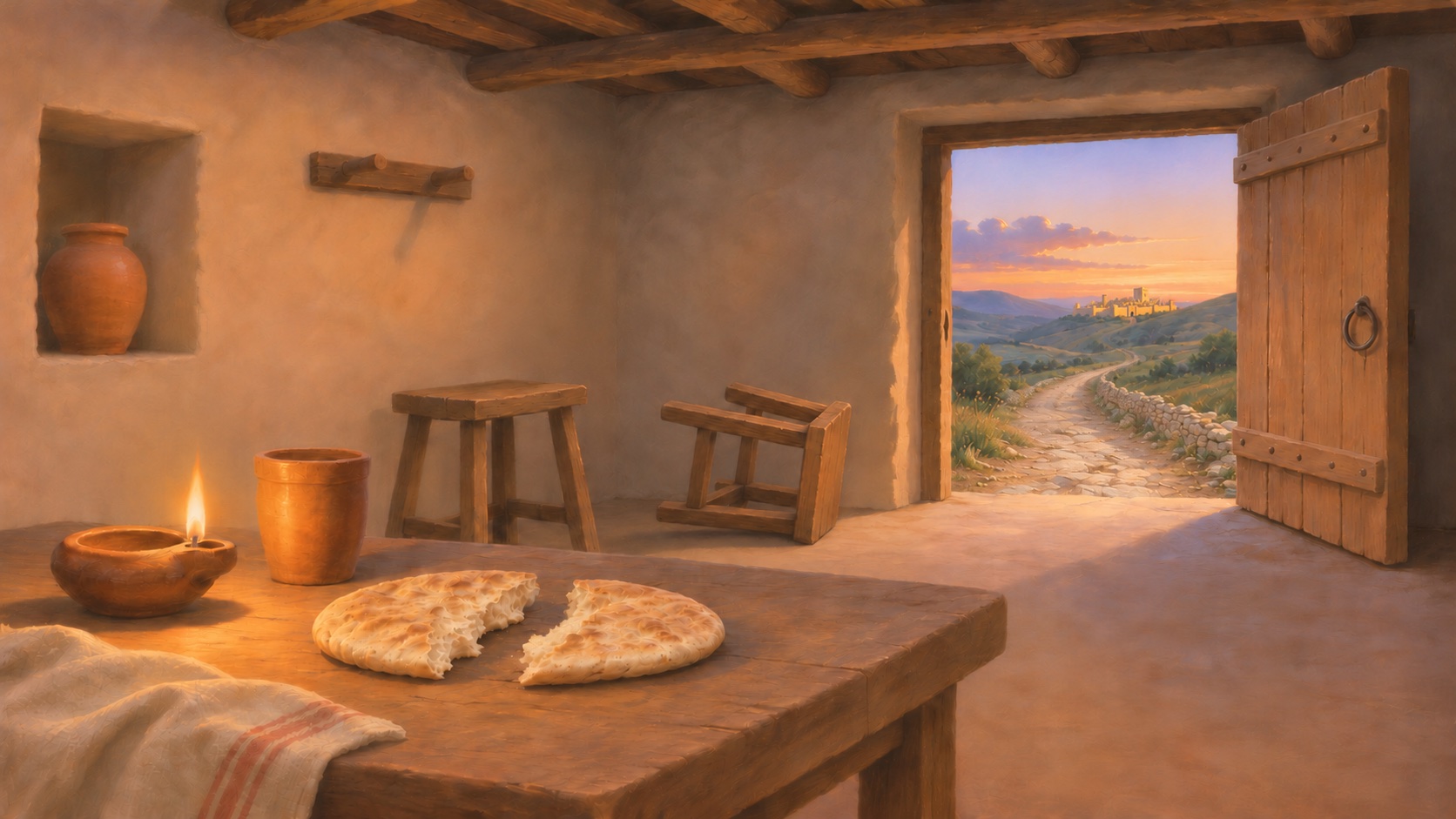
What's in this picture
- The loaf broken in two stands for the bread He broke at their table: “he took bread, and blessed it, and brake, and gave to them” (Luke 24:30). Then “their eyes were opened, and they knew him; and he vanished out of their sight” (Luke 24:31).
- The lamp still burning stands for what the two said to each other when He was gone: “Did not our heart burn within us, while he talked with us by the way, and while he opened to us the scriptures?” (Luke 24:32).
- The stools pushed back, one tipped over, and the empty pegs show how quickly they left: “they rose up the same hour, and returned to Jerusalem” (Luke 24:33).
- The open door and the evening light recall why they asked Him in: “Abide with us: for it is toward evening, and the day is far spent” (Luke 24:29).
- The road down the valley to the city on the far ridge is the way back to Jerusalem, where they “told what things were done in the way, and how he was known of them in breaking of bread” (Luke 24:35).
The chapters
Luke begins and ends in the temple, and from the turn at Luke 9:51, when Jesus “steadfastly set his face to go to Jerusalem,” the long middle of the book is His journey there.
The Births and the Boy in the Temple
Gabriel announces John and Jesus, Mary and Zacharias sing, Jesus is born in Bethlehem and presented in the temple, and at twelve is found there, about His Father’s business.
- 1 Two Announcements Luke sets out to write in order; Gabriel promises a son to an aged priest at the altar of incense and the Son of God to a virgin in Nazareth; two mothers meet, Mary sings, and Zacharias, his tongue loosed, prophesies of the dawn from on high.
- 2 The Birth of Jesus and the Boy in the Temple Born under an emperor’s decree and laid in a manger, the child is announced to shepherds, recognized in the temple by Simeon and Anna, and found at twelve about His Father’s business.
The Spirit of the Lord Is upon Me
John prepares the way, Jesus is baptized and tempted, and in the synagogue at Nazareth He reads Isaiah’s words as fulfilled that day, and His own town rejects Him.
- 3 The Word of God Came unto John In a year Luke dates by emperor, governor and high priests, John prepares the Lord's way; Jesus is baptized and prays, the Father names His Son, and Luke traces Him back to Adam and to God.
- 4 The Spirit of the Lord Is upon Me Full of the Holy Ghost, Jesus turns back the devil’s offer of power, reads Isaiah’s promise of deliverance in the synagogue at Nazareth and says it is fulfilled, is driven to the edge of a cliff by His own townspeople, and then shows in Capernaum the authority He had claimed.
The Ministry in Galilee
Jesus calls fishermen and a publican, chooses the Twelve, preaches on the plain, raises a widow’s son, forgives a woman who loved much, feeds five thousand and is transfigured, then sets His face toward Jerusalem.
- 5 From Henceforth Thou Shalt Catch Men Jesus fills Simon’s nets and calls the fishermen, touches and cleanses a leper, forgives and heals a paralyzed man let down through a roof, calls Levi the publican, and answers His critics with a bridegroom, a patch and new wine.
- 6 Lord of the Sabbath, and the Sermon on the Plain Jesus defends His disciples in the grainfields and heals a withered hand on the Sabbath; after a night of prayer He chooses the Twelve, comes down to a level place, and teaches blessings and woes, love of enemies, mercy like the Father’s, and the house built on the rock.
- 7 Who Is This That Forgiveth Sins Also? Jesus heals a centurion’s servant with a word, raises a widow’s only son at Nain, answers John the Baptist’s question from prison and bears witness of him, and forgives a woman who washes His feet in the house of Simon the Pharisee.
- 8 Take Heed Therefore How Ye Hear Women He has healed travel with Jesus and the Twelve; He tells the parable of the sower and teaches how to hear; names as His family those who hear and do; stills a storm, frees a man from a legion of devils across the lake, heals a woman by a touch and raises the daughter of Jairus.
- 9 Who Is This? Jesus sends out the Twelve, feeds five thousand, hears Peter confess Him the Christ of God, foretells His death, is transfigured on the mount, heals a boy His disciples could not, and sets His face to go to Jerusalem.
On the Road to Jerusalem
The Seventy are sent, a Samaritan shows who is a neighbor, Martha and Mary receive Him, He teaches His disciples to pray and warns against covetousness, hypocrisy and unready servants, and laments over Jerusalem.
- 10 Go, and Do Thou Likewise Jesus sends seventy more disciples ahead of Him two by two, rejoices when they return, answers a lawyer with the parable of the good Samaritan, and is welcomed by Martha while Mary sits at His feet.
- 11 Lord, Teach Us to Pray Jesus teaches a disciple to pray and promises that the Father gives to those who ask, answers the charge that He casts out devils by Beelzebub, offers His generation only the sign of Jonas, and at a Pharisee’s table pronounces woes on Pharisees and lawyers who keep the key of knowledge.
- 12 Treasure in Heaven, and Servants Who Watch Before a vast crowd Jesus warns His disciples against the leaven of hypocrisy and tells them whom to fear, answers a man’s quarrel over an inheritance with the parable of the rich fool, bids them consider the ravens and the lilies, and teaches the servants who watch for their master, the steward who must answer, and the fire He came to kindle.
- 13 Except Ye Repent Jesus turns news of sudden deaths into a call to repent, tells of a fig tree given one more year, looses a woman bound for eighteen years, answers whether few will be saved, and laments over Jerusalem.
The Lost Are Found
Parables of a great supper, a lost sheep, coin and son, the rich man and Lazarus, the Pharisee and the publican, then Zacchaeus at Jericho and the entry into Jerusalem.
- 14 Come; for All Things Are Now Ready At a Sabbath meal in the house of a leading Pharisee, Jesus heals a man with dropsy, tells the guests to take the lowest seat and the host to invite the poor, and gives the parable of the great supper; then, on the road, He tells the crowds to count the cost of following Him.
- 15 This Man Receiveth Sinners When the Pharisees and scribes murmur that Jesus welcomes sinners and eats with them, He answers with three stories of the lost and found, a sheep, a coin and a son, and ends with an elder brother who will not come in to the feast.
- 16 Ye Cannot Serve God and Mammon Jesus tells His disciples of a dishonest steward who used his last days in office to provide for his future, answers the scoffing of covetous Pharisees, and tells of a rich man and a beggar named Lazarus who meet again in the world of spirits.
- 17 Thy Faith Hath Made Thee Whole Jesus warns against causing others to stumble, commands forgiveness without limit, answers the apostles’ plea for faith with a mustard seed and an unprofitable servant, heals ten lepers of whom one returns, and tells the Pharisees and His disciples how the kingdom comes.
- 18 God Be Merciful to Me a Sinner Jesus tells of a widow who will not stop asking an unjust judge and of a Pharisee and a publican at prayer, welcomes infants, sets a rich ruler a choice he will not make, foretells His death to the Twelve, and gives sight to a blind man near Jericho.
- 19 The Time of Thy Visitation Jesus stays at the house of Zacchaeus, a chief publican of Jericho, tells the parable of the pounds, rides down the Mount of Olives to the praise of His disciples, weeps over Jerusalem, and clears the temple.
Teaching in the Temple
In the temple Jesus answers the chief priests, the Sadducees and the scribes, praises a widow’s two mites, and foretells Jerusalem’s fall and His coming.
- 20 The Things Which Be God’s In the temple the rulers challenge Jesus’s authority, and He answers with the parable of the wicked husbandmen; then spies ask about tribute to Caesar, Sadducees about the resurrection, and Jesus asks how the Christ can be David’s son and David’s Lord.
- 21 Your Redemption Draweth Nigh Jesus praises a poor widow’s two mites, foretells that the temple will be thrown down and Jerusalem surrounded by armies and trodden down until the times of the Gentiles are fulfilled, tells of the signs before His coming, and bids His disciples watch and pray.
The Cross and the Risen Lord
The Last Supper, the agony and the bloody sweat, the trials before Pilate and Herod, the cross and a promise of paradise, and the risen Lord on the road to Emmaus and in the upper room.
- 22 Not My Will, but Thine, Be Done Judas bargains with the chief priests; Jesus eats the Passover with the Twelve, gives them the bread and the cup, settles their strife over who is greatest, warns Peter, and prays on the Mount of Olives until His sweat falls like blood; He is arrested, denied three times, mocked, and at dawn questioned by the council.
- 23 This Man Hath Done Nothing Amiss Pilate and Herod find no fault in Jesus, the crowd chooses Barabbas, and Jesus is crucified between two criminals, praying for those who crucify Him and promising one of the criminals paradise before He commends His spirit to the Father and is laid in Joseph’s tomb.
- 24 The Lord Is Risen Indeed Women find the tomb empty and hear angels say that Jesus is risen; He walks unrecognized with two disciples to Emmaus and is known in the breaking of bread; He stands among the eleven with a body of flesh and bones, opens the scriptures, commissions them as witnesses, and is carried up into heaven.
Beloved passages
- “For with God nothing shall be impossible”Luke 1:37
- “Behold the handmaid of the Lord; be it unto me according to thy word”Luke 1:38
- “For unto you is born this day in the city of David a Saviour, which is Christ the Lord”Luke 2:11
- “Glory to God in the highest, and on earth peace, good will toward men”Luke 2:14
- “wist ye not that I must be about my Father’s business?”Luke 2:49
- “And Jesus increased in wisdom and stature, and in favour with God and man”Luke 2:52
- “The Spirit of the Lord is upon me, because he hath anointed me to preach the gospel to the poor”Luke 4:18
- “Mary hath chosen that good part, which shall not be taken away from her”Luke 10:42
- “But when he was yet a great way off, his father saw him, and had compassion”Luke 15:20
- “For the Son of man is come to seek and to save that which was lost”Luke 19:10
- “nevertheless not my will, but thine, be done”Luke 22:42
- “Father, forgive them; for they know not what they do”Luke 23:34
- “Did not our heart burn within us, while he talked with us by the way”Luke 24:32
- “handle me, and see; for a spirit hath not flesh and bones, as ye see me have”Luke 24:39
Most-used sources
Every note cites its sources. These are the ones this commentary leans on most.