Esther
“Who knoweth whether thou art come to the kingdom for such a time as this?” Esth. 4:14
The book of Esther is set in the Persian palace at Shushan, “in the days of Ahasuerus” (Esth. 1:1), the king the Greeks called Xerxes, a generation after the first exiles went home to Jerusalem and before Ezra and Nehemiah followed them. It opens with a king’s feast and a queen deposed: “the queen Vashti refused to come at the king’s commandment” (Esth. 1:12). In her place the king chooses an orphan raised by her cousin Mordecai, “Hadassah, that is, Esther” (Esth. 2:7), who does as Mordecai tells her and does not make known who her people are (Esth. 2:10).
Then Haman the Agagite is raised above all the princes, and “Mordecai bowed not, nor did him reverence” (Esth. 3:2). Haman casts the lot, Pur, and obtains a decree sealed with the king’s ring to destroy every Jew in the empire on one day (Esth. 3:7; Esth. 3:13). Mordecai sends word to the queen: “who knoweth whether thou art come to the kingdom for such a time as this?” (Esth. 4:14). She asks her people to fast three days with her, and answers, “so will I go in unto the king, which is not according to the law: and if I perish, I perish” (Esth. 4:16).
From there the story turns. “On that night could not the king sleep” (Esth. 6:1); Mordecai is honored in the street by the man who meant to hang him, and Haman is hanged “on the gallows that he had prepared for Mordecai” (Esth. 7:10). The first decree cannot be revoked, so a second lets the Jews stand for their lives, and the day their enemies “hoped to have power over them” is “turned to the contrary” (Esth. 9:1). The book ends by founding the feast of Purim, kept for the month “turned unto them from sorrow to joy” (Esth. 9:22). God is never named in it, yet the Church’s sources read it as a striking witness of His providence. This companion goes through all ten chapters and tries to anticipate the questions a careful reader would ask.
For the Persian kings and the Jews who stayed in the east, see A Timeline of the Old Testament and Persia and the Return.
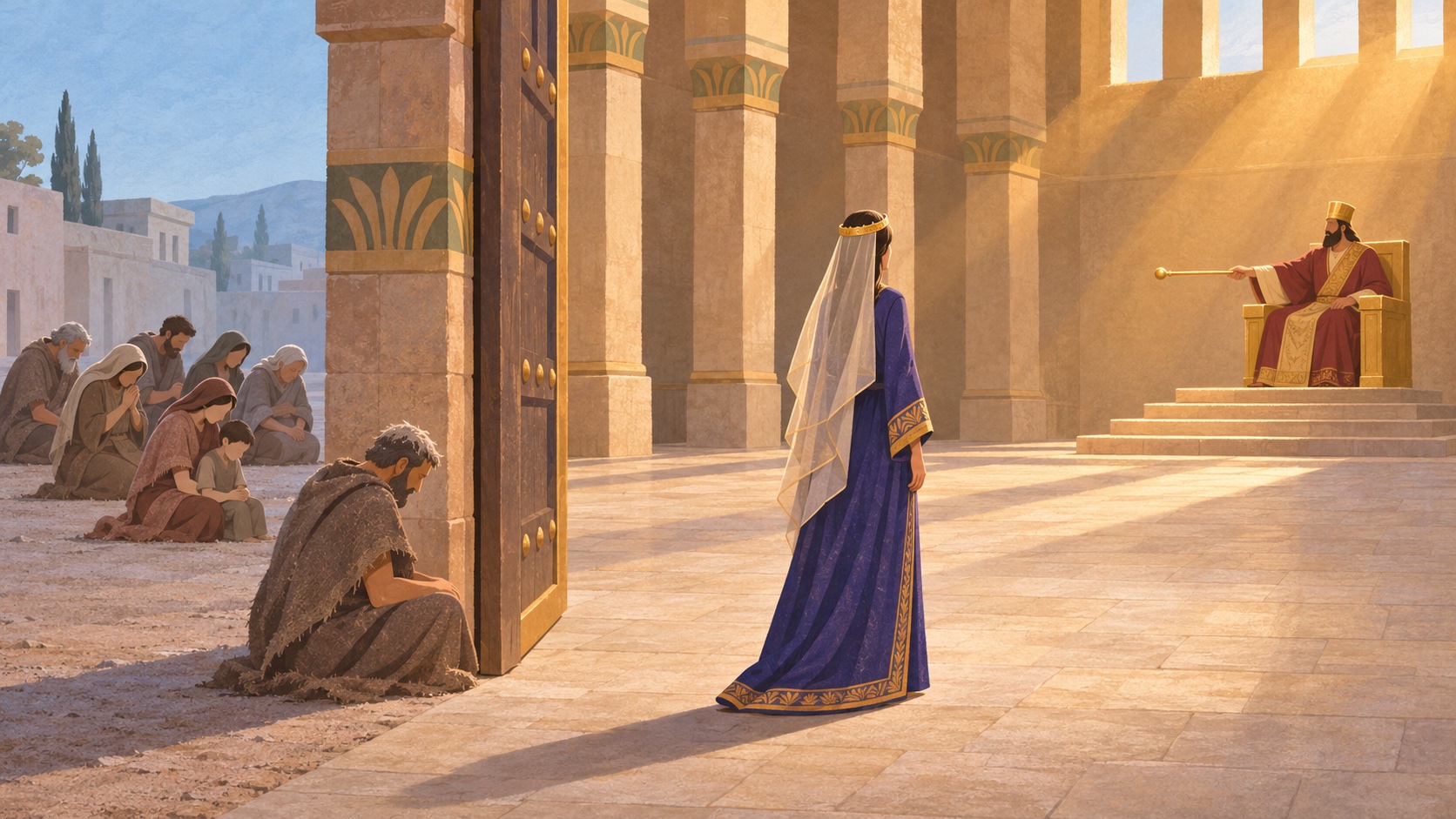
What's in this picture
- Mordecai, in sackcloth at the open gate, is where the book puts him when he learned of the decree: he “put on sackcloth with ashes” and “came even before the king’s gate: for none might enter into the king’s gate clothed with sackcloth” (Esth. 4:1–2). He stops at the threshold, and from there he sent Esther word that she must go to the king for her people (Esth. 4:8).
- The people kneeling behind him, old and young, a mother with her child among them, are the Jews under sentence of death. Wherever the decree came “there was great mourning among the Jews, and fasting, and weeping, and wailing” (Esth. 4:3). Then Esther asked for their fast: “gather together all the Jews that are present in Shushan, and fast ye for me, and neither eat nor drink three days” (Esth. 4:16).
- Esther, alone on the open floor of the court, is the queen on the third day of that fast. She “put on her royal apparel, and stood in the inner court of the king’s house” (Esth. 5:1), though to come uncalled was death unless the king spared her (Esth. 4:11). She had said before she went, “so will I go in unto the king, which is not according to the law: and if I perish, I perish” (Esth. 4:16). The empty floor between the gate and the throne is the risk she took, and the people fasting behind her are what she went in for.
- The king on his throne, holding out the golden sceptre, is the answer she could not count on: “she obtained favour in his sight: and the king held out to Esther the golden sceptre that was in his hand. So Esther drew near, and touched the top of the sceptre” (Esth. 5:2).
The chapters
A Jewish orphan becomes queen of Persia; a decree is sealed to destroy her people, and she fasts and goes in to the king unbidden; in one sleepless night the plot begins to turn; and the day appointed for death becomes the days of Purim.
A Queen in Shushan
King Ahasuerus feasts his princes for half a year and deposes Queen Vashti when she will not come at his word. The maidens of the empire are gathered to the palace, and the king makes Esther, the orphan Mordecai raised, his queen; Mordecai, sitting in the king’s gate, uncovers a plot against the king’s life.
- 1 The King’s Feast and Vashti’s Refusal In the third year of his reign Ahasuerus shows his nobles the riches of his kingdom for half a year and feasts his capital for a week, and when Queen Vashti will not come at his command, his counsellors turn her refusal into a law for every house in the empire.
- 2 Esther Made Queen The king's servants gather the empire's fair young women to Shushan; an orphan of the exile is taken with them, keeps her people hidden as Mordecai charged her, and is crowned; and a plot overheard at the king's gate is written in the king's book and forgotten.
The Decree and the Fast
Mordecai will not bow to Haman the Agagite, and Haman casts the lot and buys a decree to destroy every Jew in the empire. The Jews mourn and fast, Mordecai tells Esther she may have come to the kingdom for this, and she goes in to the king unbidden and invites him and Haman to a banquet, while Haman builds a gallows for Mordecai.
- 3 Mordecai Bows Not, and Haman’s Decree Haman the Agagite is raised above the princes, and every servant at the gate bows to him but Mordecai. Haman casts the lot for a day, buys the king’s consent, and sends a decree sealed with the king’s ring to destroy every Jew in the empire.
- 4 For Such a Time as This Mordecai mourns in sackcloth at the king’s gate and sends word to Esther that she must go to the king. She answers that the law forbids it; he answers that she may have come to the kingdom for this very hour. She calls a fast and resolves to go.
- 5 Esther Goes In unto the King On the third day of the fast Esther stands unbidden in the king’s court, is spared by the golden sceptre, and asks only that the king and Haman come to a banquet, and then to a second. Haman goes home glad, is undone by Mordecai’s refusal to rise, and on his wife’s advice builds a gallows for the morning.
The Night the King Could Not Sleep
The sleepless king hears how Mordecai saved his life, and Haman must lead Mordecai through the city in the king’s own robe. At the second banquet Esther names her people and her enemy, and Haman is hanged on his own gallows. The first decree cannot be revoked, so Mordecai writes a second, and the Jews have light and gladness.
- 6 The Night the King Could Not Sleep A sleepless king hears the record of how Mordecai saved his life, and Haman, who came to ask for Mordecai's death, must lead him through the city in the king's own robe.
- 7 Esther Names the Enemy At the second banquet Esther asks for her life and her people's, names Haman as the enemy, and Haman is hanged on the gallows he had built for Mordecai.
- 8 The Second Decree Haman's house and ring pass to Esther and Mordecai, but his decree still stands; Esther pleads again, and a second decree, sealed with the same ring, lets the Jews stand for their lives.
The Days of Purim
On the thirteenth of Adar the Jews stand for their lives against those who would destroy them, and lay no hand on the spoil. Mordecai and Esther write that the fourteenth and fifteenth be kept every year as days of feasting, gifts and remembrance, and the book closes on Mordecai, next to the king, seeking the good of his people.
- 9 The Days of Purim On the day Haman's lot had chosen, the Jews stand for their lives and prevail; then Mordecai and Esther write letters that make the days of rest a feast for every year.
- 10 Next unto the King The book closes on the king's power and on Mordecai, raised second in the empire and using his place to seek the good of his people.
Themes
Ideas that run through many chapters, gathered in one place.
Beloved passages
- “she obtained grace and favour in his sight”Esther 2:17
- “who knoweth whether thou art come to the kingdom for such a time as this?”Esther 4:14
- “and if I perish, I perish”Esther 4:16
- “On that night could not the king sleep”Esther 6:1
- “The Jews had light, and gladness, and joy, and honour.”Esther 8:16
- “the month which was turned unto them from sorrow to joy”Esther 9:22
- “seeking the wealth of his people, and speaking peace to all his seed”Esther 10:3
Most-used sources
Every note cites its sources. These are the ones this commentary leans on most.
- “Esther, book of”, Bible Dictionary.
- Esther, Scripture Helps: Old Testament (2025).
- “Ahasuerus”, Bible Dictionary.