Leviticus
“Ye shall be holy: for I the LORD your God am holy.” The Lord to the children of Israel, Lev. 19:2
Leviticus opens where Exodus ends. The tabernacle has been raised and the glory of the Lord has filled it, and from that tent “the LORD called unto Moses” (Lev. 1:1). There is almost no story in the book. It is law, given at Sinai: what to bring to the altar and why, how the priests were consecrated, what made a person clean or unclean, and how once a year the high priest passed through the veil into the Holy of Holies to make atonement for all Israel (Lev. 16:30).
Its center is a command: “Ye shall be holy: for I the LORD your God am holy” (Lev. 19:2). That command reaches the harvest and the marketplace and the treatment of the stranger, and the same chapter gives the commandment the Savior called second only to the first: “thou shalt love thy neighbour as thyself” (Lev. 19:18). Latter-day scripture reads the whole law as “pointing to that great and last sacrifice” (Alma 34:14). This companion goes through all twenty-seven chapters and tries to anticipate the questions a careful reader would ask, beginning with the most common one: why any of this was commanded.
For the offerings, the feasts and clean and unclean as a whole, see The Law and the Covenant; for the tabernacle and its priests, see The Law, the Covenant and the Temple.
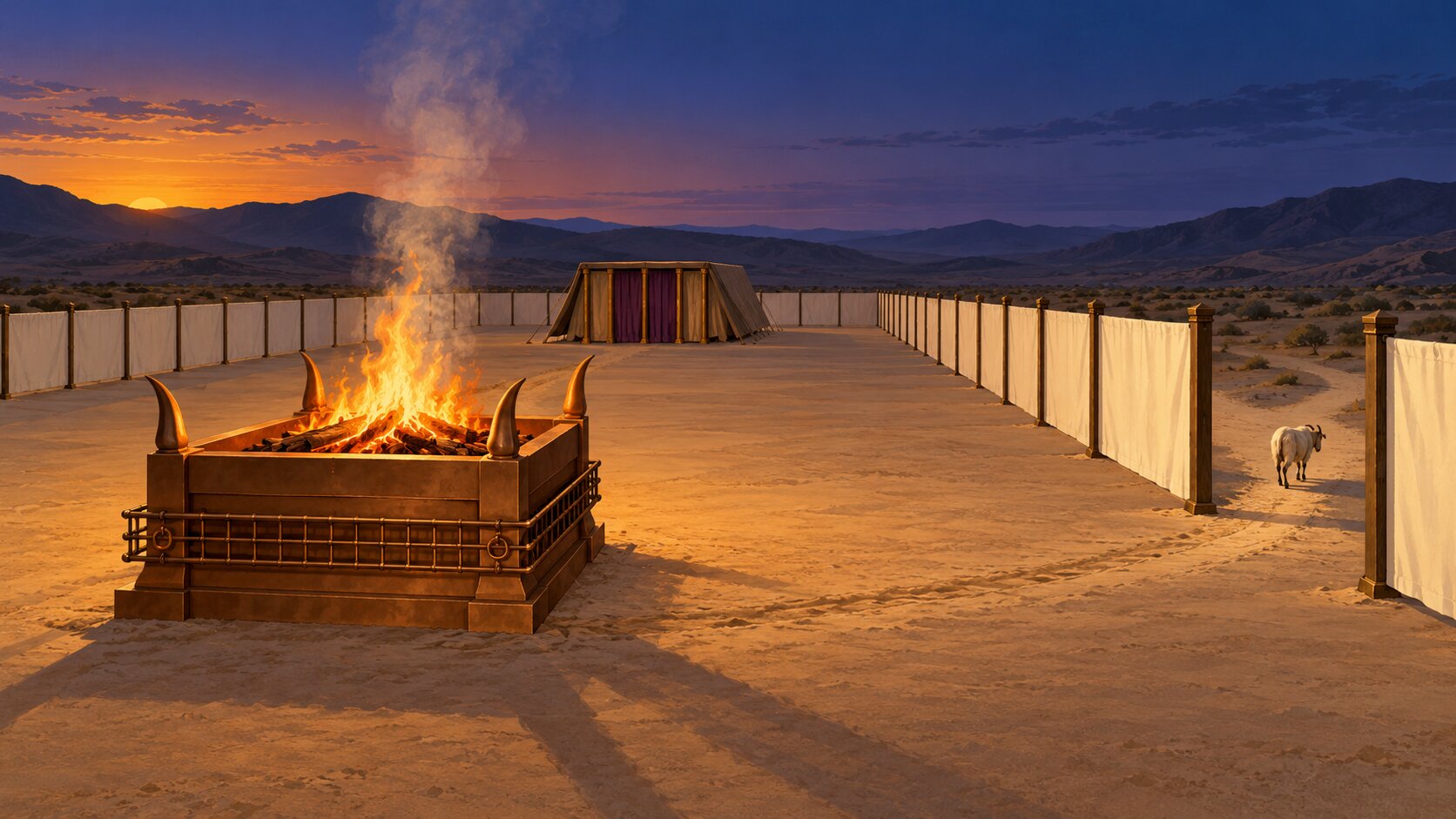
What's in this picture
- The bronze altar is the altar of burnt offering, of wood overlaid with brass, with “a grate of network of brass” around it (Ex. 27:1–4). It was set “before the door of the tabernacle of the tent of the congregation” (Ex. 40:6), and every offering of chapters 1–7 was made on it.
- The fire on the altar is the fire the law kept: “The fire shall ever be burning upon the altar; it shall never go out” (Lev. 6:13).
- The tent at the far end of the court, with its curtained door, is the tabernacle, from which “the LORD called unto Moses, and spake unto him out of the tabernacle of the congregation” to give the book (Lev. 1:1).
- The white hangings are the court around the tabernacle, of “fine twined linen” (Ex. 27:18).
- The goat going out alone at the right is the scapegoat of the Day of Atonement, sent “into the wilderness” (Lev. 16:10): “the goat shall bear upon him all their iniquities unto a land not inhabited” (Lev. 16:22). Isaiah says the same of the Savior: “he shall bear their iniquities” (Isa. 53:11; Mosiah 14:11).
The chapters
Twenty-seven chapters in five parts. The offerings come first, then the priests who offer them. Next are the laws of clean and unclean, which govern daily life, and the Day of Atonement, which cleanses the whole people once a year. The book closes with the call to be holy, carried into family, field, market and calendar.
The Offerings
The burnt offering, the meat offering, the peace offering, the sin offering and the trespass offering. The law says who brings each offering, what is done with its blood and fat, and who eats what.
- 1 The Burnt Offering From the tent just raised, the LORD gives the first law of sacrifice. A bull, a sheep or goat, or a bird is brought, killed and burned whole on the altar, and accepted “to make atonement” for the one who brings it.
- 2 The Meat Offering The LORD tells Moses how an offering of grain is brought, as fine flour, as baked bread, or as new grain roasted in the ear. A handful goes up on the altar with all the frankincense; the rest is most holy food for the priests. No leaven or honey may be burned, and every offering must have salt.
- 3 The Peace Offering The LORD tells Moses how an Israelite is to offer a peace offering from the herd, from the sheep, or from the goats. The fat is burned on the altar as the LORD’s, and Israel is never to eat fat or blood.
- 4 The Sin Offering The LORD gives the offering for sins done in error. For a high priest's sin or the whole nation's, a bull is brought and its blood carried into the tabernacle; a ruler brings a male goat, and one of the people a female goat or lamb. In every case the priest makes atonement, and the sin is forgiven.
- 5 Confess, Repay, and Be Forgiven A silent witness, an uncleanness unnoticed and a rash oath call for confession and a sin offering scaled to what the sinner can afford, down to a handful of flour. Then the trespass offering adds repayment, and a fifth more, for what was kept back from the Lord's holy things.
- 6 Restitution, and the Fire That Never Goes Out A man who has cheated his neighbour gives back what he took, with a fifth more, before he brings his trespass offering. Then the LORD tells the priests how to keep the altar fire burning and how to handle the burnt, grain, and sin offerings.
- 7 The Priests' Law of the Peace Offering The LORD finishes the priests' instructions for the offerings. He gives the law of the trespass offering and the priests' shares, then the law of the peace offering, the one sacrifice the worshipper ate, with its thanksgiving bread, its time limits, and its rules of cleanness. The breast and the right thigh go to the priests.
The Priests Consecrated
Moses washes, robes and anoints Aaron and his sons, and they offer their first sacrifices. Fire comes from before the Lord and consumes the offering. Then Nadab and Abihu offer strange fire, which the Lord had not commanded, and die.
- 8 Aaron and His Sons Consecrated Before all the people, Moses carries out what the LORD commanded on the mountain. He washes, robes and anoints Aaron, anoints the tabernacle and the altar, offers three sacrifices for the new priests, and keeps them seven days at the door of the tent, all “as the LORD commanded Moses.”
- 9 The Glory and the Fire On the day after their consecration Aaron and his sons begin their service. Aaron offers for himself and then for the people, blesses them, and the LORD keeps His promise to appear: His glory is seen by all, and fire from before Him consumes the offerings on the altar.
- 10 Strange Fire On the day the priests begin their service, Aaron's two eldest sons offer fire the Lord had not commanded, and fire from the Lord kills them. Moses gives the Lord's word, Aaron is silent, and the commands that follow tell the priests how to stand near what is holy.
Clean and Unclean
Which animals may be eaten, what a mother does after childbirth, how the priest judges leprosy in skin, cloth and walls, and how a body's discharges are made clean. In each case the way back to the sanctuary is washing, time and an offering.
- 11 Clean and Unclean Animals The LORD tells Israel which creatures of land, water and air may be eaten, how touching a carcass makes a person unclean until evening, and why it matters: “ye shall be holy; for I am holy.”
- 12 After Childbirth A mother is unclean for a time after giving birth, a week for a son and two for a daughter, and then waits longer before she may come to the sanctuary. At the end she brings a burnt offering and a sin offering, and if she cannot afford a lamb, two birds.
- 13 The Priest Shall Look The priest examines a mark on the skin, waits a week, looks again, and declares the person clean or unclean; the one declared unclean mourns as for the dead and lives outside the camp. The same law reaches mildew in cloth and leather.
- 14 The Leper Made Clean A healed leper comes back in stages, first outside the camp with two birds, living water and blood, then on the eighth day at the tabernacle door with offerings, blood and oil. A house with the plague in its walls is examined the same way and, once healed, cleansed with the same two birds.
- 15 The Tabernacle among Them The last of the purity laws turns to discharges from the body, a man's and a woman's, in illness and in ordinary life. Each makes a person, and what that person touches, unclean for a time, and the reason for all of it is that the Lord's tabernacle stands in the camp.
The Day of Atonement
Once a year the high priest enters the Holy of Holies with blood and incense. One goat is offered for the Lord, and the other carries Israel's sins into the wilderness, so that the people may be clean from all their sins before the Lord.
Ye Shall Be Holy
The life of the flesh is in the blood. Israel must not live as Egypt and Canaan did, and must love its neighbor and the stranger. The law covers the priests, the feasts of the year, the land's sabbath and jubilee, and the covenant's blessings and cursings; it ends with vows.
- 17 The Life Is in the Blood Every ox, lamb or goat killed, in the camp or out of it, is to be brought to the LORD's altar, and no one in Israel, native or stranger, is to eat blood, for the life is in the blood and the LORD has given it on the altar to make atonement.
- 18 Not after the Doings of Egypt or Canaan The Lord sets His statutes against the customs of the land Israel left and the land it is entering, forbids marriage and intercourse within the family and the unions and rites that defile, and warns that the land itself will cast out a people who do them.
- 19 Ye Shall Be Holy The LORD calls all Israel to be holy as He is holy, and spells out what that means for parents, the harvest, the market, the courts, the body and the stranger, all under one refrain, “I am the LORD”; at the center stands “thou shalt love thy neighbour as thyself.”
- 20 That Ye Should Be Mine The Lord sets penalties on the sins named in chapter 18 and on giving children to Molech and seeking the dead, shares the judgment between Himself and the people, and calls Israel to be holy because He has separated them to be His.
- 21 The Holiness of the Priests The men who offer the bread of their God are held to a stricter holiness than Israel, in how they mourn, whom they marry and who may stand at the altar, and the high priest strictest of all.
- 22 The Holy Things and the Animals Fit to Offer The priests are told who may eat the holy food Israel gives them and when they must keep away from it, and every Israelite is told what kind of animal the altar will accept.
- 23 The Appointed Times The LORD names the days Israel is to keep holy through the year, from the weekly sabbath and the Passover in the spring, through the first sheaf and the fifty days to Pentecost, to the trumpets, the Day of Atonement and the booths of the seventh month.
- 24 The Lamp, the Bread, and the Name Israel keeps the lamp burning and the bread set out before the LORD, and when a man curses the Name in a quarrel, Moses waits for the LORD's word, which sets one law for the stranger and the native alike.
- 25 The Sabbath of the Land and the Jubilee Every seventh year the land rests, and every fiftieth year a ram's horn proclaims liberty, land goes back to its families and Israelites sold for debt go home, because the land and the people both belong to the LORD.
- 26 Blessing and Cursing The law given at Sinai closes with the LORD's promises to an obedient Israel, five rounds of rising warnings to a disobedient one, and His word that even in exile He will remember His covenant.
- 27 Vows, Redemption, and the Tithe What a person gives the LORD by a vow can be bought back at a price the law sets; what is already the LORD's, the firstling, the devoted thing and the tithe, cannot be vowed or, in some cases, bought back at all.
Themes
Ideas that run through many chapters, gathered in one place.
Beloved passages
- “it shall be accepted for him to make atonement for him”Leviticus 1:4
- “that ye may be clean from all your sins before the LORD”Leviticus 16:30
- “For the life of the flesh is in the blood”Leviticus 17:11
- “Ye shall be holy: for I the LORD your God am holy”Leviticus 19:2
- “thou shalt love thy neighbour as thyself”Leviticus 19:18
- “proclaim liberty throughout all the land unto all the inhabitants thereof”Leviticus 25:10
- “I will walk among you, and will be your God, and ye shall be my people”Leviticus 26:12
Most-used sources
Every note cites its sources. These are the ones this commentary leans on most.
- “Leviticus”, Bible Dictionary.
- Exodus 35–40; Leviticus 1; 4; 16; 19, Scripture Helps: Old Testament (2025).
- John W. Welch, Old Testament Minute: Leviticus. Understanding Leviticus in Light of the Temple and Its Intertextual Appearances in the Book of Mormon, Springville, UT: Book of Mormon Central; on Scripture Central’s archive (read the page with --all).
- Daniel L. Belnap, ““That I May Dwell among Them”: Liminality and Ritual in the Tabernacle”, In Ascending the Mountain of the Lord: Temple, Praise, and Worship in the Old Testament (2013 Sperry Symposium), ed. Jeffrey R. Chadwick, Matthew J. Grey, and David Rolph Seely (Provo, UT: Religious Studies Center, Brigham Young University; Salt Lake City: Deseret Book, 2013), 12–35.