Habakkuk
“The just shall live by his faith.” The Lord to Habakkuk, Hab. 2:4
Habakkuk was a prophet in Judah about 600 B.C., probably in the reign of Josiah or Jehoiakim, when Babylon was rising; nothing more is known of him. His book is unlike the other prophets. It is not the Lord's word to the people but a conversation between the prophet and the Lord. “O LORD, how long shall I cry, and thou wilt not hear!” he begins (Hab. 1:2), troubled by the violence and broken law around him. The Lord answers that He is raising up the Chaldeans, “that bitter and hasty nation” (Hab. 1:6). That troubles Habakkuk more: how can a holy God use a nation more wicked than Judah?
The prophet takes his stand on his watchtower to wait for the answer (Hab. 2:1). It comes as a vision to be written plainly: the proud will not endure, “but the just shall live by his faith” (Hab. 2:4), a line Paul made one of the New Testament's great statements of the gospel. Five woes on the conqueror follow, and the promise that “the earth shall be filled with the knowledge of the glory of the LORD” (Hab. 2:14). The book closes with the prophet's prayer, a psalm of the Lord coming to save His people, and its ending: though the fig tree does not blossom and the fields yield nothing, “Yet I will rejoice in the LORD” (Hab. 3:18). This companion goes through all three chapters and tries to anticipate the questions a careful reader would ask.
For the rise of Babylon and the last kings of Judah, see Babylon and the Exile.
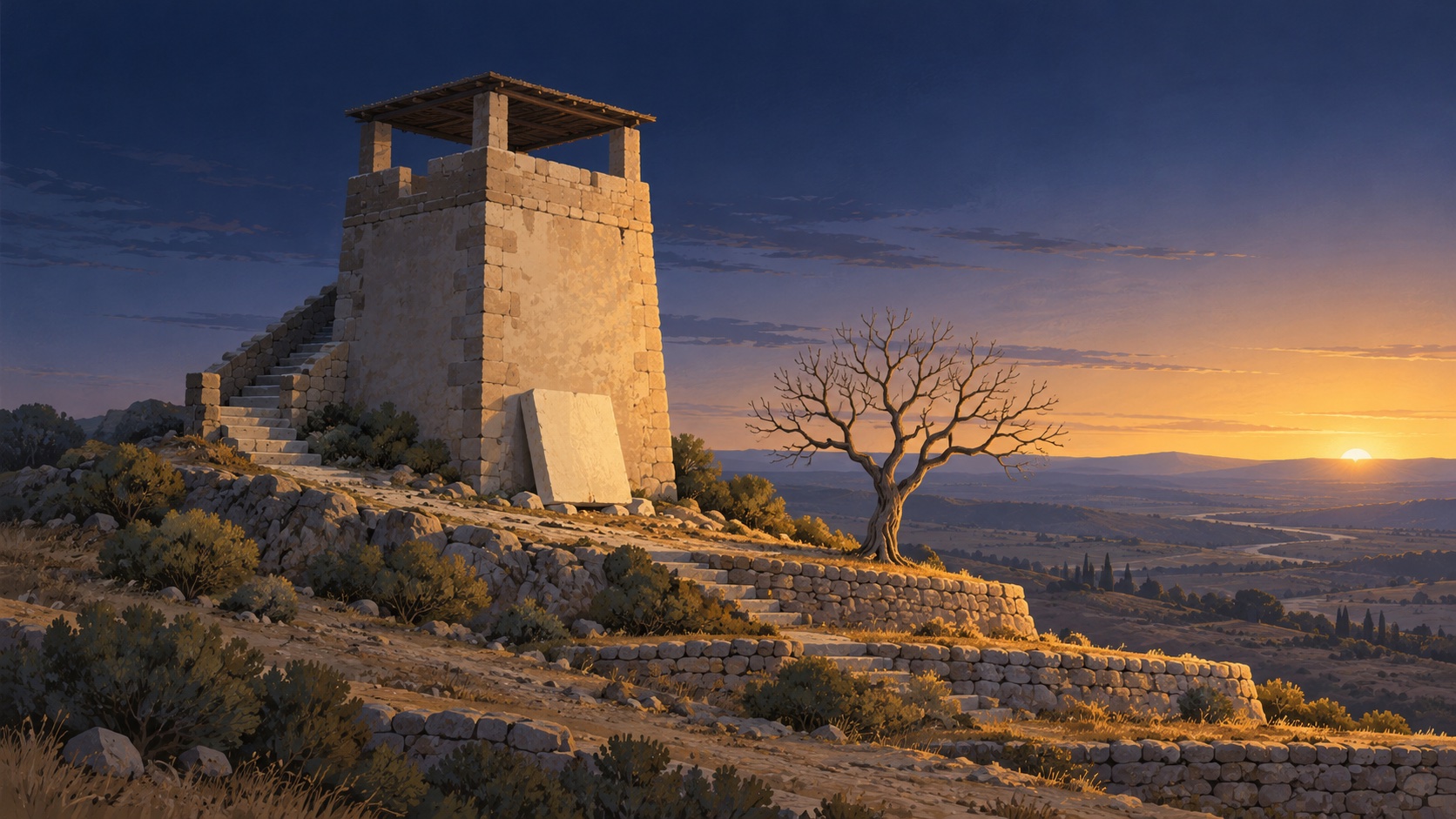
What's in this picture
- The empty lookout on the tower is where Habakkuk takes his post to wait for the Lord’s answer: “I will stand upon my watch, and set me upon the tower, and will watch to see what he will say unto me” (Hab. 2:1).
- The blank tablet leaning at the foot of the tower is the answer still to be written: “Write the vision, and make it plain upon tables, that he may run that readeth it” (Hab. 2:2).
- The sun low on the far horizon stands for the long wait for the vision to come: “the vision is yet for an appointed time … though it tarry, wait for it; because it will surely come, it will not tarry” (Hab. 2:3).
- The bare tree on the terrace stands for the harvest that fails in Habakkuk’s last prayer, when he rejoices in the Lord all the same: “Although the fig tree shall not blossom … Yet I will rejoice in the LORD” (Hab. 3:17–18).
The chapters
Three chapters in two parts. In the first, the prophet asks the Lord how long violence will go unpunished, and how He can use the cruel Chaldeans against His people; the Lord answers him twice. The second is the prophet's prayer, a psalm of the Lord's coming in power and of joy in Him when every harvest fails.
How Long Shall I Cry?
The prophet asks why violence goes unpunished, and the Lord answers that He is raising up the Chaldeans. The prophet asks how a holy God can use them, and waits on his watchtower. The Lord answers that the proud will not endure, that the just shall live by faith, and that woe will come on the conqueror.
- 1 O LORD, How Long Shall I Cry? The prophet complains that the Lord does nothing about the violence in Judah. The Lord answers that He is raising up the Chaldeans, and the prophet asks again how a holy God can let the wicked swallow up those more righteous than they.
- 2 Write the Vision Habakkuk climbs to his watch and waits, and the Lord answers. The vision will come at its time; the proud will not last, but the just shall live by his faith. Then the nations Babylon swallowed sing five woes over it, and the chapter ends in the silence of the Lord's temple.
A Prayer of Habakkuk
The prophet's psalm. He asks the Lord to revive His work and in wrath remember mercy, sees Him come from Teman and Paran as He came to deliver Israel of old, and ends in joy in the God of his salvation, though every harvest fail.
Beloved passages
- “O LORD, how long shall I cry, and thou wilt not hear!”Habakkuk 1:2
- “Thou art of purer eyes than to behold evil”Habakkuk 1:13
- “I will stand upon my watch, and set me upon the tower”Habakkuk 2:1
- “Write the vision, and make it plain upon tables, that he may run that readeth it”Habakkuk 2:2
- “though it tarry, wait for it; because it will surely come”Habakkuk 2:3
- “the just shall live by his faith”Habakkuk 2:4
- “the earth shall be filled with the knowledge of the glory of the LORD, as the waters cover the sea”Habakkuk 2:14
- “the LORD is in his holy temple: let all the earth keep silence before him”Habakkuk 2:20
- “in wrath remember mercy”Habakkuk 3:2
- “Yet I will rejoice in the LORD, I will joy in the God of my salvation”Habakkuk 3:18
- “he will make my feet like hinds’ feet”Habakkuk 3:19
Most-used sources
Every note cites its sources. These are the ones this commentary leans on most.
- “Habakkuk”, Bible Dictionary.
- Micah; Nahum; Habakkuk; Zephaniah, Scripture Helps: Old Testament (2025).
- Blair G. Van Dyke and D. Kelly Ogden, “Amos through Malachi: Major Teachings of the Twelve Prophets”, Religious Educator 4, no. 3 (2003).
- Ellis T. Rasmussen, “Habakkuk: A Prophet with a Problem”, The Instructor 97, no. 9 (Sept. 1962), center insert; read on Scripture Central's archive.
- Gaye Strathearn, “The Faith of Christ”, In A Witness for the Restoration: Essays in Honor of Robert J. Matthews, ed. Kent P. Jackson and Andrew C. Skinner (Provo, UT: Religious Studies Center, Brigham Young University, 2007).