Ezra
“For Ezra had prepared his heart to seek the law of the LORD, and to do it, and to teach in Israel statutes and judgments.” Ezra 7:10
The book of Ezra begins where 2 Kings and Jeremiah end, with Judah in exile, and tells how the exile was undone. In “the first year of Cyrus king of Persia,” about 538 B.C., “the LORD stirred up the spirit of Cyrus” to send the Jews home to rebuild the temple that Nebuchadnezzar had burned (Ezra 1:1), and those “whose spirit God had raised” went up (Ezra 1:5). They set the altar on its old base and laid the foundation of the house, and the old men who had seen Solomon’s temple wept while many shouted for joy, “so that the people could not discern the noise of the shout of joy from the noise of the weeping” (Ezra 3:13). Then their neighbours opposed them, and the work “ceased unto the second year of the reign of Darius” (Ezra 4:24). It began again at the word of the prophets Haggai and Zechariah (Ezra 5:1–2), and the house was finished and dedicated “with joy” in the sixth year of Darius, 516 or 515 B.C. (Ezra 6:15–16).
Ezra himself does not appear until chapter 7, about sixty years later. He was a priest of Aaron’s line and “a ready scribe in the law of Moses” (Ezra 7:6), sent from Babylon in 458 B.C. with a letter from King Artaxerxes, and the book says of him what it says of no one else: he “had prepared his heart to seek the law of the LORD, and to do it, and to teach in Israel statutes and judgments” (Ezra 7:10). From Ezra 7:27 he tells the story himself: the fast at the river Ahava, when he was ashamed to ask the king for soldiers after saying that “the hand of our God is upon all them for good that seek him” (Ezra 8:22); the report that the people, their leaders first, had married into the nations around them; and his prayer of confession, in which the return is “a little space” of grace and “a nail in his holy place” (Ezra 9:8). The book ends with the hardest thing in it, the covenant to put away the foreign wives. Latter-day Saints meet Ezra in the Doctrine and Covenants, where the Prophet Joseph Smith cites the priests of Ezra 2:61–62, whose names were not found in the register (D&C 85:11–12). This companion goes through all ten chapters and tries to anticipate the questions a careful reader would ask.
For the Persian kings, the return and the rebuilding of the temple, see A Timeline of the Old Testament and Persia and the Return.
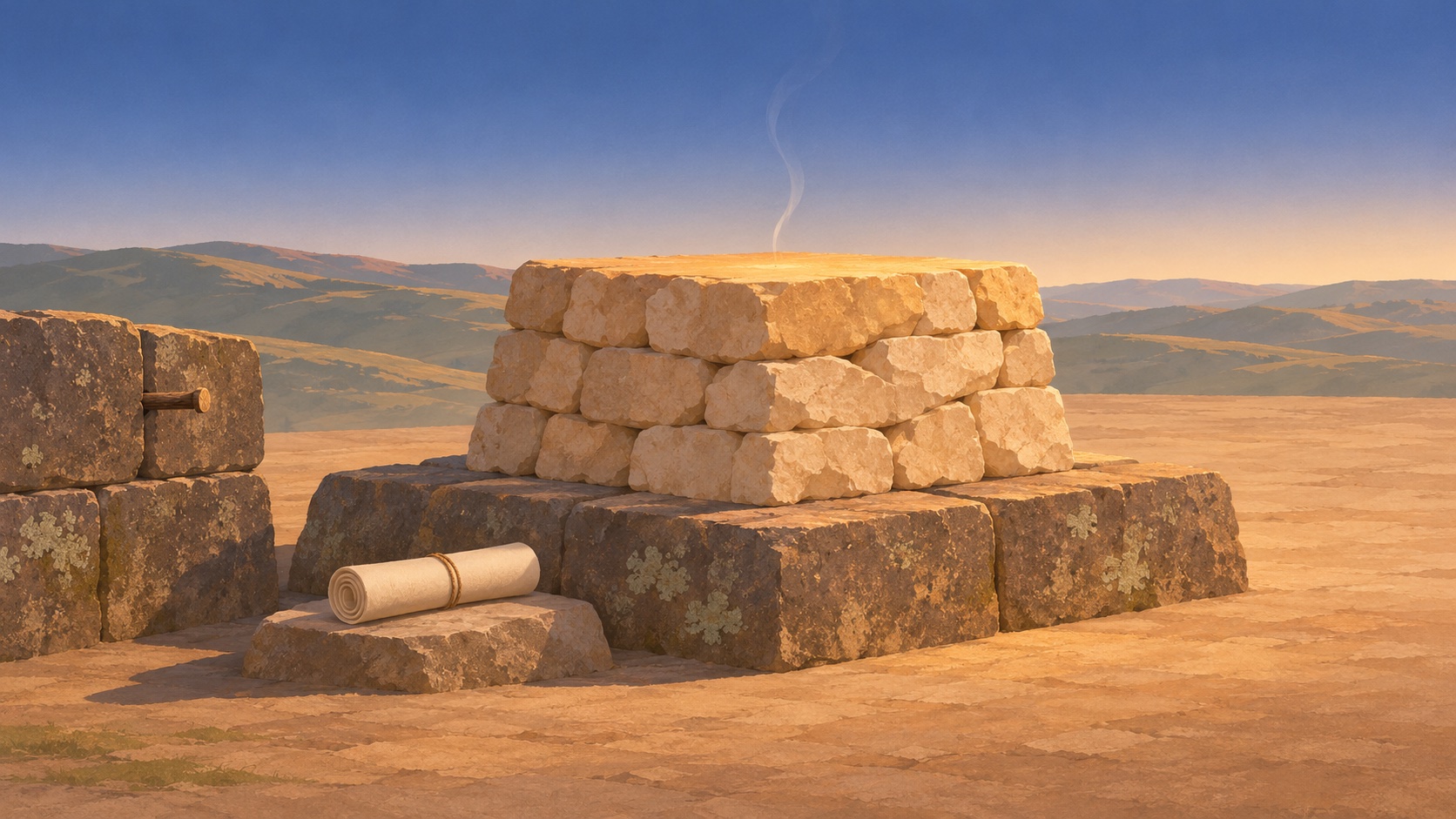
What's in this picture
- The altar of pale new stones is the first thing the returned exiles built: “they set the altar upon his bases… and they offered burnt offerings thereon unto the LORD, even burnt offerings morning and evening” (Ezra 3:3). Worship began again before there was a house to worship in.
- The dark, weathered stones under the altar and in the wall at the left are what was left of Solomon’s temple, which Nebuchadnezzar “destroyed” (Ezra 5:12). The new altar stands on the old base.
- The empty ground to the right is where the house will stand: “the foundation of the temple of the LORD was not yet laid” (Ezra 3:6).
- The closed scroll is the law of Moses that Ezra the scribe brought from Babylon. He “had prepared his heart to seek the law of the LORD, and to do it, and to teach in Israel statutes and judgments” (Ezra 7:10).
- The small nail driven into the old temple wall is from Ezra’s prayer of confession. The nail of his day was a wooden one, and he calls the whole return a small, firm mercy fixed in the Lord’s own house: “for a little space grace hath been shewed from the LORD our God… to give us a nail in his holy place” (Ezra 9:8).
The chapters
Two returns from Babylon, some eighty years apart. In the first the exiles rebuild the altar and the house of the Lord against long opposition; in the second Ezra the scribe comes to Jerusalem to teach the law of Moses and finds a people who have not kept it.
The House Rebuilt
Cyrus sends the exiles home with the temple’s vessels. They are counted by family, build the altar and lay the foundation of the house; their adversaries stop the work until Haggai and Zechariah prophesy, Darius confirms Cyrus’s decree, and the temple is finished and dedicated with joy.
- 1 The LORD Stirred Up the Spirit of Cyrus In his first year over Babylon the Persian king sends the Jews home to build the LORD’s house, the exiles whose spirits God has stirred set out, and the temple’s vessels go back with them, counted one by one.
- 2 They Sought Their Register The first exiles to come home are counted by family, by town and by their office in the temple, and the priests who cannot find their names in the record are told to wait until the Lord can settle their case.
- 3 The Altar First Back in the land, the exiles raise the altar and keep the feast before a stone of the house is laid; the next spring they lay the foundation to David’s songs, and the old men’s weeping mingles with the shout.
- 4 Then Ceased the Work Neighbors who claim to worship Israel’s God offer to help build the temple and are refused. They work against the builders through the reign of Cyrus, the chapter adds their later letters against Jerusalem’s walls, and the work on the house stops until Darius.
- 5 Who Hath Commanded You? Prophets speak, the builders go back to work, and a Persian governor asks who gave them leave. He lets the work go on while he writes to Darius, and the elders' answer names their God, their fathers' sin, and Cyrus's decree.
- 6 The House Finished Darius finds Cyrus's decree in a fortress in Media, confirms it, and pays for the work. Through the prophesying of Haggai and Zechariah the house is finished, dedicated, and opened with a Passover, “for the LORD had made them joyful.”
Ezra and the Law
About sixty years later Ezra, a priest and scribe, comes from Babylon with the king’s letter, fasting for a safe journey instead of asking for soldiers. In Jerusalem he learns that the people have married into the nations around them; he confesses the sin as his own, and the people covenant to put away their foreign wives.
- 7 Ezra Prepared His Heart A priest of Aaron's line and a scribe expert in the law of Moses comes up from Babylon with a Persian king's letter in his hand, and the first words he speaks for himself bless the Lord who put it in the king's heart.
- 8 The Journey from Ahava Ezra gathers the families who will go with him, sends for Levites, fasts rather than ask the king for soldiers, and brings the temple's gifts safely to Jerusalem by weight, “and the hand of our God was upon us.”
- 9 Ezra's Confession The leaders tell Ezra that the returned exiles, priests and Levites among them, have married into the peoples of the land and their abominations. He sits stunned until the evening sacrifice, then kneels and confesses the people's sin as his own, and asks for nothing.
- 10 The Covenant to Put Away the Strange Wives While Ezra prays at the temple, a crowd gathers in tears, and one of them proposes a covenant. The people assemble in the winter rain, a court sits for three months, and the book ends on the names of the men who had married foreign wives, priests first.
Themes
Ideas that run through many chapters, gathered in one place.
Beloved passages
- “his God be with him, and let him go up to Jerusalem”Ezra 1:3
- “because he is good, for his mercy endureth for ever toward Israel”Ezra 3:11
- “the people could not discern the noise of the shout of joy from the noise of the weeping”Ezra 3:13
- “the LORD had made them joyful”Ezra 6:22
- “Ezra had prepared his heart to seek the law of the LORD, and to do it, and to teach”Ezra 7:10
- “The hand of our God is upon all them for good that seek him”Ezra 8:22
- “to give us a nail in his holy place”Ezra 9:8
Most-used sources
Every note cites its sources. These are the ones this commentary leans on most.
- “Ezra”, Bible Dictionary.
- Ezra 1; 3–7; Nehemiah 2; 4–6; 8, Scripture Helps: Old Testament.
- “Temple of Zerubbabel”, Bible Dictionary.
- “Cyrus”, Bible Dictionary.