Judges
“Nevertheless the LORD raised up judges, which delivered them out of the hand of those that spoiled them.” Judg. 2:16
Judges begins after the death of Joshua, with the land only partly taken: tribe by tribe, Israel “did not drive out” the Canaanites (Judg. 1:21). A generation arose “which knew not the LORD” (Judg. 2:10), and the book sets out the pattern of what followed. Israel served other gods and fell into the hands of its enemies. When the people cried to the Lord, “the LORD raised up judges, which delivered them” (Judg. 2:16), and when the judge died they turned away again.
The stories run through that pattern a dozen times. Ehud, Deborah and Barak, and Gideon with his three hundred bring the land rest. After Gideon the deliverers grow more troubled: his son Abimelech makes himself king, Jephthah makes a vow that costs him his daughter, and Samson, a Nazarite from birth, follows his own desires until the Philistines blind him. The book closes with two stories from the same years, Micah's idol and the Danites, and the crime at Gibeah and the war on Benjamin that followed. Its last words are “In those days there was no king in Israel: every man did that which was right in his own eyes” (Judg. 21:25). This companion goes through all twenty-one chapters and tries to anticipate the questions a careful reader would ask, the hard ones included: what a judge was, what Jephthah did, where Samson's strength came from, and why the book ends where it does.
For the period, see The Conquest, the Judges, and One Kingdom and A Timeline of the Old Testament; for the women of these stories, see Women and Marriage in the Old Testament.
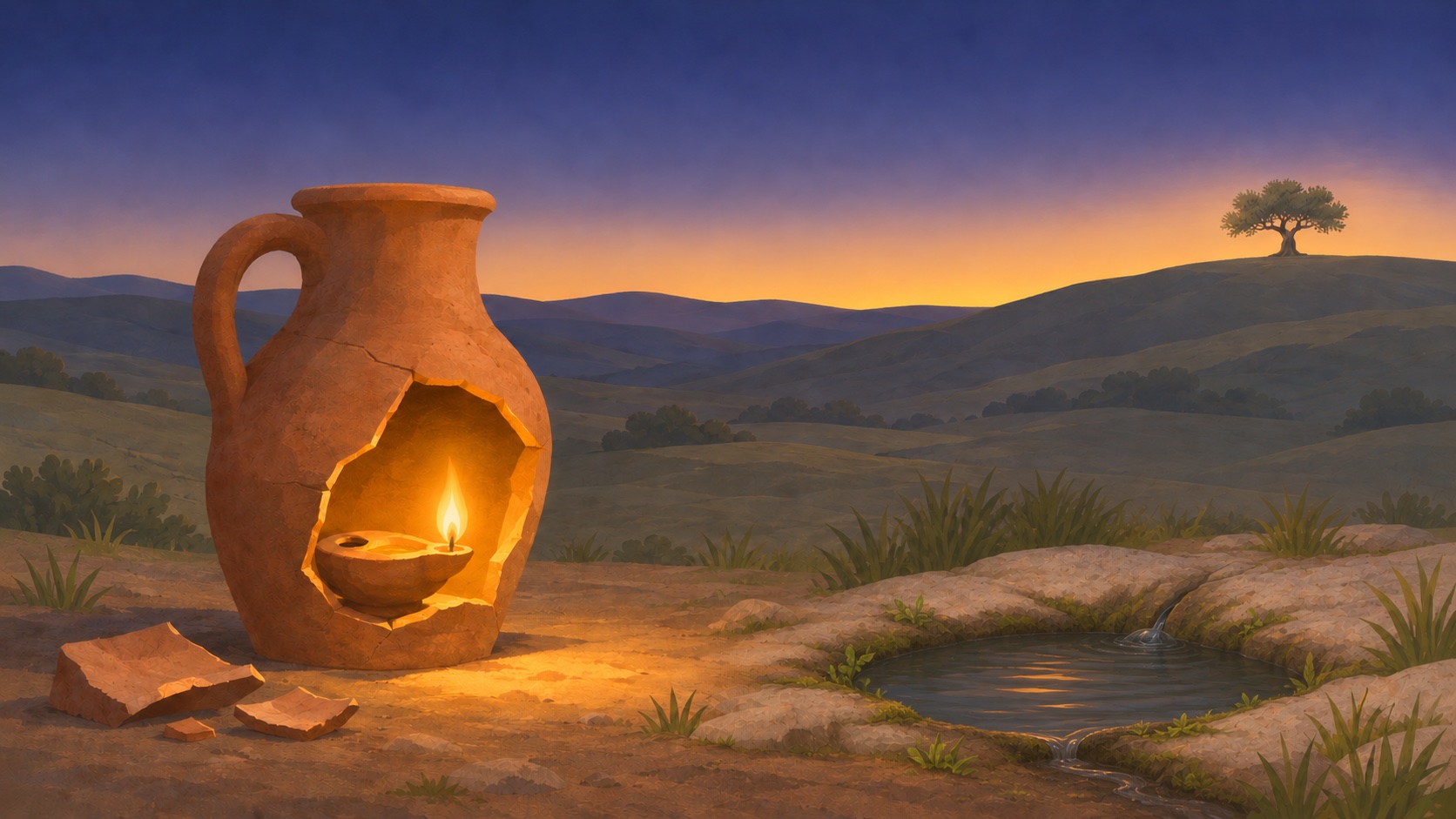
What's in this picture
- The clay pitcher broken open, with a lamp burning inside, is what Gideon’s three hundred carried: “empty pitchers, and lamps within the pitchers” and at the signal “brake the pitchers, and held the lamps … and they cried, The sword of the LORD, and of Gideon” (Judg. 7:16; Judg. 7:20).
- The spring coming out of the rock is En-hakkore, “the spring of him who called,” opened for Samson when he was dying of thirst and called on the LORD: “God clave an hollow place that was in the jaw, and there came water thereout; and when he had drunk, his spirit came again, and he revived” (Judg. 15:19). The “jaw” is Lehi, the place where it happened, and the hollow was in its ground, not in the jawbone.
- The lone olive tree on the far hill is the olive tree of Jotham’s parable, which would not be made king over the trees: “Should I leave my fatness, wherewith by me they honour God and man, and go to be promoted over the trees?” (Judg. 9:9). Jotham’s father, Gideon, had refused the same offer: “the LORD shall rule over you” (Judg. 8:23).
The chapters
Twenty-one chapters in five parts. A new generation forgets the Lord, and the land is only partly taken. Then come the deliverers from Othniel to Gideon, Gideon's house and the judges after him, and Samson. Two closing stories show what Israel became when every man did that which was right in his own eyes.
Another Generation Which Knew Not the LORD
After Joshua's death the tribes fight on, but town after town is left to the Canaanites. The angel of the Lord rebukes Israel at Bochim, a generation arises that does not know the Lord, and the book sets out the pattern of its stories. Israel turns to Baal, falls to its enemies, cries to the Lord, and is delivered by a judge.
- 1 Who Shall Go Up for Us? After Joshua's death the tribes ask the LORD who will fight first; Judah goes up and takes the hill country, and then, tribe by tribe, the chapter lists the Canaanite towns Israel did not drive out.
- 2 Another Generation Which Knew Not the LORD The LORD's messenger reproves Israel at Bochim, a generation rises that does not know Him, and the narrator lays out the pattern the whole book will follow, of apostasy, oppression, a judge raised up to deliver, and a deeper fall.
The LORD Raised Up a Deliverer
Othniel delivers Israel from Mesopotamia, and left-handed Ehud from Moab. Deborah the prophetess sends Barak against Sisera, and Jael kills Sisera in her tent; Deborah and Barak sing of the victory. The Lord calls Gideon, who tears down his father's altar to Baal, asks for the sign of the fleece, and routs Midian with three hundred men. He refuses to be king, but the ephod he makes becomes a snare.
- 3 The LORD Raised Up a Deliverer The nations left in the land test a new generation; the first two cycles turn, Othniel's in five verses and Ehud's in a sharp and comic story, and Shamgar gets one line.
- 4 Into the Hand of a Woman Under Jabin’s iron chariots Israel cries to the LORD; Deborah the prophetess sends Barak to Tabor, the LORD routs Sisera at the Kishon, and Jael kills him in her tent.
- 5 The Song of Deborah Deborah and Barak sing the victory of chapter 4 again as a poem, in which the LORD marches from Sinai, the stars and the river fight for Israel, the tribes are praised or rebuked, and Sisera's mother waits at her window for a son who will not come home.
- 6 The LORD Is with Thee Midian strips the land, a prophet reminds Israel why, and the LORD Himself calls a frightened farmer from a winepress, gives him a sign of fire, sends him against his father’s altar, clothes him with His Spirit, and bears with his fleece.
- 7 The Sword of the LORD, and of Gideon The LORD cuts Gideon’s army from thousands to three hundred, lets him overhear an enemy’s dream, and routs Midian in the night with trumpets, broken jars and torches, so that no one can say Israel saved itself.
- 8 The LORD Shall Rule over You Gideon soothes Ephraim, punishes the towns that would not feed his men, avenges his brothers on the kings of Midian, refuses a crown, makes an ephod that becomes a snare, and dies; and Israel forgets the LORD at once.
Ye Have Forsaken Me
Gideon's son Abimelech kills his brothers and is made king at Shechem; Jotham's fable of the trees foretells his end. After Tola and Jair, Israel serves other gods, and the Lord tells them to cry to the gods they have chosen. Jephthah, an outcast, delivers Israel from Ammon and keeps a vow that costs him his daughter, and Ephraim's men are known by “Shibboleth.”
- 9 The Bramble King Gideon’s son Abimelech buys a crown at Shechem with temple silver and his brothers’ blood; the one brother who escapes tells a fable of trees choosing a king; and the fire it foretells consumes both the king and the city that made him.
- 10 I Will Deliver You No More Two quiet judges come and go; then Israel serves the gods of every nation around it, falls to Ammon and the Philistines at once, and cries to a LORD who first refuses, then cannot bear their misery.
- 11 I Have Opened My Mouth unto the LORD Gilead’s elders call home the son they drove out; Jephthah argues Israel’s right to the land before the LORD the Judge, defeats Ammon, and keeps a vow that costs him his only child.
- 12 Say Now Shibboleth Ephraim threatens Jephthah for fighting Ammon without them; Gilead defeats Ephraim and kills its fugitives at the fords of the Jordan by a word they cannot say; Jephthah dies, and Ibzan, Elon and Abdon judge Israel in turn.
He Shall Begin to Deliver Israel
The angel of the Lord promises Manoah's wife a son who will be a Nazarite from the womb. Samson kills a lion, marries a Philistine, and wars on the Philistines by fire and with a jawbone. Delilah learns the secret of his strength; he is shaved, blinded and set to grind in Gaza, and in his death he pulls down the house of Dagon.
- 13 The Angel Did Wondrously Under the Philistines, the angel of the LORD promises a childless woman of Dan a son who will be a Nazarite from the womb, comes again at Manoah’s prayer, will not give his name, and goes up in the flame of their offering.
- 14 Out of the Strong Came Forth Sweetness Samson wants a Philistine wife, tears a lion apart by the Spirit of the LORD, finds honey in its carcass, and loses a wedding riddle to his bride’s tears.
- 15 This Great Deliverance Refused his wife, Samson burns the Philistines’ harvest; they burn her and her father; Judah binds him and hands him over, and at Lehi he kills a thousand with a jawbone, then calls on the LORD and is given water.
- 16 The LORD Was Departed from Him Samson carries off the gates of Gaza, tells Delilah the secret of his strength, is shaved, blinded and set to the mill, and in his last prayer brings Dagon’s house down on the Philistines and himself.
No King in Israel
Micah makes an image and hires a Levite as his priest, and the Danites, seeking land, carry off both and take Laish. A Levite's concubine is abused to death at Gibeah, and all Israel goes to war against Benjamin, which is nearly destroyed. To keep the tribe alive, Israel finds it wives at Jabesh-gilead and Shiloh. Every man did that which was right in his own eyes.
- 17 Micah’s House of Gods Silver dedicated to the LORD becomes a graven image; Micah sets up a shrine with an ephod and teraphim, makes his son a priest, and then hires a wandering Levite, sure that the LORD will now do him good.
- 18 From Laish to Dan Danite spies consult Micah’s hired priest and find a quiet town in the far north; six hundred men take Micah’s images and his Levite, destroy Laish, and set up the image at Dan, with a descendant of Moses as its priest.
- 19 The Night at Gibeah A Levite brings his concubine back from Bethlehem, passes by Jebus for an Israelite town, and finds no welcome in Gibeah but an old man’s; the men of the city surround the house, the woman is put out to them and dies, and the Levite sends her body through all Israel.
- 20 Knit Together as One Man The tribes gather at Mizpeh to hear the Levite, demand the men of Gibeah, and go to war when Benjamin will not give them up; twice beaten, they weep and fast before the ark, and the third time Benjamin is all but destroyed.
- 21 One Tribe Lacking in Israel Israel weeps for the tribe it nearly destroyed, keeps its oaths by destroying Jabesh-gilead and by letting Benjamin seize the daughters of Shiloh, and the book ends with no king in Israel.
Themes
Ideas that run through many chapters, gathered in one place.
Beloved passages
- “Nevertheless the LORD raised up judges, which delivered them out of the hand of those that spoiled them”Judges 2:16
- “is not the LORD gone out before thee?”Judges 4:14
- “let them that love him be as the sun when he goeth forth in his might”Judges 5:31
- “The LORD is with thee, thou mighty man of valour”Judges 6:12
- “The sword of the LORD, and of Gideon”Judges 7:20
- “the LORD shall rule over you”Judges 8:23
- “his soul was grieved for the misery of Israel”Judges 10:16
- “In those days there was no king in Israel: every man did that which was right in his own eyes”Judges 21:25
Most-used sources
Every note cites its sources. These are the ones this commentary leans on most.
- “Judges, book of”, Bible Dictionary.
- Judges 2–4; 6–8; 13–16, Scripture Helps: Old Testament.
- Appendix: Violence and Destruction in the Old Testament, Scripture Helps: Old Testament (2025).