Jonah
“I knew that thou art a gracious God, and merciful, slow to anger, and of great kindness.” Jonah to the Lord, Jonah 4:2
Jonah the son of Amittai was a prophet of the northern kingdom of Israel, from Gath-hepher in Galilee, who foretold that Jeroboam II would restore Israel’s borders (2 Kgs. 14:25). The book that bears his name is not a collection of his prophecies but a story about him. The Lord told him to “go to Nineveh, that great city, and cry against it” (Jonah 1:2), a great city of Assyria, the empire that would end the kingdom of Israel. Jonah “rose up to flee unto Tarshish from the presence of the LORD” (Jonah 1:3), and the book follows him through a storm at sea, three days and three nights in the belly of a great fish, and a second call to Nineveh.
The pagan sailors and the people of Nineveh turn to the Lord more readily than His prophet does. When Nineveh repents and is spared, Jonah finally says why he fled: “I knew that thou art a gracious God, and merciful” (Jonah 4:2). The Saviour made Jonah’s three days a sign of His own death and Resurrection (Matt. 12:39–41), and the book ends with a question the Lord asks His prophet, which the prophet does not answer: “should not I spare Nineveh, that great city?” (Jonah 4:11). This companion goes through all four chapters and tries to anticipate the questions a careful reader would ask.
For the wider setting of the northern kingdom under Jeroboam II and of Assyria, see A Timeline of the Old Testament and Two Kingdoms and Assyria.
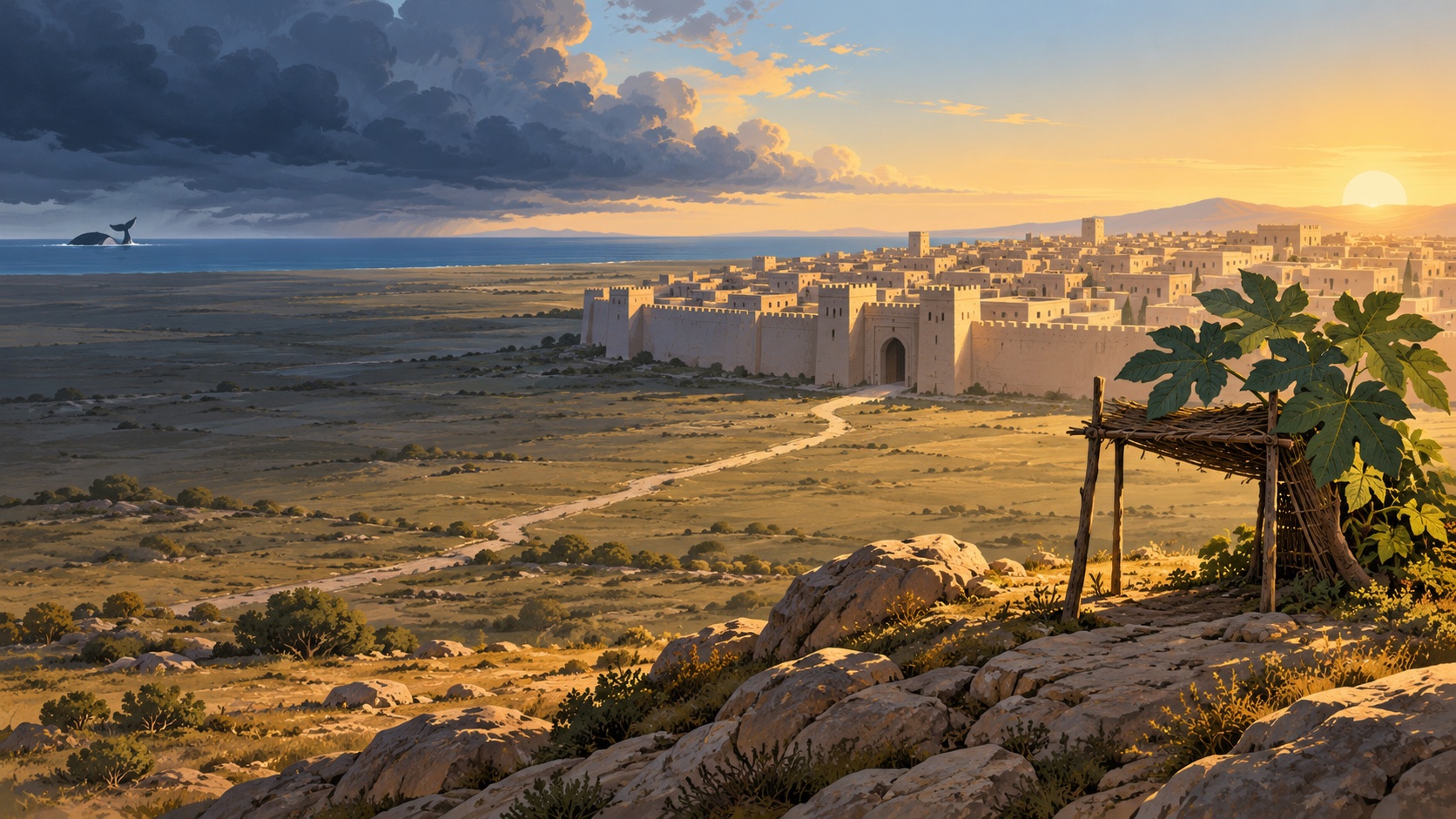
What's in this picture
- The city in the light is Nineveh, “that great city,” still standing. The Lord asks at the end of the book, “should not I spare Nineveh?” (Jonah 3:10; Jonah 4:11).
- The storm drawing away from the city is the threat of destruction turned back. When God saw that the people “turned from their evil way,” He “repented of the evil, that he had said that he would do unto them; and he did it not” (Jonah 3:10).
- The booth under the gourd is where Jonah sat on the east side of the city “till he might see what would become of the city,” and where “the LORD God prepared a gourd” to shade him (Jonah 4:5–6).
- The path to the city gate is Jonah’s road when, sent “the second time,” he “arose, and went unto Nineveh, according to the word of the LORD” (Jonah 3:1–3).
- The great fish far out at sea is the one “the LORD had prepared” to swallow Jonah, and which “vomited out Jonah upon the dry land” after three days and three nights (Jonah 1:17; Jonah 2:10).
The chapters
Four chapters, told as two calls. In the first, Jonah runs from the Lord, is thrown into the sea and prays from the belly of a great fish. In the second, he preaches in Nineveh, the city repents and is spared, and the Lord teaches His angry prophet with a gourd.
Jonah Rose Up to Flee
The Lord sends Jonah to Nineveh, and he takes ship for Tarshish instead. A storm, the sailors’ prayers and the casting of lots bring him overboard, where a great fish swallows him. From its belly he gives thanks that salvation is of the Lord.
- 1 Jonah Rose Up to Flee unto Tarshish The Lord sends Jonah to Nineveh, and he takes ship the other way. A storm, a sleeping prophet, the sailors’ lots and prayers, and a man thrown into the sea, where the Lord has a great fish waiting.
- 2 Out of the Belly of Hell From inside the great fish Jonah gives thanks in the words of the psalms. He tells how he sank to the roots of the mountains, looked toward the Lord’s temple and was brought up alive. Then the Lord speaks to the fish.
The Second Time
The word of the Lord comes to Jonah a second time. He warns Nineveh that it will be overthrown in forty days, and the city fasts and turns from its violence. The Lord spares it, and Jonah is angry. A gourd that grows and withers in a night becomes the Lord’s lesson about His mercy.
- 3 The People of Nineveh Believed God Called a second time, Jonah goes to Nineveh and announces its overthrow in forty days. The whole city fasts, from the king to the cattle, and turns from its violence, and God spares it.
- 4 Should Not I Spare Nineveh? Nineveh is spared, and Jonah is angry. He says at last why he ran, asks to die, and sits outside the city to watch it. The Lord grows a gourd over him, withers it, and asks why He should not spare a great city.
Beloved passages
- “Jonah rose up to flee unto Tarshish from the presence of the LORD”Jonah 1:3
- “the LORD had prepared a great fish to swallow up Jonah”Jonah 1:17
- “out of the belly of hell cried I, and thou heardest my voice”Jonah 2:2
- “They that observe lying vanities forsake their own mercy”Jonah 2:8
- “Salvation is of the LORD”Jonah 2:9
- “the people of Nineveh believed God”Jonah 3:5
- “thou art a gracious God, and merciful, slow to anger, and of great kindness”Jonah 4:2
- “should not I spare Nineveh, that great city”Jonah 4:11
Most-used sources
Every note cites its sources. These are the ones this commentary leans on most.
- “Jonah”, Bible Dictionary.
- Amos; Obadiah; Jonah, Scripture Helps: Old Testament (2025).
- Matthew S. Holland, “Forsake Not Your Own Mercy”, General conference, October 2025.
- LeGrande Davies, “Jonah: Testimony of the Resurrection”, In Isaiah and the Prophets: Inspired Voices from the Old Testament, ed. Monte S. Nyman and Charles D. Tate Jr. (Provo, UT: Religious Studies Center, Brigham Young University, 1984), 89–104.
- David R. Scott, “The Book of Jonah: Foreshadowings of Jesus as the Christ”, BYU Studies Quarterly 53, no. 3 (2014).