Zechariah
“Not by might, nor by power, but by my spirit, saith the LORD of hosts.” The Lord to Zerubbabel, Zech. 4:6
Zechariah, “the son of Berechiah, the son of Iddo the prophet” (Zech. 1:1), belonged to a priestly family that returned from Babylon with Zerubbabel (Neh. 12:4; Neh. 12:16). He began to prophesy in “the eighth month, in the second year of Darius” (Zech. 1:1), two months after Haggai, and with Haggai he urged the returned exiles to finish the house of the Lord (Ezra 5:1–2; Ezra 6:14). His dated prophecies run from 520 to 518 B.C.
The first half of the book is a night of visions: horsemen among the myrtle trees, four horns and four carpenters, a man with a measuring line, Joshua the high priest in filthy garments with Satan at his right hand, a candlestick between two olive trees, a flying roll, a woman in an ephah, and four chariots. An angel who talks with Zechariah explains them, and they end with crowns set on Joshua's head and the promise of “the man whose name is The BRANCH” (Zech. 6:12). Then the Lord answers a question about fasting: “Execute true judgment, and shew mercy and compassions every man to his brother” (Zech. 7:9).
The second half looks further ahead. The Gospels read several of its passages as fulfilled in Jesus: the King “lowly, and riding upon an ass” (Zech. 9:9; Matt. 21:4–5), the “thirty pieces of silver” (Zech. 11:12; Matt. 27:9), the one “whom they have pierced” (Zech. 12:10; John 19:37), and the smitten shepherd (Zech. 13:7; Matt. 26:31). In the Doctrine and Covenants the Lord takes up its last chapters to describe His coming, when He sets His foot on the Mount of Olives and the Jews ask, “What are these wounds in thine hands and in thy feet?” (D&C 45:48–53). This companion goes through all fourteen chapters and tries to anticipate the questions a careful reader would ask.
For the return from exile and the rebuilding of the temple, see A Timeline of the Old Testament and Persia and the Return.
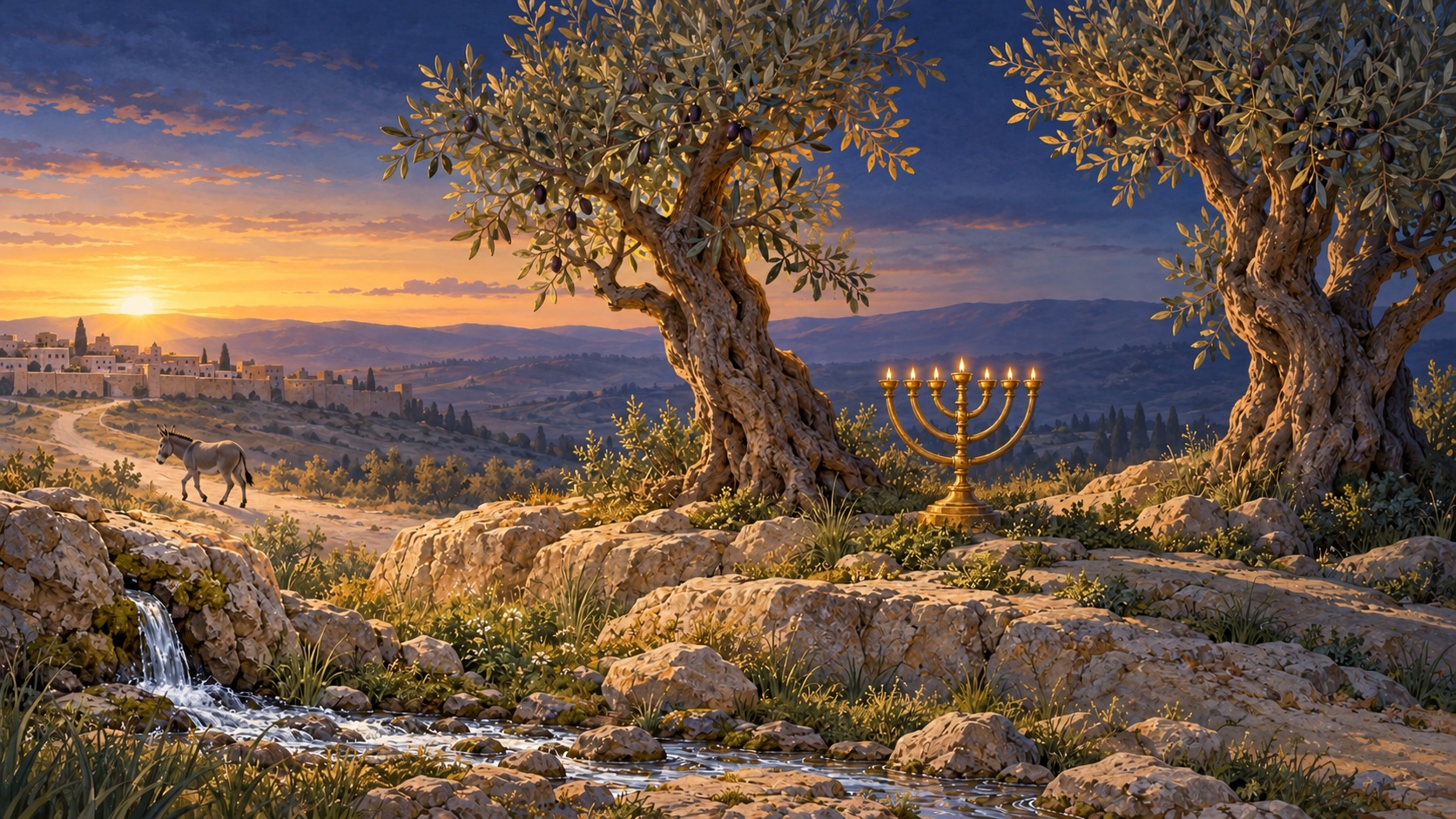
What's in this picture
- The golden lampstand between two olive trees is the vision of the lamp fed with oil, and the Lord's word to Zerubbabel: “Not by might, nor by power, but by my spirit, saith the LORD of hosts” (Zech. 4:2–3; Zech. 4:6).
- The donkey on the road to Jerusalem is the coming of Zion's King: “behold, thy King cometh unto thee: he is just, and having salvation; lowly, and riding upon an ass” (Zech. 9:9). It stands without a rider: Matthew sees the verse fulfilled when Jesus rode into Jerusalem (Matt. 21:4–5).
- The spring coming out of the rock is the fountain promised for that day: “a fountain opened to the house of David and to the inhabitants of Jerusalem for sin and for uncleanness” (Zech. 13:1).
The chapters
Fourteen chapters in four parts. Eight visions in one night, while the temple is being rebuilt; the Lord's answer to a question about fasting; and two burdens, the first about a king and a rejected shepherd, the second about the day the Lord stands on the Mount of Olives.
Eight Visions in the Night
The Lord calls His people to turn to Him. In one night Zechariah sees horsemen, horns and carpenters, a measuring line, Joshua the high priest made clean, a golden candlestick between two olive trees, a flying roll, a woman in an ephah and four chariots. The night ends with crowns for Joshua and the promise of the BRANCH, who shall build the temple of the Lord.
- 1 Turn Ye unto Me, and I Will Turn unto You Zechariah calls the exiles home from Babylon to turn to the Lord, and in a night vision learns that the Lord has already turned back to Jerusalem with mercies.
- 2 A Wall of Fire A man sets out to measure Jerusalem, and an angel runs with the answer that the city will spill past any wall, because the Lord Himself will be its wall of fire and the glory in its midst. Then the exiles still in Babylon are called home, and the nations are promised a place among the Lord's people.
- 3 The High Priest Made Clean In the fourth night vision, Joshua the high priest stands in filthy garments before the angel of the Lord, with the accuser at his right hand. The Lord rebukes the accuser, has the filthy garments taken away, sets a clean turban on Joshua's head, and makes him and his fellow priests a sign of the coming Branch, who will remove the land's iniquity in one day.
- 4 Not by Might, nor by Power A golden lampstand fed by two olive trees tells Zerubbabel how the stalled temple will be finished, by the Lord’s Spirit, and why no one should despise the day of small things.
- 5 The Flying Scroll and the Woman in the Ephah A scroll twenty cubits by ten flies over the land carrying the curse on thieves and false swearers, and it brings their houses down. Then wickedness, a woman shut in a measuring vessel under a lid of lead, is carried off to a house in Shinar.
- 6 A Priest upon His Throne Four chariots drive out from between two mountains of brass to the ends of the earth, and the Lord’s Spirit rests in the north. Then Zechariah crowns Joshua the high priest and names the coming Branch, who will build the temple and be a priest upon His throne.
Fasts Turned to Feasts
Men come to ask whether they should still weep and fast for the burned temple. The Lord asks whether they fasted to Him at all, calls for true judgment and mercy, and promises a Jerusalem full of old men and children playing, where the fasts become cheerful feasts and the nations come to seek the Lord.
- 7 Did Ye Fast unto Me? Men from Bethel ask whether to keep mourning the temple’s fall now that a new temple is rising. The Lord answers with a question of His own, then recalls what the former prophets asked of Judah, and what came of refusing them.
- 8 A City of Truth The Lord answers a question about fasting with promises of a Jerusalem full of old men and playing children, of a gathered people, of fasts turned into feasts, and of nations who come to seek Him.
The King and the Shepherd
The first burden. The Lord defends His house, and Zion's King comes to her lowly, riding upon an ass. He gathers Judah and Joseph, and sets the prisoners free. Then the prophet shepherds a flock doomed to slaughter, breaks his two staves, and is weighed his wages, thirty pieces of silver, cast to the potter in the house of the Lord.
- 9 Thy King Cometh unto Thee The Lord’s word sweeps over the nations on Israel’s border, and Jerusalem is told to shout, for her King is coming, just and having salvation, lowly and riding upon an ass.
- 10 I Will Hiss for Them, and Gather Them A flock that asked its idols for rain wandered off with no shepherd. Now the LORD of hosts takes the flock into His own care, raises leaders out of Judah, and whistles the scattered house of Joseph home from Egypt and Assyria in a second exodus.
- 11 The Shepherd They Valued at Thirty Pieces The prophet is set to shepherd a flock marked for slaughter, with two staffs named Favour and Union. The flock rejects him and pays him thirty pieces of silver, so he breaks both staffs, and the flock is left to a worthless shepherd.
In That Day
The second burden. The nations gather against Jerusalem; the Lord pours out a spirit of grace, and they look on Him whom they pierced and mourn. A fountain is opened for sin, the shepherd is smitten, and a third part is refined as silver. The Lord's feet stand on the Mount of Olives, He is king over all the earth, and even the bells of the horses read Holiness unto the Lord.
- 12 They Shall Look upon Me Whom They Have Pierced The second “burden” of Zechariah’s closing chapters. All nations gather against Jerusalem, and the Lord makes the city a cup that sends them reeling and a stone that wounds whoever lifts it. Then He pours out the spirit of grace on His people, and they look on the one they pierced and mourn for Him as for an only son.
- 13 A Fountain Opened The Lord opens a fountain to wash Jerusalem clean, sweeps away idols and lying prophets, and calls a sword against His own Shepherd, then refines a remnant who call Him their God.
- 14 The LORD Shall Be King over All the Earth Jerusalem is besieged by all nations, the Lord stands on the Mount of Olives and fights for her, living waters flow, the nations come up to worship, and even the cooking pots are holy.
Themes
Ideas that run through many chapters, gathered in one place.
Beloved passages
- “Turn ye unto me, saith the LORD of hosts, and I will turn unto you”Zechariah 1:3
- “I, saith the LORD, will be unto her a wall of fire round about”Zechariah 2:5
- “he that toucheth you toucheth the apple of his eye”Zechariah 2:8
- “is not this a brand plucked out of the fire?”Zechariah 3:2
- “Not by might, nor by power, but by my spirit, saith the LORD of hosts”Zechariah 4:6
- “who hath despised the day of small things?”Zechariah 4:10
- “the streets of the city shall be full of boys and girls playing in the streets thereof”Zechariah 8:5
- “behold, thy King cometh unto thee: he is just, and having salvation; lowly, and riding upon an ass”Zechariah 9:9
- “Turn you to the strong hold, ye prisoners of hope”Zechariah 9:12
- “they shall look upon me whom they have pierced”Zechariah 12:10
- “What are these wounds in thine hands?”Zechariah 13:6
- “And the LORD shall be king over all the earth”Zechariah 14:9
- “HOLINESS UNTO THE LORD”Zechariah 14:20
Most-used sources
Every note cites its sources. These are the ones this commentary leans on most.
- “Zechariah”, Bible Dictionary.
- Haggai 1–2; Zechariah 1–4; 7–14, Scripture Helps: Old Testament.
- Blair G. Van Dyke and D. Kelly Ogden, “Amos through Malachi: Major Teachings of the Twelve Prophets”, Religious Educator 4, no. 3 (2003).
- Nicholas J. Frederick, “Old Wine in New Bottles: Exploring the Use of the Old Testament in the Doctrine and Covenants”, In Prophets and Prophecies of the Old Testament, ed. Aaron P. Schade, Brian M. Hauglid, and Kerry Muhlestein (Provo, UT: Religious Studies Center, Brigham Young University; Salt Lake City: Deseret Book, 2017).
- Scripture Central, “Why Does Doctrine and Covenants 45 Quote the Book of Zechariah?”, KnoWhy #790, April 29, 2025.