John
“I am the resurrection, and the life: he that believeth in me, though he were dead, yet shall he live.” Jesus to Martha at Bethany, John 11:25
John was one of the Twelve, a son of Zebedee and a fisherman, one of the three who were with the Lord at the raising of Jairus’s daughter, on the mount of Transfiguration and in Gethsemane. In his Gospel he never gives his own name; he is “the disciple whom Jesus loved” (John 13:23; John 21:20), and the Lord’s revelation to Joseph Smith calls him “John, my beloved” and promises that he will “tarry until I come in my glory” (D&C 7:1–3). The Joseph Smith Translation names the book “The Testimony of St. John.” The Bible Dictionary judges that he wrote for members of the Church who already knew the basic story, and that his first purpose was to show the divine nature of Jesus as the Only Begotten Son.
John’s Gospel is unlike the other three. It begins before the creation, with the Word who “was with God, and … was God” (John 1:1); nearly all of it is told in no other Gospel: the water made wine, Nicodemus, the woman at the well, the man born blind, the raising of Lazarus, the washing of feet, the long talk in the upper room and the prayer that ends it. Its miracles are “signs,” its Jesus goes up to Jerusalem at the feasts, and its story turns on His “hour.” John says why he wrote: “that ye might believe that Jesus is the Christ, the Son of God; and that believing ye might have life through his name” (John 20:31). This companion goes through all twenty-one chapters and tries to anticipate the questions a careful reader asks: Who were “the Jews” Jesus argued with? What did Joseph Smith change, and why? What does “I am” mean? Who is the other Comforter? Is John still on the earth?
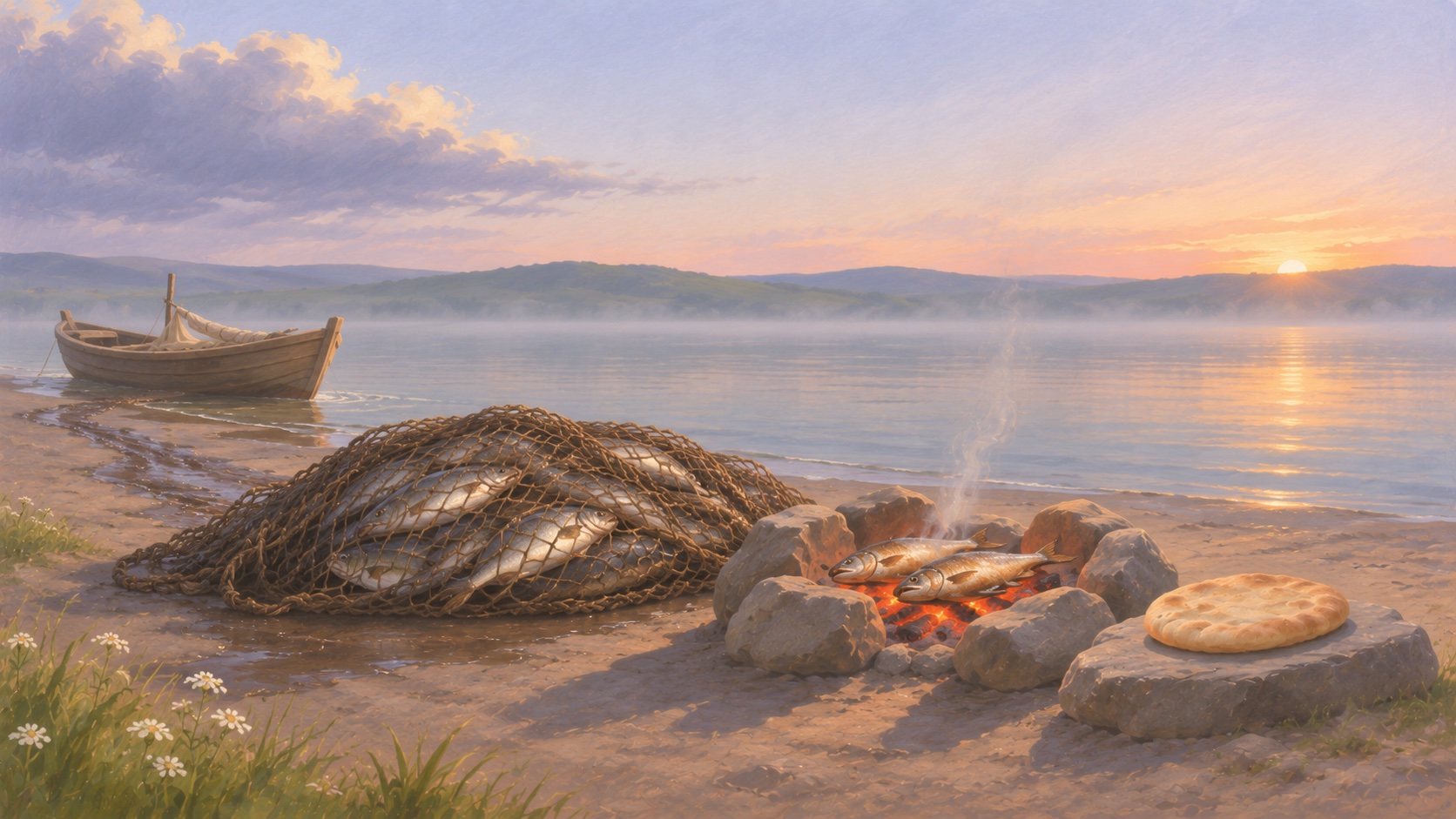
What's in this picture
- The fire of coals, with fish on it and bread beside it is the meal the disciples found already laid when they came ashore: “they saw a fire of coals there, and fish laid thereon, and bread” (John 21:9). He had asked them from the shore, “Children, have ye any meat?” and they had answered, “No” (John 21:5); now He says, “Come and dine” (John 21:12).
- The net heaped full of fish and not torn is the catch Peter drew to land: “full of great fishes, an hundred and fifty and three: and for all there were so many, yet was not the net broken” (John 21:11).
- The small boat and the wet trail up the sand recall the disciples coming in “in a little ship; (for they were not far from land, but as it were two hundred cubits,) dragging the net with fishes” (John 21:8).
- The sun just risen over the lake marks the hour: “when the morning was now come, Jesus stood on the shore: but the disciples knew not that it was Jesus” (John 21:4).
The chapters
John opens with the Word who was in the beginning with God, gives seven signs and the feasts of the Jews, and turns when Jesus says, “The hour is come, that the Son of man should be glorified.”
The Word Was Made Flesh
The Word who was in the beginning with God becomes flesh, John the Baptist bears record of the Lamb of God, and the first disciples come and see.
From Cana to Cana
Water becomes wine at a wedding, Jesus cleanses the temple, teaches Nicodemus to be born again and a Samaritan woman of living water, and heals a nobleman’s son with a word.
- 2 Thou Hast Kept the Good Wine until Now At a wedding in Cana Jesus turns the water of purification into the best wine of the feast, His first sign; at the Passover in Jerusalem He drives the traders from His Father’s house and speaks of a temple to be destroyed and raised in three days.
- 3 Born from Above Nicodemus comes to Jesus by night and hears that a man must be born of water and of the Spirit and that the Son of man must be lifted up; John the Baptist rejoices as the friend of the bridegroom.
- 4 The Saviour of the World On the road from Judea to Galilee Jesus asks a Samaritan woman for a drink, offers her living water and tells her plainly who He is; her town comes out to hear Him, and back in Cana a king’s officer believes His word and his son lives.
At the Feasts of the Jews
At a Sabbath, a Passover, the Feast of Tabernacles and the Feast of Dedication, Jesus heals, feeds five thousand, and declares Himself the bread of life, the light of the world, the great I Am and the good shepherd.
- 5 My Father Worketh Hitherto, and I Work At a feast in Jerusalem Jesus heals a man who had lain ill thirty-eight years beside the pool of Bethesda, on the Sabbath; accused of breaking the Sabbath and making Himself equal with God, He answers that the Son does what He sees the Father do, gives life, will raise the dead and judge them, and has the witness of John, of His works, of the Father and of the scriptures.
- 6 The Bread of Life Jesus feeds five thousand, walks on the sea, and in the synagogue at Capernaum declares Himself the bread of life; many disciples turn back, and Peter answers for the Twelve.
- 7 If Any Man Thirst Jesus goes up to Jerusalem for the feast of tabernacles after His unbelieving brothers have gone, teaches in the temple that His doctrine is the Father's, answers the charge about the Sabbath, and on the last day of the feast cries out that whoever thirsts should come to Him and drink; the crowd divides over whether He is the Christ, the officers sent to arrest Him come back empty-handed, and Nicodemus asks the council to hear Him first.
- 8 Before Abraham Was, I Am In the temple after the feast of tabernacles, Jesus sends away the accusers of a woman taken in adultery and tells her to sin no more; then He declares Himself the light of the world, promises that the truth will make free those who continue in His word, tells those who claim Abraham as their father that they do not do Abraham's works, and answers “Before Abraham was, I am,” and they take up stones.
- 9 Whereas I Was Blind, Now I See In Jerusalem on a Sabbath Jesus gives sight to a man blind from birth, sending him to wash in the pool of Siloam; questioned by his neighbours and twice by the Pharisees, who cast him out, the man comes step by step to believe on the Son of God and worship Him, while those who say “We see” remain in their sin.
- 10 The Good Shepherd Jesus calls Himself the door of the sheep and the good shepherd who lays down His life and takes it again; at the Feast of the Dedication He says, “I and my Father are one,” and escapes those who would stone Him.
The Resurrection and the Life
Jesus raises Lazarus, the council resolves on His death, Mary anoints Him at Bethany, He enters Jerusalem, and when Greeks ask to see Him He says, “The hour is come.”
- 11 I Am the Resurrection, and the Life Jesus goes back into Judea to the grave of His friend Lazarus, four days dead; He tells Martha that He is the resurrection and the life, weeps with Mary, and calls Lazarus out of the tomb, and the council in Jerusalem, hearing of it, resolves that He must die, as Caiaphas says that one man should die for the people.
- 12 The Hour Is Come At Bethany Mary anoints Jesus's feet against the day of His burial; the next day the crowds hail Him as the King of Israel; when Greeks ask to see Him, Jesus says the hour has come for the Son of man to be glorified, and a voice from heaven answers His prayer; John then weighs the unbelief that met Him, and gives His last public words.
In the Upper Room
Jesus washes His disciples’ feet, gives a new commandment, promises the Comforter and a place in His Father’s house, calls Himself the true vine, and prays for His disciples and for all who believe through them.
- 13 He Loved Them unto the End At supper on His last night, Jesus lays aside His garments and washes the disciples’ feet, Judas’s apparently among them, and bids them do as He has done; He names the betrayer with a morsel, Judas goes out into the night, and Jesus gives the new commandment, to love one another as He has loved them, and warns Peter that he will deny Him three times.
- 14 I Am the Way, the Truth, and the Life On the night of the Last Supper Jesus calms His troubled disciples. He is going to prepare a place for them in His Father's house; He is Himself the way to the Father, who is seen in Him; and He will not leave them orphans, but will send another Comforter and come to them Himself, leaving them His peace.
- 15 I Am the True Vine On the night before His death Jesus tells the eleven that He is the true vine and they are the branches; they bear fruit only as they abide in Him and in His love, and He calls them friends, for He is about to lay down His life for them; the world that hated Him will hate them, but the Comforter will testify of Him, and they will bear witness too.
- 16 I Have Overcome the World On the night before His death Jesus finishes His farewell to the Eleven, warning them of persecution, promising the Comforter who will convict the world and guide them into all truth, foretelling a little while of sorrow that will turn to joy, and ending, as they are about to scatter, with “be of good cheer; I have overcome the world.”
- 17 That They All May Be One At the close of the Last Supper Jesus lifts His eyes to heaven and prays aloud before His disciples, for His own glorifying in the hour now come, for the eleven He is leaving in the world, and for all who will believe through their word, that they may be kept, sanctified, made one, and brought to be with Him where He is.
The Lamb of God Lifted Up
Jesus is arrested in a garden, questioned by Annas and Caiaphas, tried before Pilate, crucified as the King of the Jews, and says, “It is finished.”
- 18 My Kingdom Is Not of This World Jesus goes out to meet the band that comes for Him in the garden and answers “I am he,” and they fall to the ground; He is bound and questioned by Annas, while Peter, by the fire in the courtyard, three times says “I am not”; at dawn the chief priests bring Him to Pilate, and to the governor He speaks of a kingdom not of this world and of the truth, and the crowd asks for Barabbas.
- 19 It Is Finished Pilate has Jesus scourged and brings Him out crowned with thorns, first as “the man” and then as “your King”; condemned at noon on the day the Passover is prepared, Jesus carries His own cross to Golgotha, gives His mother to the disciple He loves, says “It is finished,” and is buried by Joseph of Arimathaea and Nicodemus in a new tomb in a garden.
That Ye Might Believe
Mary Magdalene finds the tomb empty and meets the risen Lord in the garden, He breathes on the disciples, and Thomas, who would not believe without seeing, says, “My Lord and my God.”
Feed My Sheep
By the sea of Tiberias the risen Lord fills the net, asks Peter three times whether he loves Him, and speaks of the beloved disciple who would tarry.
Beloved passages
- “In the beginning was the Word, and the Word was with God, and the Word was God”John 1:1
- “And the Word was made flesh, and dwelt among us”John 1:14
- “Behold the Lamb of God, which taketh away the sin of the world”John 1:29
- “For God so loved the world, that he gave his only begotten Son”John 3:16
- “I am the bread of life: he that cometh to me shall never hunger”John 6:35
- “And ye shall know the truth, and the truth shall make you free”John 8:32
- “Before Abraham was, I am”John 8:58
- “I am the good shepherd: the good shepherd giveth his life for the sheep”John 10:11
- “I am the resurrection, and the life”John 11:25
- “Jesus wept”John 11:35
- “A new commandment I give unto you, That ye love one another; as I have loved you, that ye also love one another”John 13:34
- “In my Father’s house are many mansions”John 14:2
- “I am the way, the truth, and the life”John 14:6
- “Peace I leave with you, my peace I give unto you”John 14:27
- “Greater love hath no man than this, that a man lay down his life for his friends”John 15:13
- “And this is life eternal, that they might know thee the only true God, and Jesus Christ, whom thou hast sent”John 17:3
- “My Lord and my God”John 20:28
- “Lord, thou knowest all things; thou knowest that I love thee”John 21:17
Most-used sources
Every note cites its sources. These are the ones this commentary leans on most.