Job
“For I know that my redeemer liveth, and that he shall stand at the latter day upon the earth.” Job 19:25
Job was “perfect and upright, and one that feared God, and eschewed evil” (Job 1:1), and in a single day he lost his flocks, his servants and all ten of his children; then his body broke out in sores. Three friends came to comfort him and sat with him in silence for seven days. When at last he spoke, it was to curse the day he was born (Job 3:3), and the long argument that follows is the heart of the book: the friends insist that God punishes only the wicked, so Job must have sinned; Job insists that he has not, and demands a hearing with God.
Most of the book is poetry, some of the hardest Hebrew in the Bible, framed by a prose story at the beginning and the end. It does not explain why the righteous suffer, but it makes clear that suffering is not proof of sin, and the LORD Himself says the friends “have not spoken of me the thing that is right” (Job 42:7). In the middle of his darkness Job testifies, “I know that my redeemer liveth” (Job 19:25), and when the LORD answers out of the whirlwind He asks where Job was “when the morning stars sang together, and all the sons of God shouted for joy” (Job 38:7). The Lord reminded Joseph Smith of Job in Liberty Jail: “Thou art not yet as Job” (D&C 121:10).
This companion goes through all forty-two chapters and tries to anticipate the questions a careful reader would ask: who Job was and when he lived, whether God really spoke with Satan, what the friends got wrong, what Job meant by his Redeemer, and what he repented of at the end. For how Hebrew poetry is built, see Hebrew Poetry and the Prophets' Speech; for why the book is given no date, A Timeline of the Old Testament.
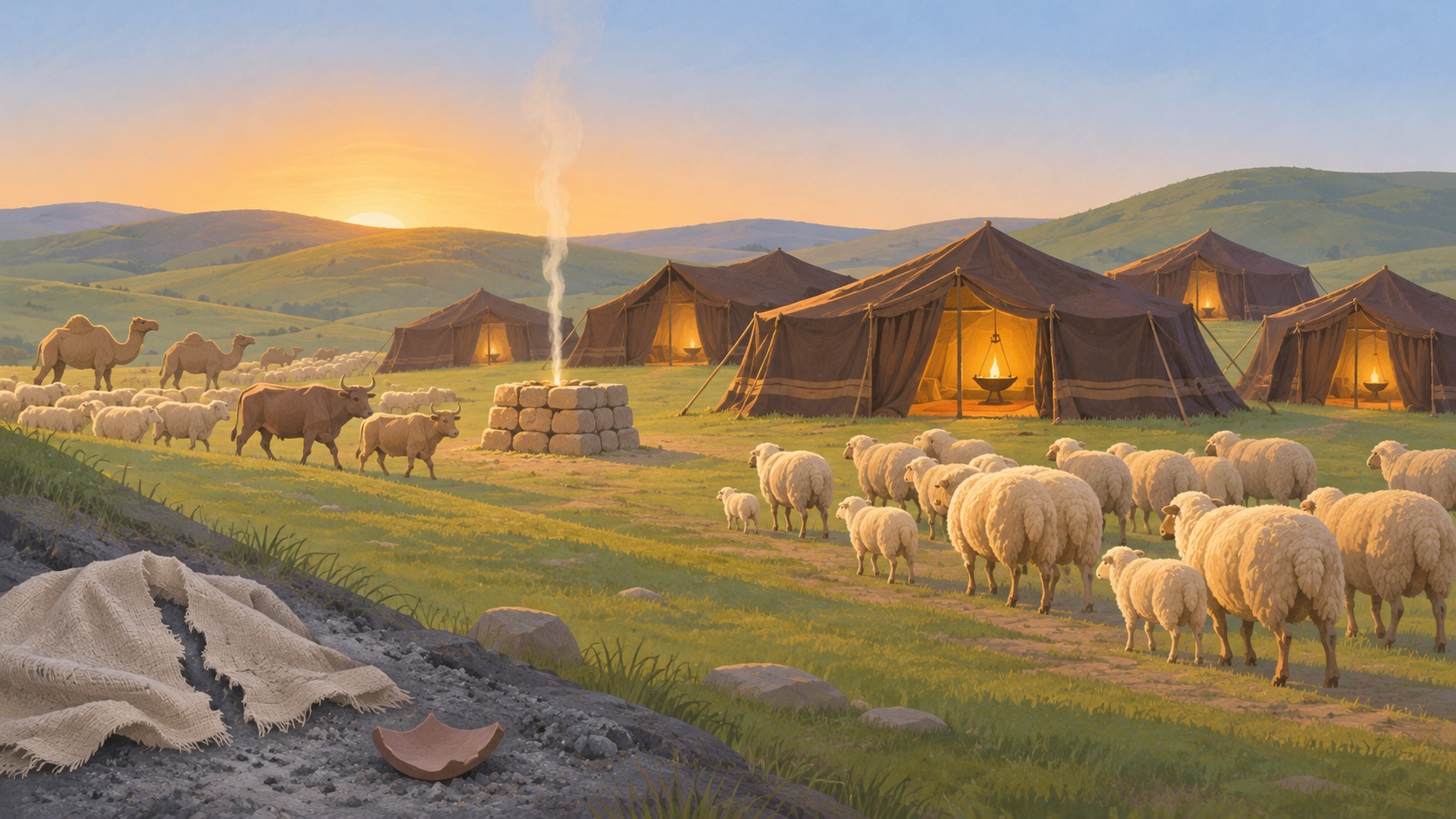
What's in this picture
- The torn mantle on the ashes is Job's answer to losing everything in one day. He “rent his mantle, and shaved his head, and fell down upon the ground, and worshipped,” and said, “the LORD gave, and the LORD hath taken away; blessed be the name of the LORD” (Job 1:20–21).
- The broken piece of pottery is the potsherd Job took “to scrape himself withal; and he sat down among the ashes” (Job 2:8).
- The flocks coming home are the restoration: “the LORD blessed the latter end of Job more than his beginning: for he had fourteen thousand sheep, and six thousand camels, and a thousand yoke of oxen” (Job 42:12), twice the flocks and herds he had lost (Job 42:10).
- The lamplit tents are his household restored, with “seven sons and three daughters” (Job 42:13). In his grief Job had looked back, saying, “when his candle shined upon my head” and “when my children were about me” (Job 29:3, Job 29:5).
- The altar with its rising smoke is Job's faithfulness from first to last. When he had everything he “offered burnt offerings” for his children: “Thus did Job continually” (Job 1:5). At the end the LORD sent the friends who had accused him to Job with their burnt offering, “and my servant Job shall pray for you” (Job 42:8); “the LORD turned the captivity of Job, when he prayed for his friends” (Job 42:10).
The chapters
Forty-two chapters in six parts. A righteous man loses everything; he curses the day he was born and argues with three friends who are sure he has sinned; a fourth speaker rebukes them all; and the LORD answers out of the whirlwind.
Hast Thou Considered My Servant Job?
In a prose prologue, Job is perfect and upright and greatly blessed. Satan says Job serves God only for what he gets; Job loses his wealth, his children and his health, and still he does not curse God.
- 1 Doth Job Fear God for Nought? A blameless man in the land of Uz offers sacrifices for his children. In the council of heaven the adversary asks whether Job serves God only for what he receives, and in one day Job loses his wealth and his children. He mourns, worships, and blesses the name of the LORD.
- 2 Still He Holdeth Fast His Integrity Satan is allowed to strike Job’s body but not his life; Job refuses his wife’s counsel to curse God, and three friends come to mourn with him in silence.
Let the Day Perish
Job curses the day he was born. Eliphaz, Bildad and Zophar each answer that God punishes only the wicked, and Job answers each in turn, longing for a daysman between himself and God and asking, “If a man die, shall he live again?”
- 3 Let the Day Perish After seven days of silence Job speaks at last, cursing the day he was born and asking why light is given to the one in misery.
- 4 Who Ever Perished, Being Innocent? Eliphaz, the first of Job’s friends to speak, reminds Job of the comfort he once gave others, insists that the innocent never perish, and tells of a voice in the night that asked whether any mortal can be righteous before God.
- 5 Happy Is the Man Whom God Correcteth Eliphaz finishes his first speech. No holy one will answer a man who rages against God, man is born to trouble, and the wise man seeks God, accepts His chastening, and is restored.
- 6 Oh That My Grief Were Throughly Weighed Job answers Eliphaz. His words were wild because his grief is heavy, he would welcome death if God would send it, and his friends have failed him like a stream that runs dry in summer.
- 7 My Life Is Wind Job finishes his answer to Eliphaz by turning to God. Life is hard service and short, the dead do not come back, and so he will speak; why does God watch him so closely, and why not simply pardon him before he is gone?
- 8 Doth God Pervert Judgment? Bildad, the second friend, asks whether God perverts justice, says Job’s children died for their own sins, sends Job to the wisdom of the fathers, and promises that God will not cast away a perfect man.
- 9 How Should Man Be Just with God? Job answers Bildad. He grants that God is just and mighty, and finds in that very might the reason he can never win his case, for there is no daysman to stand between them.
- 10 Shew Me Wherefore Thou Contendest with Me Job stops arguing with Bildad and speaks to God. You made me with your own hands, he says, and kept me alive with care; why now hunt me down, and why will you not tell me the charge?
- 11 Canst Thou by Searching Find Out God? Zophar, the third friend, answers Job for the first time. Job talks too much and calls himself clean; God has punished him less than he deserves; no one can search out God; let Job put away his sin, and his trouble will pass like water.
- 12 With Him Is Wisdom and Strength Job answers Zophar. He knows as much of God as his friends do, and what he knows is a God whose wisdom and strength tear down as readily as they build.
- 13 Though He Slay Me Job answers Zophar. He dismisses his friends as physicians of no value who lie on God's behalf, resolves to take his case to God at the risk of his life, and turns to demand a hearing.
- 14 If a Man Die, Shall He Live Again? Job ends his answer to Zophar by turning to death. A felled tree may sprout again, but a man lies down and does not rise; and then, for a moment, Job imagines God calling him back from the grave.
I Know That My Redeemer Liveth
In the second round the friends describe the fate of the wicked ever more darkly. Job, abandoned by family and friends, says his witness is in heaven, and testifies that his Redeemer lives and that in his flesh he shall see God.
- 15 What Is Man, That He Should Be Clean? Eliphaz opens the second round. He calls Job's words wind, says his own mouth condemns him, asks whether he sat in God's council, and paints the end of the wicked man in colors Job is meant to recognize.
- 16 My Witness Is in Heaven Job answers Eliphaz's second speech. He sends back the friends' comfort, describes God as an enemy who has torn him for no fault, and then, with no defender left on earth, declares that his witness is in heaven.
- 17 Where Is Now My Hope? Job, near death and misjudged by everyone, asks God Himself to stand surety for him, holds that the righteous will keep to their way, and looks into the grave for a hope he cannot find.
- 18 The King of Terrors Bildad, stung that Job thinks the friends stupid, answers with a long portrait of the wicked man’s end, and fills it with Job’s own losses.
- 19 I Know That My Redeemer Liveth Job answers Bildad. Cut off from family, household and friends, and sure that God has put him in the wrong, he wishes his words were cut into rock, and then testifies of a Redeemer who lives and whom he will see.
- 20 The Triumphing of the Wicked Is Short Zophar, insulted by Job's warning, answers with a portrait of the wicked rich man whose sweet sin turns to poison and whom heaven and earth rise up to accuse, and he means the portrait for Job.
- 21 Wherefore Do the Wicked Live? Job answers Zophar and closes the second round. The friends say the wicked are always cut down; Job points to what anyone can see, the wicked growing old in wealth and going quietly to the grave.
Where Shall Wisdom Be Found?
The third round breaks down. Job says that when God has tried him he shall come forth as gold, asks where wisdom can be found and answers that it is the fear of the Lord, remembers his former days, and swears to his innocence.
- 22 Acquaint Now Thyself with Him In his last speech Eliphaz tells Job that his righteousness is no gain to God, charges him with crimes against the poor that Job never committed, and closes with a call to return to God whose last promise turns back on Eliphaz himself.
- 23 Oh That I Knew Where I Might Find Him! Job answers Eliphaz by turning away from him. He longs to stand before God's own seat and argue his case, cannot find God anywhere, and is sure all the same that God knows his way and that the test will prove him gold.
- 24 Why Do They That Know Him Not See His Days? Job finishes his answer to Eliphaz by looking away from his own trouble to the poor of the earth, stripped, hungry and crying out, while those who wrong them go on unpunished.
- 25 How Then Can Man Be Justified with God? Bildad’s last speech, and the friends’ last word, is six verses long. He praises the God who rules the heavens and asks how a man, a worm before Him, could ever be clean.
- 26 These Are Parts of His Ways Job brushes aside Bildad's borrowed counsel and answers with his own hymn to God's power, from the trembling dead to the clouded throne, and ends by saying that all of it is only a whisper of Him.
- 27 Till I Die I Will Not Remove Mine Integrity With no friend left to answer him, Job swears by the God he says has wronged him that he will never confess to sins he did not commit, then hands the friends' own picture of the wicked man's end back to them.
- 28 The Fear of the Lord, That Is Wisdom Job's poem on wisdom. Men dig silver and gold out of the dark and trade in precious stones, but wisdom can be neither dug up nor bought; God alone knows its place, and He has told man that the fear of the Lord is wisdom.
- 29 Oh That I Were as in Months Past Job, the friends now silent, remembers the days when God's friendship rested over his tent, the city rose when he came to the gate, and he was eyes to the blind and a father to the poor.
- 30 But Now They Have Me in Derision Job sets his present beside the past he has just recalled. Outcasts he once would not have hired now mock and spit at him, God seems to have turned cruel and will not answer, and his harp plays only mourning.
- 31 Let Me Be Weighed in an Even Balance Job ends his defense under oath. Sin by sin, from a lingering look to a field taken from its owners, he calls down a curse on himself if he is guilty, signs his name to the whole, and asks the Almighty to answer.
Great Men Are Not Always Wise
A young man, Elihu, angry with Job for justifying himself and with the friends for finding no answer, speaks at length of God's justice and His greatness in the storm. No one answers him.
- 32 There Is a Spirit in Man The three friends fall silent, and a younger man, Elihu, angry with Job and with them, explains why he will speak at last.
- 33 I Have Found a Ransom Elihu turns to Job by name, quotes his complaints back to him, and answers that God does speak to man, in dreams and in pain, and that a messenger may plead for him until God says, “I have found a ransom.”
- 34 Far Be It from God Elihu turns from Job to the listeners. He quotes Job's complaints against God, defends God as a Judge who cannot do wrong and needs no hearing, and asks that Job's trial go on to the end.
- 35 What Givest Thou Him? Elihu takes up two things he says Job has claimed, that righteousness does not pay and that God does not hear, and answers that God is beyond the reach of human gain or loss, that cries go unanswered when they do not seek their Maker, and that Job's case already lies before God.
- 36 Who Teacheth Like Him? Elihu's last speech begins. He claims to speak for God with sound knowledge, teaches that God opens the ears of the afflicted through their affliction, warns Job that he has chosen iniquity over patient suffering, and turns to praise God in the gathering storm.
- 37 With God Is Terrible Majesty Elihu's speech ends in a storm. Thunder, snow, rain, ice and cloud all move at God's command; Elihu turns to Job with questions he cannot answer, and closes by saying that the Almighty cannot be found out.
Out of the Whirlwind
The LORD answers Job out of the whirlwind with questions about the creation, the animals, behemoth and leviathan. Job says, “Now mine eye seeth thee,” and repents; the LORD rebukes the friends, accepts Job's prayer for them, and blesses his latter end more than his beginning.
- 38 Where Wast Thou? The LORD answers Job at last, out of the whirlwind, and gives him not reasons but questions. Where was Job when the earth was founded and the sons of God shouted for joy? Can he shut in the sea, command the morning, bind the stars, or feed the lion and the raven?
- 39 Doth the Hawk Fly by Thy Wisdom? The LORD's first speech goes on among the wild animals. Job does not know when the wild goats give birth, cannot harness the wild ass or the wild ox, did not make the foolish ostrich or give the war horse its courage, and does not send the hawk south or the eagle to its crag.
- 40 Wilt Thou Condemn Me, That Thou Mayest Be Righteous? The LORD's first speech ends with a challenge, and Job, who demanded an answer, puts his hand over his mouth. The second speech names the fault in his complaint, invites him to rule the world as God does if he can, and sets before him behemoth, a creature only its Maker can master.
- 41 Who Then Is Able to Stand before Me? The LORD ends His second speech with leviathan, a creature no man can hook, tame or wound. If no one dares rouse him, no one can stand before his Maker, to whom everything under heaven belongs.
- 42 Now Mine Eye Seeth Thee Job answers the LORD a last time, takes back the words he spoke without knowledge, and says that now he has seen Him. Then the LORD rebukes the three friends, Job prays for them, and the LORD gives him twice what he had lost.
Themes
Ideas that run through many chapters, gathered in one place.
Beloved passages
- “The LORD gave, and the LORD hath taken away; blessed be the name of the LORD”Job 1:21
- “Though he slay me, yet will I trust in him”Job 13:15
- “If a man die, shall he live again?”Job 14:14
- “I know that my redeemer liveth”Job 19:25
- “When he hath tried me, I shall come forth as gold”Job 23:10
- “When the morning stars sang together, and all the sons of God shouted for joy”Job 38:7
Most-used sources
Every note cites its sources. These are the ones this commentary leans on most.
- “Job, book of”, Bible Dictionary.
- “Job”, Guide to the Scriptures.
- Job 1–3; 12–14; 19; 21–24; 38–40; 42, Scripture Helps: Old Testament.