Micah
“What doth the LORD require of thee, but to do justly, and to love mercy, and to walk humbly with thy God?” Micah, Micah 6:8
Micah the Morasthite, from Moresheth-gath in the low hills southwest of Jerusalem, prophesied “in the days of Jotham, Ahaz, and Hezekiah, kings of Judah” (Micah 1:1), the same years as Isaiah. He foretold the fall of Samaria to Assyria and mourned the towns of Judah’s countryside, his own among them, before the Assyrian armies came (Micah 1:6; Micah 1:10–16). His charges are against the powerful in Jerusalem: men who “covet fields, and take them by violence” (Micah 2:2), rulers who “judge for reward,” priests who “teach for hire,” and prophets who “divine for money” (Micah 3:11). A century later the elders of Judah remembered his warning that “Zion shall be plowed like a field” and that King Hezekiah had heeded it (Jer. 26:18–19).
Each of the book’s three parts turns from judgment to hope. Micah sees the mountain of the Lord’s house raised “in the last days,” in words nearly the same as Isaiah’s (Micah 4:1–3); he names Bethlehem as the town from which a ruler would come “whose goings forth have been from of old, from everlasting” (Micah 5:2), the prophecy the chief priests gave Herod (Matt. 2:4–6); and he answers the question of what the Lord wants from His people with “do justly, and … love mercy, and … walk humbly with thy God” (Micah 6:8). The resurrected Saviour quoted Micah to the Nephites (3 Ne. 20:16–19; 3 Ne. 21:12–18), and the book ends with the question its prophet’s name asks: “Who is a God like unto thee, that pardoneth iniquity?” (Micah 7:18). This companion goes through all seven chapters and tries to anticipate the questions a careful reader would ask.
For the wider setting of Judah under Ahaz and Hezekiah and of Assyria, see A Timeline of the Old Testament and Two Kingdoms and Assyria.
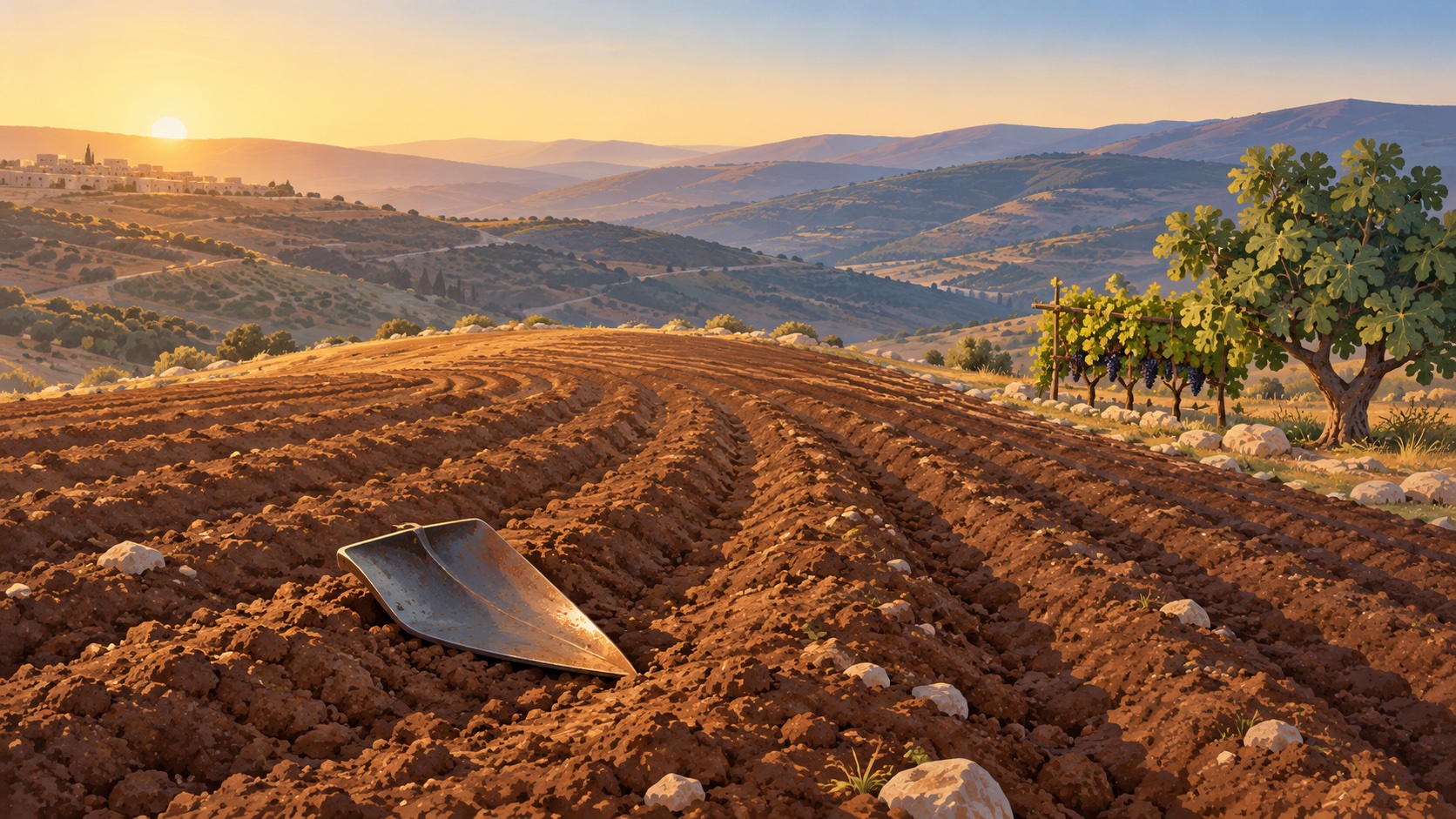
What's in this picture
- The plowed hill is Micah’s warning to Jerusalem’s rulers: “Therefore shall Zion for your sake be plowed as a field, and Jerusalem shall become heaps” (Micah 3:12).
- The metal blade lying in the furrow is a plowshare, the promise that follows the warning: in the last days the nations “shall beat their swords into plowshares, and their spears into pruninghooks” (Micah 4:3).
- The vine and the fig tree at the edge of the field are the peace of that day: “they shall sit every man under his vine and under his fig tree; and none shall make them afraid” (Micah 4:4).
- The little town on the far ridge is Beth-lehem: “though thou be little among the thousands of Judah, yet out of thee shall he come forth unto me that is to be ruler in Israel; whose goings forth have been from of old, from everlasting” (Micah 5:2).
The chapters
Seven chapters in three movements, each passing from judgment to hope. Micah warns that Samaria and Jerusalem will fall for their idols and their injustice; he sees the house of the Lord raised in the last days and a ruler coming out of Bethlehem; and he hears the Lord’s case against His people, which ends in praise of the God who pardons.
Zion Shall Be Plowed
The Lord comes down from His holy temple against Samaria and Jerusalem. Micah laments the towns of his own countryside, condemns those who seize fields and houses, and turns on the rulers, priests and prophets who sell judgment and prophecy, until Zion is plowed as a field. In the middle, the Lord promises to gather the remnant of Israel like sheep.
- 1 The LORD Cometh Forth out of His Place The Lord comes down to testify against Samaria and Jerusalem, and Micah mourns barefoot through the towns of his own countryside, each name a sign of its fate.
- 2 They Covet Fields Micah names the crime behind the coming judgment, the powerful taking the land and homes of their neighbours, answers the people who tell him to stop preaching, and closes with the Lord gathering the remnant of Israel like a flock.
- 3 Is Not the LORD Among Us? Micah turns on the men who should have kept justice in Jerusalem, the rulers who devour the people and the prophets who preach peace to whoever feeds them, and sets himself against them as a prophet full of the Spirit of the Lord. Their confidence that the Lord is among them ends in the sentence that Zion will be plowed as a field.
In the Last Days
The mountain of the Lord’s house is raised above the hills, the nations come to learn His ways, and swords become plowshares. Zion will travail and go to Babylon, and be delivered there. Out of little Bethlehem comes a ruler whose goings forth are from everlasting, and the remnant of Jacob stands among the nations as dew and as a lion.
- 4 The Mountain Raised from the Ruins The temple mount that Micah had just seen plowed like a field is lifted above the hills, and the nations stream to it to learn the Lord’s ways. The lame are gathered into a remnant, Zion goes through labor pains to Babylon and is redeemed there, and the nations that gather against her are threshed like sheaves.
- 5 Out of Thee Shall He Come Forth Jerusalem is besieged and its judge struck on the cheek. From little Beth-lehem comes a Ruler whose goings forth are from everlasting, and He shall be the peace. The remnant of Jacob becomes dew and lion among the nations, and the Lord cuts off His own people’s horses, fortresses and idols.
What Doth the Lord Require
The Lord calls the mountains to hear His case against His people and reminds them what He has done for them. He asks not for rams or rivers of oil but for them to do justly, love mercy and walk humbly. Micah mourns a land where no one can be trusted, waits for the God of his salvation, and ends in praise of the God who pardons and casts sins into the sea.
- 6 What Doth the Lord Require The Lord takes His people to court with the mountains as witnesses and asks what He has done to weary them. They ask whether ever larger sacrifices, up to a firstborn child, will satisfy Him; the prophet answers with what they had already been told, and the Lord names the false weights and the treasures of wickedness in the city.
- 7 Who Is a God Like unto Thee Micah walks through a vineyard after the harvest and finds no one upright left. Then fallen Israel speaks, confesses her sin and waits for the Lord to raise her, and the book closes by asking who is a God like Israel's, who pardons iniquity and casts sins into the depths of the sea.
Themes
Ideas that run through many chapters, gathered in one place.
Beloved passages
- “I am full of power by the spirit of the LORD”Micah 3:8
- “for the law shall go forth of Zion, and the word of the LORD from Jerusalem”Micah 4:2
- “they shall beat their swords into plowshares, and their spears into pruninghooks”Micah 4:3
- “they shall sit every man under his vine and under his fig tree; and none shall make them afraid”Micah 4:4
- “But thou, Beth-lehem Ephratah, though thou be little among the thousands of Judah”Micah 5:2
- “what doth the LORD require of thee, but to do justly, and to love mercy, and to walk humbly with thy God”Micah 6:8
- “I will look unto the LORD; I will wait for the God of my salvation”Micah 7:7
- “Who is a God like unto thee, that pardoneth iniquity”Micah 7:18
- “thou wilt cast all their sins into the depths of the sea”Micah 7:19
Most-used sources
Every note cites its sources. These are the ones this commentary leans on most.
- “Micah”, Bible Dictionary.
- Micah; Nahum; Habakkuk; Zephaniah, Scripture Helps: Old Testament (2025).
- Dale G. Renlund, “Do Justly, Love Mercy, and Walk Humbly with God”, General conference, October 2020 (Ensign or Liahona, Nov. 2020, 109–11).
- Dana M. Pike, “Passages from the Book of Micah in the Book of Mormon”, In They Shall Grow Together: The Bible in the Book of Mormon, ed. Charles Swift and Nicholas J. Frederick (Provo, UT: Religious Studies Center, Brigham Young University; Salt Lake City: Deseret Book, 2022), 393–444.
- Joseph M. Spencer, “The Prophets’ Remnant Theology”, In Prophets and Prophecies of the Old Testament, ed. Aaron P. Schade, Brian M. Hauglid, and Kerry Muhlestein (Provo, UT: Religious Studies Center; Salt Lake City: Deseret Book, 2017), 205–230.