Hosea
“I will heal their backsliding, I will love them freely.” The Lord to Israel, Hosea 14:4
Hosea prophesied in the northern kingdom of Israel in the eighth century B.C., from the last years of Jeroboam the son of Joash into the decades when that kingdom came apart and was taken by Assyria. He is the only prophet of the northern kingdom whose written prophecies have come down to us. The kingdom he speaks to he most often calls Ephraim, after its leading tribe. The two kingdoms and Assyria's conquest of the north are set out in A Timeline of the Old Testament.
The book begins with the Lord’s command that Hosea take “a wife of whoredoms” (Hosea 1:2), and with three children whose names are sentences passed on Israel. From that household the book reads the whole history of the covenant as a marriage: a bride who went after other lovers, and a husband who will not give her up. Chapters 4–14 carry the same charge and the same promise to the nation, in a rush of images from the farm, the oven, the hunt, and the nursery. This companion goes through all fourteen chapters and tries to anticipate the questions a careful reader asks: Did Hosea really marry such a woman? Who is Ephraim? What does that image mean? Where is Christ in this?
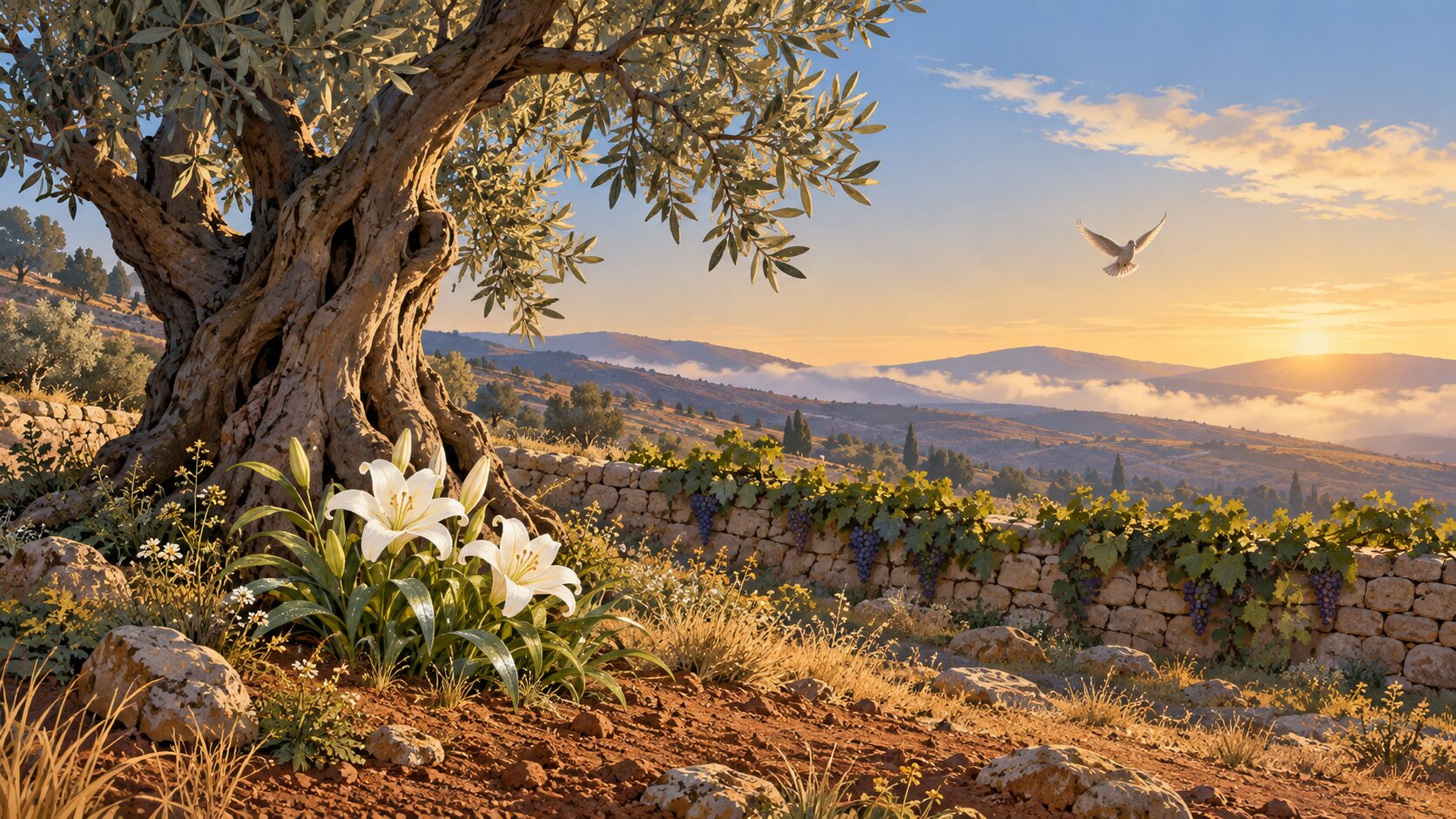
What's in this picture
- The morning cloud along the hills is Israel’s fading devotion: “your goodness is as a morning cloud, and as the early dew it goeth away” (Hosea 6:4).
- The red earth loosened by hand is the Lord’s call: “break up your fallow ground: for it is time to seek the LORD” (Hosea 10:12).
- The lilies, the olive tree and the vine are the Lord’s promise at the end of the book: Israel “shall grow as the lily,” and “shall … grow as the vine,” its beauty “as the olive tree” (Hosea 14:5–7).
- The dove flying in from the far hills is Israel coming home: “They shall tremble … as a dove out of the land of Assyria” (Hosea 11:11).
The chapters
The book opens with a household, a wife who leaves and children with hard names, and then turns to the nation that household stands for. Warning and promise alternate to the end, and the last word is a promise.
The Prophet’s Household
Hosea is told to take a wife of whoredoms, and her three children are named for what is coming on Israel. The Lord pleads with His unfaithful bride, promises to betroth her to Him for ever, and sends Hosea to love and buy back a woman who has left him.
- 1 The Prophet’s Household as a Sign The Lord’s first word through Hosea is a command to marry, and the three children of the marriage are named for what is coming on the northern kingdom. Then, with one word, “Yet,” the names begin to turn.
- 2 The Unfaithful Wife and the Betrothal The Lord brings His charge against Israel as a husband against a wife, takes back the gifts she credited to Baal, and then, where the sentence is expected, leads her into the wilderness to win her again.
- 3 Bought Back, and the Many Days The Lord sends Hosea to love an unfaithful woman again. He buys her and sets her a long time of waiting, and the Lord says what it means. Israel will wait many days without king or altar, and afterward will seek the Lord and David their king.
The Lord’s Controversy with Israel
There is no truth, mercy, or knowledge of God in the land. Priests, princes, and people are charged with idols, with kings set up and cut down, and with running to Egypt and Assyria for help. They have sown the wind and will reap the whirlwind.
- 4 The Lord’s Controversy The household story is over and a courtroom opens. The Lord charges Israel with having no truth, no mercy, and no knowledge of God, and He lays the last of these at the door of the priests.
- 5 Judgment on Priests, People, and King; the Lord Withdraws The Lord summons Israel’s priests, people, and royal house to judgment and draws Judah into the same sentence. He is moth, rot, and lion to both kingdoms, and He goes back to His place until they seek His face.
- 6 Mercy, and Not Sacrifice The people speak of returning to the Lord, sure that He will heal them as certainly as morning and rain come. The Lord answers that their devotion is gone as quickly as a morning cloud, says what He wants in place of their offerings, and names the places where His covenant was broken.
- 7 A Cake Not Turned The Lord moves to heal Israel, and its guilt comes to light. A court burns like an oven and consumes its own kings, a nation flutters between Egypt and Assyria like a dove, and through all of it no one calls on Him.
- 8 Sowing the Wind An alarm sounds over the Lord’s house. Israel has made its own kings, its own calf, its own allies, and its own altars, and has forgotten the One who made Israel. What it sowed as wind comes back as a storm.
- 9 No Harvest Joy; Ephraim Bears No Fruit Israel is told not to rejoice at the harvest, for the land, the feasts, and the children will all be lost. The Lord who once found Israel like grapes in the wilderness names Gibeah, Baal-peor, and Gilgal, and Ephraim will wander among the nations.
- 10 Sow in Righteousness, Reap in Mercy Israel is a vine that spent its fruit on altars. The Lord takes away the altars, the calf, and the king, offers one more season for sowing, and says what harvest is already in.
“I Will Love Them Freely”
The Lord remembers Israel as a child He called out of Egypt and taught to walk, and cannot give him up. He recalls Jacob, promises to ransom His people from the grave, and calls them to return with words of repentance.
- 11 A Father Who Cannot Give Up His Son The Lord remembers Israel as a child He called out of Egypt, taught to walk, and fed. The child has turned away and the Assyrian will be his king, yet the Lord asks how He can give Ephraim up, and promises to call His children home.
- 12 Jacob’s Children and Jacob’s Way The Lord sets the patriarch beside the nation that carries his names. Jacob strove, wept, and found God at Bethel; Ephraim trades with false scales and counts its wealth as innocence. Between the two stands the appeal to turn, keep mercy, and wait.
- 13 No Saviour Beside Me Ephraim died when it turned to Baal, and the king it asked for cannot save it. The Lord, who has been its God since Egypt, says there is no saviour but Him, and then speaks to death and the grave.
- 14 Take with You Words The prophet calls Israel back one last time and gives them the prayer to bring. The Lord answers that He will heal them and love them freely, and the book closes by asking its reader to be wise.
Themes
Ideas that run through many chapters, gathered in one place.
Beloved passages
- “I will betroth thee unto me for ever”Hosea 2:19
- “I will say to them which were not my people, Thou art my people”Hosea 2:23
- “My people are destroyed for lack of knowledge”Hosea 4:6
- “I desired mercy, and not sacrifice”Hosea 6:6
- “they have sown the wind, and they shall reap the whirlwind”Hosea 8:7
- “Sow to yourselves in righteousness, reap in mercy; break up your fallow ground”Hosea 10:12
- “I drew them with cords of a man, with bands of love”Hosea 11:4
- “How shall I give thee up, Ephraim?”Hosea 11:8
- “I will ransom them from the power of the grave; I will redeem them from death”Hosea 13:14
- “I will heal their backsliding, I will love them freely”Hosea 14:4
Most-used sources
Every note cites its sources. These are the ones this commentary leans on most.
- “Hosea, or Hoshea”, Bible Dictionary.
- “Hosea”, Guide to the Scriptures.
- Hosea 1–6; 10–14; Joel, Scripture Helps: Old Testament.
- Chapter 10: The Ministry of Hosea: A Call to Faithfulness (Hosea), Old Testament Student Manual: 1 Kings–Malachi (2003).