Song of Solomon
“Many waters cannot quench love, neither can the floods drown it.” Song 8:7
The Song of Solomon is a book of love poems: “The song of songs, which is Solomon's” (Song 1:1). A woman and a man speak to each other and about each other, with the “daughters of Jerusalem” as a chorus, in images taken from vineyards, gardens, flocks and spices. It never names God. The Church's edition of the Bible prints a note at its head: “The JST manuscript states that ‘the Songs of Solomon are not inspired writings.’” Joseph Smith changed nothing in its text, and he left no reason for the note.
The Song has stayed in the Bible, Jewish and Christian, for some two thousand years, long read as an allegory of God's love for His people. Its words also stand in three revelations given through Joseph Smith, two of them after the note: “fair as the moon, clear as the sun, and terrible as an army with banners” (Song 6:10), used in the Kirtland Temple dedicatory prayer (D&C 109:73) among others. This companion reads all eight chapters as love poetry. It tries to anticipate the questions a careful reader would ask: who is speaking, what the images meant, why the book is in the Bible, and what Joseph Smith's note does and does not say.
For how Hebrew poetry is built, see Hebrew Poetry and the Prophets' Speech; for Solomon's reign, A Timeline of the Old Testament.
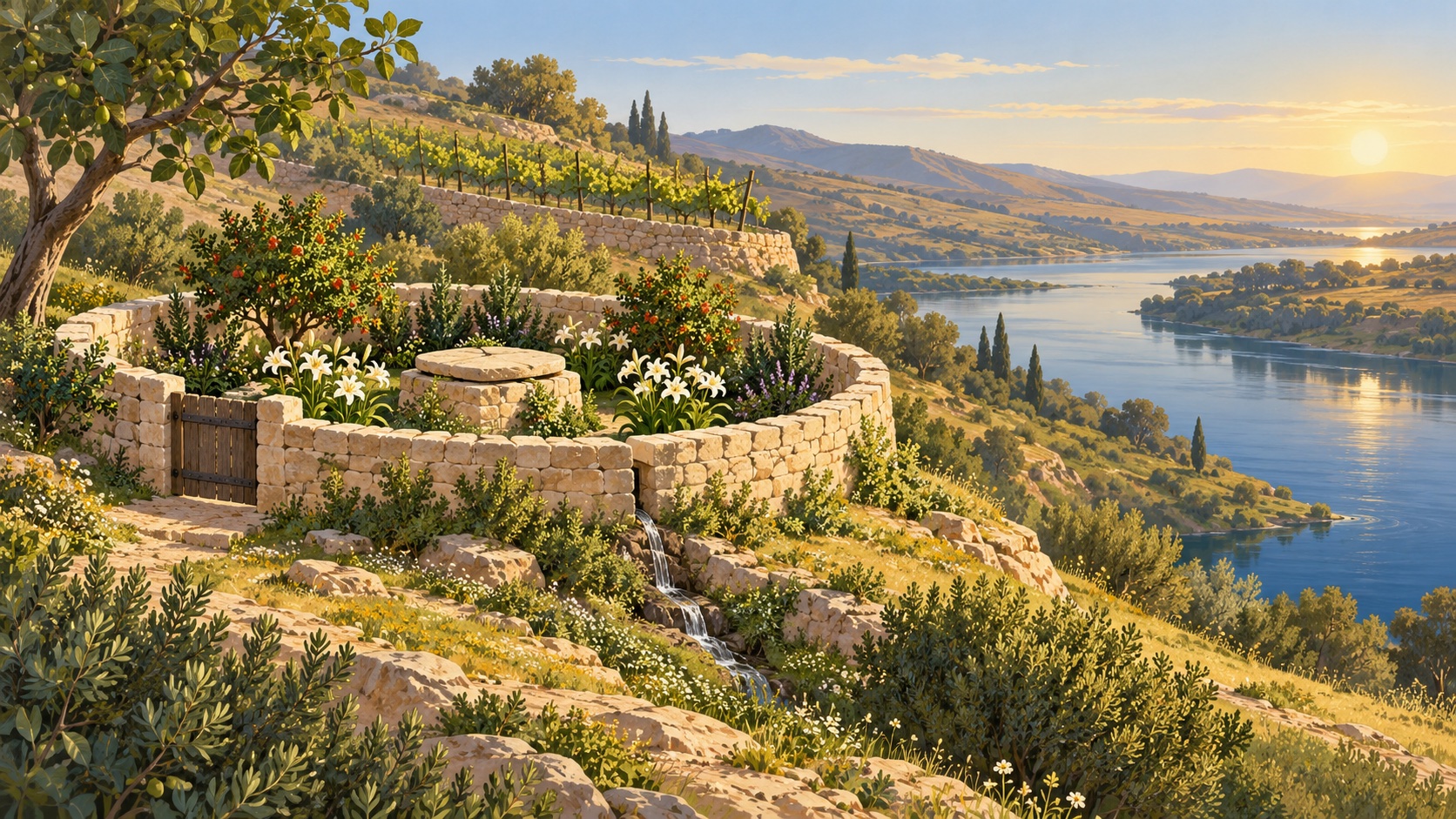
What's in this picture
- The walled garden with its shut gate and covered spring is the man's picture of the woman he loves: “A garden inclosed is my sister, my spouse; a spring shut up, a fountain sealed” (Song 4:12).
- The water running out under the wall is the same spring in the next lines: “A fountain of gardens, a well of living waters, and streams from Lebanon” (Song 4:15).
- The lilies inside the garden are where her beloved is found: “My beloved is mine, and I am his: he feedeth among the lilies” (Song 2:16).
- The broad river below, which does not reach the garden, shows the book's last word on love: “Many waters cannot quench love, neither can the floods drown it” (Song 8:7).
- The fig tree and the terraced vines show the springtime he calls her into: “The fig tree putteth forth her green figs, and the vines with the tender grape give a good smell. Arise, my love, my fair one, and come away” (Song 2:13).
The chapters
Eight chapters of love poems between a woman and a man, with the daughters of Jerusalem as a chorus. The divisions here follow the book's recurring refrain, “stir not up, nor awake my love.”
Thy Love Is Better Than Wine
The woman, black but comely, longs for her beloved among the daughters of Jerusalem. They praise each other, he comes leaping over the hills in the spring, and she says, “My beloved is mine, and I am his.”
- 1 Thy Love Is Better Than Wine The woman longs for her beloved, tells the daughters of Jerusalem that she is black but comely, and asks where he pastures his flock. He praises her, she answers with images of fragrance, and the two end praising each other in a house of cedar.
- 2 Rise Up, My Love, and Come Away The lovers trade praises, she rests in his embrace and charges the daughters of Jerusalem not to awaken love before its time, and he comes over the hills in spring to call her out.
A Garden Inclosed
She seeks him by night through the city and finds him. Solomon's procession comes up from the wilderness on his wedding day, and the man praises his bride from head to foot, a garden inclosed and a fountain sealed.
- 3 I Sought Him Whom My Soul Loveth The woman seeks her beloved by night through the city and will not let him go when she finds him, and then a royal procession comes up from the wilderness, Solomon's litter guarded by sixty men, on the day of his wedding.
- 4 A Garden Locked, a Fountain Sealed The man praises the woman from her eyes downward, calls her from the mountains of Lebanon as his bride, and pictures her as a locked garden full of spices and a sealed fountain; she answers by inviting him into the garden.
I Sought Him, but I Could Not Find Him
He knocks in the night and is gone when she opens. The watchmen strike her, she tells the daughters of Jerusalem what her beloved is like, and he praises her again, fair as the moon and clear as the sun.
- 5 I Opened to My Beloved The man comes into his garden; then, in a night scene, the woman is slow to answer his knock, opens too late, searches the city, is struck by the watchmen, and answers the daughters of Jerusalem with a portrait of him from head to foot.
- 6 Fair as the Moon, Clear as the Sun The woman knows where her beloved has gone, he praises her again as awe-inspiring as an army with banners, the women ask who it is that looks out like the dawn, and they call the Shulamite back to be seen.
Many Waters Cannot Quench Love
He praises her beauty once more, and she invites him to the fields and vineyards. The closing poems give the seal upon the heart, a love strong as death that many waters cannot quench, her brothers' plans for their little sister, and Solomon's vineyard.
- 7 His Desire Is toward Me The Shulamite is praised from her sandals to her hair, he likens her to a palm tree he will climb, she answers that she is her beloved's and his desire is toward her, and she invites him out to the vineyards, where the mandrakes give their scent.
- 8 Love Is Strong as Death The woman wishes she could love her beloved openly, then asks to be set as a seal upon his heart, for love is as strong as death and many waters cannot quench it. Her brothers speak of their little sister, she answers that her vineyard is her own, and the book ends with her calling her beloved to make haste, like a roe on the mountains of spices.
Beloved passages
- “I am the rose of Sharon, and the lily of the valleys”Song of Solomon 2:1
- “My beloved is mine, and I am his”Song of Solomon 2:16
- “Fair as the moon, clear as the sun, and terrible as an army with banners”Song of Solomon 6:10
- “Set me as a seal upon thine heart … for love is strong as death”Song of Solomon 8:6
- “Many waters cannot quench love”Song of Solomon 8:7
Most-used sources
Every note cites its sources. These are the ones this commentary leans on most.
- “Song of Solomon”, Bible Dictionary.
- Dana M. Pike, “Reading the Song of Solomon as a Latter-day Saint”, Religious Educator 15, no. 2 (2014): 91–113.