2 Samuel
“And thine house and thy kingdom shall be established for ever before thee: thy throne shall be established for ever.” The LORD to David, by Nathan, 2 Sam. 7:16
The second book of Samuel is the reign of David. It opens with the news of Saul's death and David's lament for Saul and Jonathan, and for seven years David reigns over Judah at Hebron while the house of Saul holds the other tribes. Then all the tribes come to him, and he takes the Jebusite stronghold of Jerusalem, brings the ark of the covenant up to it, and asks to build the LORD a house. Through Nathan the prophet the LORD answers that He will build David a house instead, a line of kings, and that “thy throne shall be established for ever” (2 Sam. 7:16): the promise the prophets and the New Testament read as fulfilled in Jesus Christ, the Son of David.
At the height of his power David takes Bath-sheba, the wife of one of his own soldiers, and has her husband Uriah killed in battle. Nathan tells him a parable and then says, “Thou art the man” (2 Sam. 12:7), and that “the sword shall never depart from thine house” (2 Sam. 12:10). The rest of the book carries it out: his son Amnon's violence against his sister Tamar, Absalom's revenge and revolt, David's flight from Jerusalem, and his grief, “O my son Absalom” (2 Sam. 18:33). The book ends with a famine, David's song of deliverance, his last words, and a census that brings a plague and leads him to buy the threshing floor where the temple will stand. This companion goes through all twenty-four chapters and tries to anticipate the questions a careful reader would ask: why Uzzah died, what the covenant with David promised, what latter-day revelation says of David's wives and his sin, and who moved David to number Israel.
For the period, see The Conquest, the Judges, and One Kingdom and A Timeline of the Old Testament; for Bath-sheba, Tamar and David's wives, see Women and Marriage in the Old Testament.
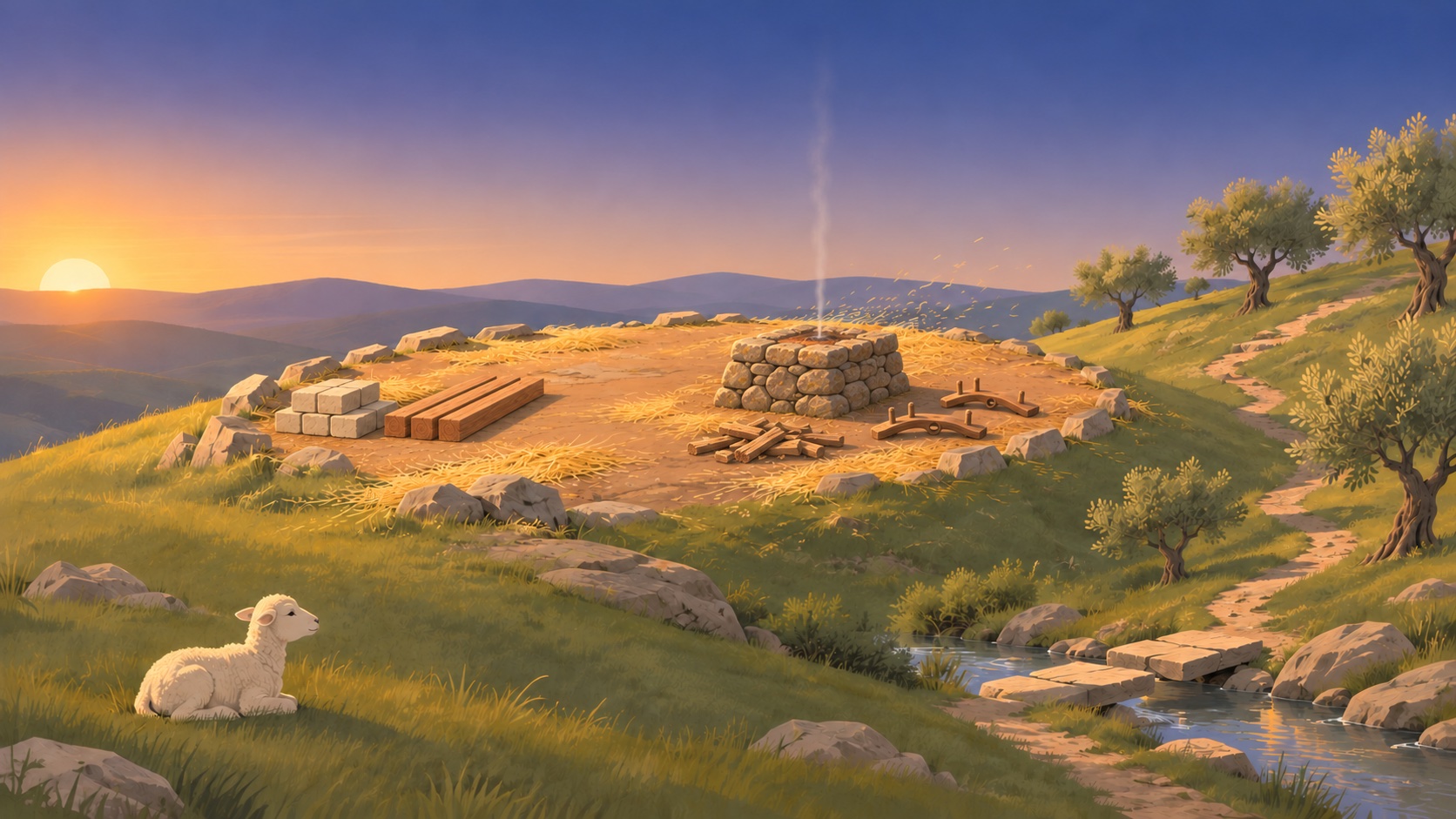
What's in this picture
- The altar on the threshing floor is the one David built on Araunah’s floor, with the sledges and the oxen’s yokes for wood (2 Sam. 24:22), when “the LORD was entreated for the land, and the plague was stayed” (2 Sam. 24:25): “neither will I offer burnt offerings unto the LORD my God of that which doth cost me nothing” (2 Sam. 24:24); Chronicles names it as the ground of the temple (2 Chr. 3:1).
- The dressed stones and cedar beams waiting at the edge of the floor are the house David wanted to build: “I dwell in an house of cedar, but the ark of God dwelleth within curtains” (2 Sam. 7:2); the LORD answered that his son “shall build an house for my name” (2 Sam. 7:13), and David gathered the materials for him (1 Chr. 22:5).
- The ewe lamb is Nathan’s parable of the poor man’s “one little ewe lamb” (2 Sam. 12:3), which brought David to “Thou art the man” (2 Sam. 12:7) and to “I have sinned against the LORD” (2 Sam. 12:13).
- The brook and the path up through the olives are the way David fled from Absalom: “all the country wept with a loud voice … the king also himself passed over the brook Kidron” and “went up by the ascent of mount Olivet, and wept as he went up” (2 Sam. 15:23; 2 Sam. 15:30).
The chapters
Twenty-four chapters in three parts. David becomes king over Judah and then all Israel, takes Jerusalem, brings up the ark, and receives the LORD's promise of a house for ever. He takes Bath-sheba and has Uriah killed, and Nathan tells him, “Thou art the man.” Then the sword never departs from his house: Amnon, Absalom's revolt, and the last troubles of his reign.
The LORD God of Hosts Was with Him
David mourns Saul and Jonathan and is anointed king of Judah at Hebron. Abner and Ish-bosheth are killed, and all Israel anoints David. He takes Jerusalem, brings up the ark, and the LORD promises him a house and a throne for ever. He shows kindness to Jonathan's son and subdues his enemies.
- 1 How Are the Mighty Fallen An Amalekite comes to Ziklag with Saul's crown and a story of how he killed the king; David mourns, has the man put to death for lifting his hand against the LORD's anointed, and makes a lament for Saul and Jonathan.
- 2 Shall the Sword Devour for Ever? David asks the LORD and goes up to Hebron, where Judah anoints him king, and he blesses the men of Jabesh-gilead for burying Saul; Abner makes Saul's son Ish-bosheth king over Israel; the two sides meet at the pool of Gibeon, Abner kills Asahel, and Abner calls on Joab to end the slaughter of brothers.
- 3 A Prince and a Great Man Fallen While David's house grows in Hebron, Abner quarrels with Ish-bosheth and offers to bring all Israel to David, until Joab murders him in the gate and David mourns him before the people.
- 4 Who Hath Redeemed My Soul out of All Adversity With Abner dead, two of Ish-bosheth's own captains kill him on his bed at noon and carry his head to Hebron, expecting a reward; David has them put to death for killing a righteous man in his own house, and buries the head in Abner's tomb.
- 5 The LORD God of Hosts Was with Him All the tribes come to Hebron and anoint David king over Israel; he takes the Jebusite stronghold of Zion and makes it the city of David, Hiram of Tyre builds him a house, sons are born to him in Jerusalem, and twice he asks the LORD before he fights the Philistines.
- 6 How Shall the Ark of the LORD Come to Me David sets out to bring the ark to Jerusalem on a new cart, and Uzzah dies for touching it; three months later the ark is carried up with sacrifice, music and dancing, and Michal, Saul's daughter, despises the king who danced.
- 7 He Will Make Thee an House David wants to build the LORD a house; through Nathan the LORD answers that He will build David a house instead, a son on his throne and a kingdom established for ever; and David goes in and sits before the LORD to give thanks.
- 8 The LORD Preserved David Whithersoever He Went David subdues the Philistines, Moab, the Syrian kingdoms of Zobah and Damascus, and Edom; he dedicates the spoil to the LORD, reigns with judgment and justice, and names the officers of his kingdom.
- 9 That I May Shew Him Kindness for Jonathan's Sake David, now king over all Israel, asks whether anyone of Saul's house is left; he finds Jonathan's lame son Mephibosheth, gives him back Saul's land, and seats him at the king's table for the rest of his life.
- 10 Be of Good Courage, and Let Us Play the Men David sends men to comfort the new king of Ammon for his father's death; Hanun's princes call them spies, and he shaves half their beards and cuts their garments; Joab and Abishai beat the Ammonites and their hired Syrians, and David defeats Hadarezer's army at Helam.
Thou Art the Man
David takes Bath-sheba and arranges the death of her husband, Uriah. Nathan tells him the parable of the ewe lamb, and David confesses. The child dies, and Solomon is born.
- 11 But David Tarried Still at Jerusalem While his army besieges Rabbah, David takes Bath-sheba, the wife of Uriah; when she conceives and Uriah will not go home, David sends him back to Joab with the letter that orders his death.
- 12 Thou Art the Man Nathan tells the king of a poor man's stolen lamb, lets him pass sentence, and turns the sentence on him; David confesses, the child dies, the LORD names Solomon, and Rabbah falls.
The Sword Shall Never Depart from Thine House
Amnon forces Tamar, and Absalom kills him, returns, and steals the hearts of Israel. David flees, Absalom is killed, and David weeps for him. Then Sheba's revolt, the Gibeonites, David's song and last words, his mighty men, and the census that ends at the threshing floor of Araunah.
- 13 Amnon and Tamar David's eldest son forces his half-sister Tamar and casts her out; the king is angry and does nothing; two years later Absalom has Amnon killed at a sheepshearing feast and flees to Geshur.
- 14 That His Banished Be Not Expelled Joab sends a wise woman of Tekoah to lay a made-up case before the king; David grants her son his life, sees that he has judged his own case, and lets Absalom come home, but will not see his face for two years, until Absalom forces the matter and the king kisses him.
- 15 Absalom Stole the Hearts of the Men of Israel Absalom wins the people at the city gate, has himself proclaimed king in Hebron, and draws Ahithophel to his side; David leaves Jerusalem on foot and weeping, sends the ark back, and sends his friend Hushai back to defeat Ahithophel's counsel.
- 16 Let Him Curse Fleeing Jerusalem, David is met by Ziba with provisions and an accusation and by Shimei with stones and a curse; in the city Hushai offers Absalom his service, and on Ahithophel's counsel Absalom takes his father's concubines on the palace roof.
- 17 The Good Counsel of Ahithophel Ahithophel would strike David that night; Hushai talks Absalom into delay; the priests' sons carry the warning, David crosses the Jordan, Ahithophel hangs himself, and friends feed David's people at Mahanaim.
- 18 O My Son Absalom David's army defeats Absalom's in the wood of Ephraim; Joab kills Absalom against the king's order; two runners carry the news to Mahanaim, and David weeps for his son.
- 19 Return Thou, and All Thy Servants Joab rouses the weeping king; Judah calls David home; at the Jordan he pardons Shimei, hears Mephibosheth, and parts from Barzillai; and Israel and Judah quarrel over who has the better right in him.
- 20 We Have No Part in David Sheba the Benjamite calls Israel away from David; Joab murders Amasa and pursues Sheba to Abel of Beth-maachah, where a wise woman saves her city by giving up the rebel's head.
- 21 Wherewith Shall I Make the Atonement? A famine is laid to Saul's broken oath with the Gibeonites; seven of his sons die for it, Rizpah guards their bodies until the rain, David buries Saul's house, and four giants of Gath fall to David's servants.
- 22 Thou Art My Lamp, O LORD David's song of thanksgiving for a life of rescues, the same song as Psalm 18, set near the close of his story; it ends with the LORD's mercy to His king and to David's seed for evermore.
- 23 The Last Words of David David's last oracle sets out the king God requires, just and ruling in the fear of God, and rests his house on the everlasting covenant; then the roll of his mighty men, the three, the water of Bethlehem, Abishai and Benaiah, and the thirty, ending with Uriah the Hittite.
- 24 That Which Doth Cost Me Nothing David numbers Israel against Joab's counsel, confesses, and chooses to fall into the LORD's hand; a pestilence sweeps the land until the angel is stayed at Jerusalem, and David buys Araunah's threshing floor and builds an altar there.
Themes
Ideas that run through many chapters, gathered in one place.
Beloved passages
- “The beauty of Israel is slain upon thy high places: how are the mighty fallen!”2 Samuel 1:19
- “thy throne shall be established for ever”2 Samuel 7:16
- “Thou art the man”2 Samuel 12:7
- “O my son Absalom, my son, my son Absalom! would God I had died for thee”2 Samuel 18:33
- “neither will I offer burnt offerings unto the LORD my God of that which doth cost me nothing”2 Samuel 24:24
Most-used sources
Every note cites its sources. These are the ones this commentary leans on most.
- “Samuel, books of”, Bible Dictionary.
- “David”, Bible Dictionary.
- Robbie Taggart, ““I Have Sworn unto David My Servant”: The Davidic Covenant as Manifestation of God’s Ḥesed”, In Tender Mercies and Loving-Kindness: The Goodness of God in the Old Testament, ed. David Rolph Seely, Jo Ann H. Seely, Joshua M. Sears, Joshua M. Matson, and Beverly Yellowhorse (Religious Studies Center, Brigham Young University; Deseret Book, 2025), 107–124.
- Monte S. Nyman, “The Contribution of the JST to the Old Testament Historical Books”, In The Joseph Smith Translation: The Restoration of Plain and Precious Truths, ed. Monte S. Nyman and Robert L. Millet (Provo, UT: Religious Studies Center, Brigham Young University, 1985), 89–102.