Nehemiah
“I am doing a great work, so that I cannot come down.” Neh. 6:3
The book of Nehemiah opens in the Persian palace at Shushan, “in the twentieth year” of King Artaxerxes (Neh. 1:1; Neh. 2:1), some thirteen years after Ezra came to Jerusalem. Nehemiah, “the king’s cupbearer” (Neh. 1:11), hears that “the wall of Jerusalem also is broken down, and the gates thereof are burned with fire” (Neh. 1:3), and he sits down and weeps, fasts, and prays. The king sends him to Judah as governor, and he tells the people, “come, and let us build up the wall of Jerusalem, that we be no more a reproach” (Neh. 2:17). They build with their enemies mocking and plotting, “every one with one of his hands wrought in the work, and with the other hand held a weapon” (Neh. 4:17), and when those enemies invite Nehemiah to a meeting he answers, “I am doing a great work, so that I cannot come down” (Neh. 6:3). The wall is finished “in fifty and two days” (Neh. 6:15).
Then the book turns from the wall to the people inside it. Ezra reads the law from a pulpit of wood, and the Levites “gave the sense, and caused them to understand the reading” (Neh. 8:8); the people weep, and are told, “neither be ye sorry; for the joy of the LORD is your strength” (Neh. 8:10). They keep the Feast of Tabernacles, confess the whole history of Israel before a God “ready to pardon, gracious and merciful, slow to anger, and of great kindness” (Neh. 9:17), and “make a sure covenant, and write it” (Neh. 9:38). The last chapters fill the city, dedicate the wall so that “the joy of Jerusalem was heard even afar off” (Neh. 12:43), and then show Nehemiah, back from the king, finding the covenant already broken and setting it right again. Most of the book is told in his own voice, and it ends on his own prayer: “Remember me, O my God, for good” (Neh. 13:31). This companion goes through all thirteen chapters and tries to anticipate the questions a careful reader would ask.
For the Persian kings, the return and the rebuilding of Jerusalem, see A Timeline of the Old Testament and Persia and the Return.
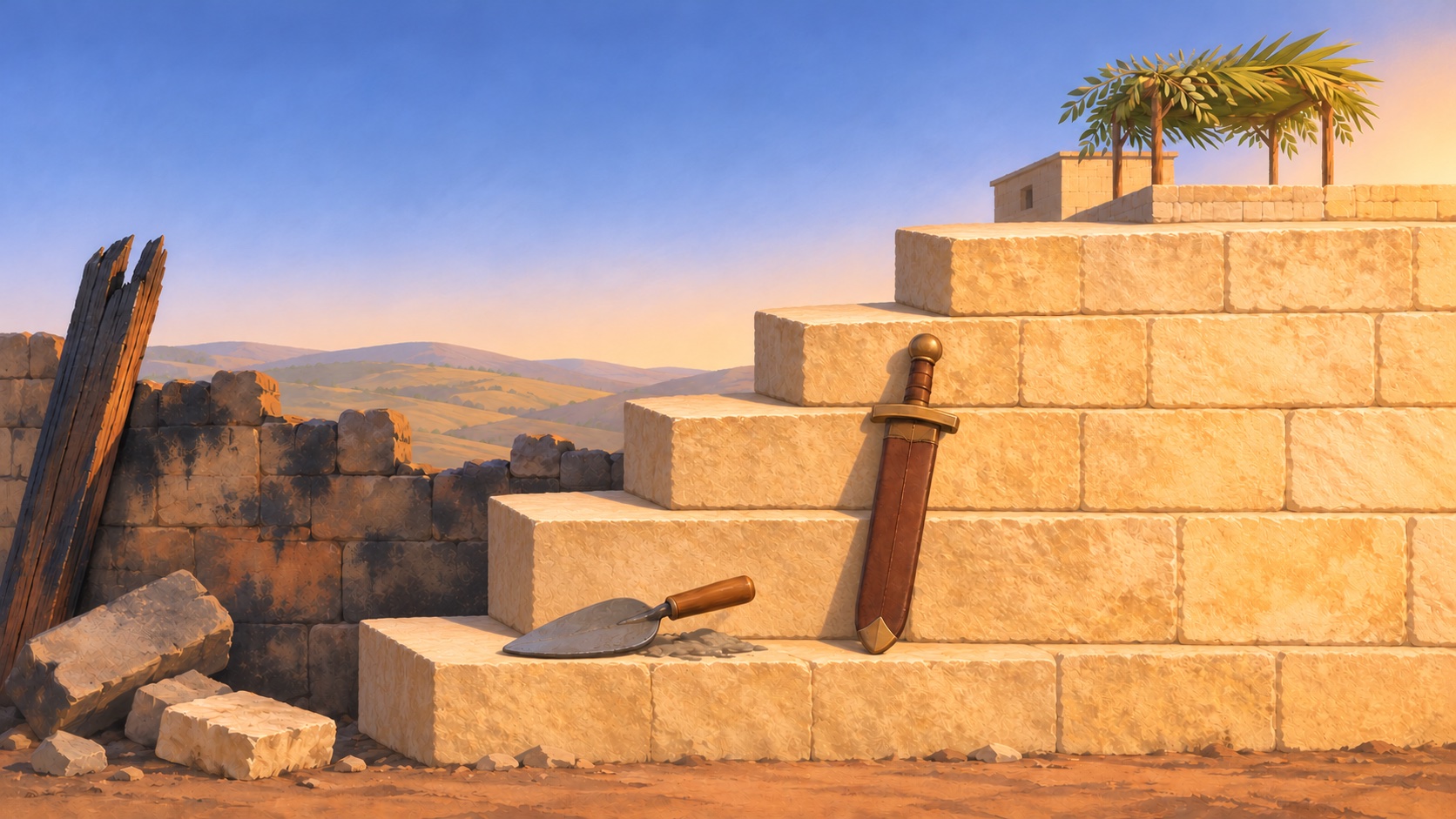
What's in this picture
- The blackened wall and the fallen blocks on the left are Jerusalem as Nehemiah heard of it in Persia: “the wall of Jerusalem also is broken down, and the gates thereof are burned with fire” (Neh. 1:3). He sat down and wept, and then he prayed.
- The charred timbers leaning on the ruin are what was left of the gates, which he found “consumed with fire” when he rode out by night to look (Neh. 2:13).
- The new pale stone, rising in steps, is the wall going up, not yet done. Nehemiah told the people, “come, and let us build up the wall of Jerusalem, that we be no more a reproach,” and they answered, “Let us rise up and build” (Neh. 2:17–18). It was finished “in fifty and two days” (Neh. 6:15).
- The trowel and the sword, side by side on the newest stone, are how it was built while enemies threatened: “every one with one of his hands wrought in the work, and with the other hand held a weapon” (Neh. 4:17). The people prayed, worked and kept watch at once: “we made our prayer unto our God, and set a watch against them day and night” (Neh. 4:9).
- The booth of green branches on the rooftop is from the Feast of Tabernacles, kept after Ezra read the law inside the finished wall. The people “made themselves booths, every one upon the roof of his house” (Neh. 8:16), “and there was very great gladness” (Neh. 8:17). With the wall standing, the people gathered inside it to hear the law and keep the feast.
The chapters
The king’s cupbearer rebuilds the wall of Jerusalem in fifty-two days; then the people hear the law read, confess, and bind themselves by covenant; then the city is filled, the wall dedicated, and the covenant tested.
The Wall Rebuilt
Nehemiah weeps and prays in Shushan, comes to Jerusalem with the king’s letters, and sets every family to build its part of the wall. He answers mockery, threats and plots with prayer and a guard, stops the nobles from taking usury of their brethren, finishes the wall in fifty-two days, and finds the register of those who first came back.
- 1 Remember, I Beseech Thee, the Word In the Persian palace at Shushan the king’s cupbearer hears that Jerusalem’s wall still lies broken, and he weeps, fasts and prays, holding God to His word to Moses and asking for mercy before the king.
- 2 Let Us Rise Up and Build The king’s cupbearer, sad before the king, prays and asks to be sent to rebuild Jerusalem. He comes with letters and an escort, looks over the broken walls by night, and calls the people to build, while three officials of the region mock.
- 3 Next unto Him Builded Nehemiah sets down who built each stretch of Jerusalem’s wall, from the high priest at the sheep gate around the city and back again, and one company of nobles who would not bend their necks to the work.
- 4 A Mind to Work Sanballat and Tobiah mock the builders and then plot an attack. Nehemiah prays, sets a watch, and arms the people, and the wall goes up with a weapon in every builder’s reach.
- 5 Will Ye Even Sell Your Brethren? While the wall goes up, the poor cry out against their own brethren. Nehemiah calls an assembly, makes the creditors swear to give back what they hold, and tells how for twelve years he never took the governor's bread.
- 6 This Work Was Wrought of Our God Nehemiah's enemies try to draw him out of the city, accuse him of rebellion, and hire a prophet to frighten him into the temple. He will not come down, and the wall is finished in fifty-two days.
- 7 A Register of the Genealogy With the wall finished and the gates guarded, Nehemiah finds a city with room for many and few to live in it, and God moves him to begin with a record of who belongs. He finds the register of the first return and copies it.
The Law Read and the Covenant Made
Ezra reads the law to all who can understand, and the people weep, rejoice, and keep the Feast of Tabernacles. They confess their fathers’ sins and God’s mercies from the Creation on, and seal a written covenant to keep the law, the Sabbath and the house of God.
- 8 The Joy of the LORD Is Your Strength With the wall finished, the people ask Ezra for the book of the law. He reads it from a wooden tower while the Levites make its meaning plain; the people weep and are told to feast instead, and when they find the booths written in the law they build them, as the whole congregation had not done since Joshua.
- 9 A God Ready to Pardon Two days after the feast the people fast, read the law and confess, and the Levites retell Israel's history from the Creation to their own servitude, a record of rebellion answered each time by a God who would not forsake them. It ends in a written, sealed covenant.
- 10 A Sure Covenant The leaders set their seals to the covenant written at the end of the great fast, and the rest of the people, wives and children who could understand among them, swear to keep the law of Moses. Then come the terms, which end in a promise not to forsake the house of God.
The City Filled and the Covenant Kept
A tenth of the people come to live in Jerusalem, and the wall is dedicated with two companies singing along its top. Nehemiah returns from the king to find Tobiah lodged in the temple, the Levites unpaid, the Sabbath sold and the marriages mixed again, and he sets each right.
- 11 One of Ten to Dwell in Jerusalem The wall stands around a half-empty city. The people cast lots to bring one in ten of them into Jerusalem, bless those who go willingly, and the chapter records who lived in the holy city and in the towns of Judah and Benjamin.
- 12 The Joy of Jerusalem Was Heard Even Afar Off The priests and Levites are listed from the first return down to Jaddua. Then the wall is dedicated, with two thanksgiving choirs walking it in procession, and Judah gives the portions of the law gladly.
- 13 Remember Me, O My God, for Good Back from the king, Nehemiah finds the covenant of chapter 10 slipping. An Ammonite is lodged in the temple, the Levites are unpaid, the Sabbath has become a market day, and men have made the marriages they swore off. He sets each right and ends his book asking God to remember him for good.
Themes
Ideas that run through many chapters, gathered in one place.
Beloved passages
- “I sat down and wept, and mourned certain days, and fasted, and prayed”Nehemiah 1:4
- “So I prayed to the God of heaven”Nehemiah 2:4
- “Let us rise up and build”Nehemiah 2:18
- “for the people had a mind to work”Nehemiah 4:6
- “I am doing a great work, so that I cannot come down”Nehemiah 6:3
- “the joy of the LORD is your strength”Nehemiah 8:10
- “thou art a God ready to pardon, gracious and merciful, slow to anger, and of great kindness”Nehemiah 9:17
- “Remember me, O my God, for good”Nehemiah 13:31
Most-used sources
Every note cites its sources. These are the ones this commentary leans on most.
- “Nehemiah”, Bible Dictionary.
- Ezra 1; 3–7; Nehemiah 2; 4–6; 8, Scripture Helps: Old Testament.
- “Ezra”, Bible Dictionary.