Numbers
“The LORD bless thee, and keep thee: The LORD make his face shine upon thee, and be gracious unto thee: The LORD lift up his countenance upon thee, and give thee peace.” The priestly blessing, Num. 6:24–26
Numbers takes Israel from Sinai to the edge of the promised land. Its Hebrew name is “In the wilderness,” from its first verse, “the LORD spake unto Moses in the wilderness of Sinai” (Num. 1:1). Its English name comes from the two times the people are counted, at Sinai and again forty years later on the plains of Moab. Between the two counts a whole generation dies. At Kadesh the people believed the spies who said the land could not be taken, and the Lord said of them, “They shall surely die in the wilderness” (Num. 26:65). Only Caleb and Joshua, who said “the LORD is with us: fear them not” (Num. 14:9), were spared that sentence.
The book is full of murmuring, and of the Lord's answers to it. Manna falls every morning, the cloud lifts and settles over the tabernacle, and Moses intercedes again and again. When the people are bitten by fiery serpents, Moses lifts up a serpent of brass, so “that every one that is bitten, when he looketh upon it, shall live” (Num. 21:8). The Savior used that serpent to describe His own lifting up (John 3:14–15), and Book of Mormon prophets used it to teach faith in Him (Alma 33:19–22; Hel. 8:14–15). Numbers also holds the blessing Aaron's sons were to speak over Israel (Num. 6:24–26), Moses' wish “that all the LORD’s people were prophets” (Num. 11:29), and Balaam's “Star out of Jacob” (Num. 24:17). This companion goes through all thirty-six chapters and tries to anticipate the questions a careful reader would ask, the hard ones included: how many came out of Egypt, why Moses was barred from the land, and what is to be made of Balaam.
For the priests and the Levites, see The Law, the Covenant and the Temple; for the land the tribes were given on both sides of the Jordan, see The Land.
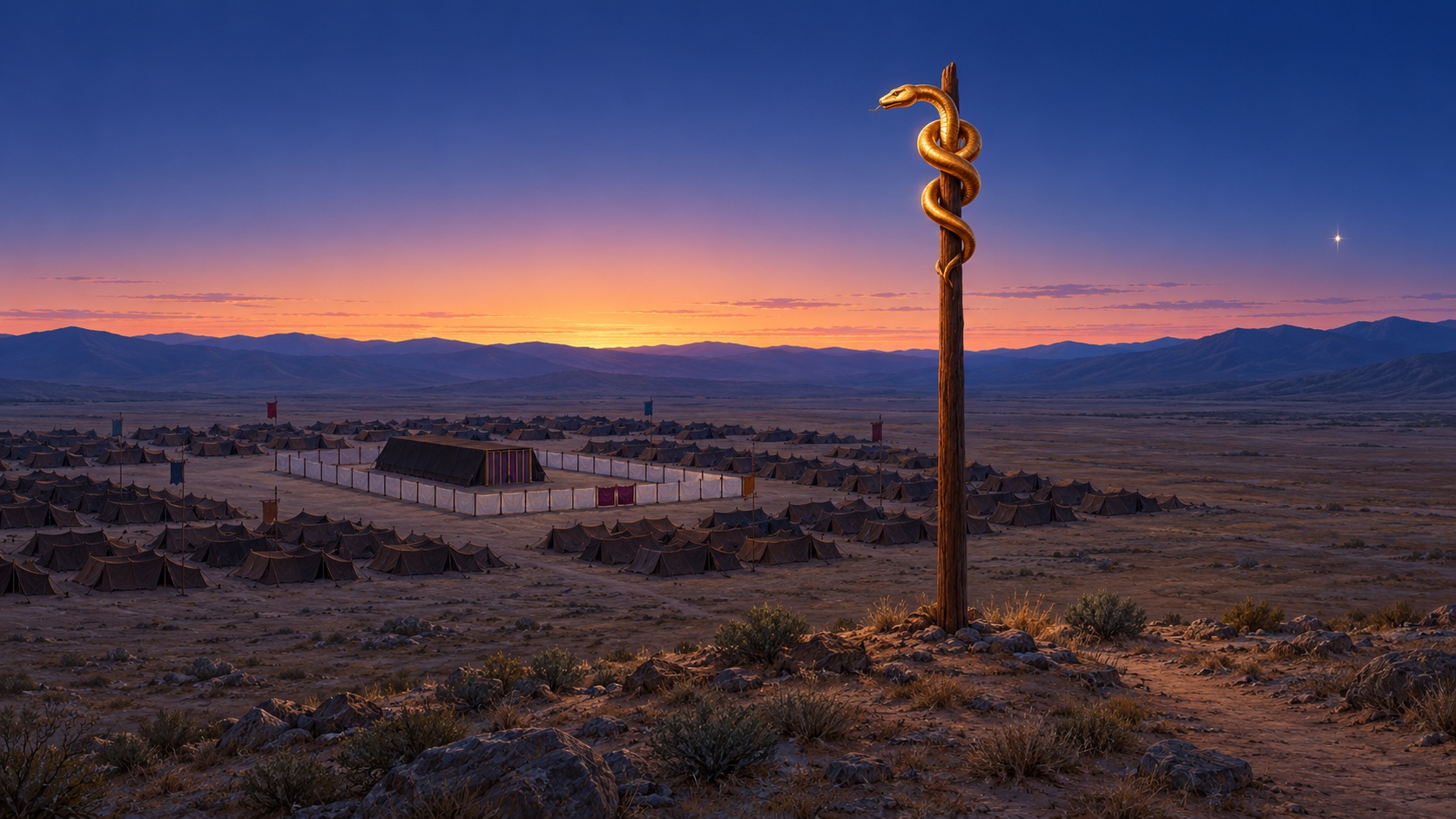
What's in this picture
- The brass serpent on the pole is the remedy the LORD gave when fiery serpents bit the people: “Make thee a fiery serpent, and set it upon a pole: and it shall come to pass, that every one that is bitten, when he looketh upon it, shall live” (Num. 21:8). Jesus took it as a figure of Himself: “As Moses lifted up the serpent in the wilderness, even so must the Son of man be lifted up” (John 3:14).
- The camp around the white court is Israel camped by tribes with the tabernacle in the middle: “Every man of the children of Israel shall pitch by his own standard, with the ensign of their father’s house: far off about the tabernacle of the congregation shall they pitch” (Num. 2:2).
- The banners above the tents are the standards by which the tribes camped and marched, “every man in his place by their standards” (Num. 2:17).
- The star over the hills is Balaam’s prophecy: “there shall come a Star out of Jacob, and a Sceptre shall rise out of Israel” (Num. 24:17).
The chapters
Thirty-six chapters in five parts. Israel is counted and ordered at Sinai, then sets out and refuses the land at Kadesh. Through the wilderness years the people rebel and are rescued, and the first generation dies. On the plains of Moab, Balaam blesses the camp he was hired to curse, and a new generation is counted and readied for the land.
Ordered at Sinai
The men of war are counted, the tribes are set around the tabernacle, and the Levites are taken in place of the firstborn. The princes bring their offerings, the priests are given a blessing to speak over Israel, and the cloud lifts. In the second year after Egypt, Israel sets out.
- 1 Every Man by Name At Sinai the LORD has Moses and Aaron, with a prince from every tribe, count the men of Israel who can go to war. They number 603,550. Levi is not counted with them, for Levi is given the tabernacle to carry and to guard.
- 2 Every Man in His Place The men counted in chapter 1 are given their places. Twelve tribes camp in four groups of three, one group on each side of the tabernacle, with the Levites between, and they march in the same order in which they camp.
- 3 Instead of All the Firstborn Aaron's sons are named as the priests, the tribe of Levi is given to them, and the Levites are counted from a month old to stand in the place of Israel's firstborn.
- 4 The Burden of the Sons of Levi Before the camp moves, Aaron and his sons wrap each holy thing of the tabernacle; then the three families of Levi carry it, each its own load. Moses counts the men from thirty to fifty who can bear it, 8,580 of them.
- 5 The Unclean, the Wronged, and the Suspected Wife The camp where the LORD dwells is kept clean, a wrong to a neighbour is confessed and repaid, and a wife suspected of adultery with no witness is set before the LORD for His judgment.
- 6 Holy unto the LORD Any man or woman of Israel may vow to be a Nazarite for a time, keeping from every fruit of the vine, letting the hair grow, and keeping away from the dead. Then the LORD gives Aaron and his sons the words with which to bless the people and put His name upon them.
- 7 Gifts for the Altar On the day the tabernacle is set up and anointed, the twelve princes of Israel bring wagons and oxen to carry it, and then, one a day for twelve days, the same gifts for the dedication of the altar. When Moses goes in to speak with the LORD, he hears the voice from above the mercy seat.
- 8 Offered Before the LORD Aaron sets the seven lamps to shine across the holy place. Then the Levites are cleansed, the people lay their hands on them, and Aaron presents the whole tribe to the LORD as Israel's offering, to serve at the tabernacle in place of the firstborn.
- 9 At the Commandment of the LORD At Sinai Israel keeps the Passover, and men made unclean by a death ask why they must be left out; the LORD answers with a second Passover a month later. Then the cloud on the tabernacle directs every move of the camp.
- 10 The Camp Sets Out Two silver trumpets are made to call the people and to move the camps. Then the cloud lifts from the tabernacle, the tribes march out of Sinai in their order, Moses asks Hobab to be Israel's eyes, and the ark goes ahead to find a resting place.
The Refusal at Kadesh
The people complain of the manna, and seventy elders receive the spirit that was on Moses. Miriam and Aaron speak against him, and the Lord defends His servant. Twelve men search the land, ten bring an evil report, and the people refuse to go up. The Lord pardons them, but that generation will die in the wilderness.
- 11 Flesh to Eat, and the Spirit Shared On the way from Sinai the people complain, and fire burns at the edge of the camp. Then they weep for the food of Egypt, and Moses tells the LORD the burden is too heavy. The LORD puts Moses' spirit on seventy elders and sends quails until the people sicken of them.
- 12 My Servant Moses Miriam and Aaron speak against Moses and claim that the LORD speaks by them too. The LORD calls the three to the tabernacle, sets Moses above every prophet of visions and dreams, and Miriam is struck with leprosy. Moses prays for her, and the camp waits seven days until she comes back.
- 13 Grapes and Giants From the wilderness of Paran Moses sends a ruler from each tribe to search Canaan. After forty days they return to Kadesh with a cluster of grapes so large that two men carry it, and all twelve agree the land is good. Ten say it cannot be taken; Caleb says, “Let us go up at once.”
- 14 The Refusal at Kadesh The people weep through the night and talk of choosing a captain to lead them back to Egypt. Moses pleads for them, and the LORD pardons, but He swears that the generation that would not go up will die in the wilderness. The next morning the people go up anyway, without the ark, and are beaten back to Hormah.
The Wilderness Years
Laws for the land to come, a rebellion against Moses and Aaron, and Aaron's rod that budded. The ashes of a red heifer cleanse those defiled by the dead. Miriam dies, Moses strikes the rock at Meribah and is told he will not enter the land, and Aaron dies on mount Hor. The brass serpent is lifted up, and Sihon and Og fall.
- 15 Error, Defiance, and a Cord of Blue After the sentence at Kadesh, the LORD speaks of worship “when ye be come into the land.” He provides forgiveness for sins done in error and cuts off the one who sins with a high hand, a man is stoned for gathering sticks on the Sabbath, and Israel is given tassels to look on and remember.
- 16 Who Is Holy Korah, a Levite, and three Reubenites lead two hundred and fifty princes against Moses and Aaron, saying that all the congregation is holy. The earth swallows the households of the rebels, fire consumes the men with censers, and when the people murmur again Aaron runs among them with incense and stands between the dead and the living.
- 17 Bloomed Blossoms, and Yielded Almonds After Korah's rebellion and the plague, the LORD settles who may come near Him with a sign that harms no one. Twelve princes' rods lie overnight before the testimony, and the one with Aaron's name buds, blossoms and bears almonds. It is kept as a warning to the rebellious, and the people cry out that anyone who comes near the tabernacle will die.
- 18 The Priests' Charge and the Levites' Tithe After the people cry that whoever comes near the tabernacle will die, the LORD speaks to Aaron. The priests and Levites will guard the sanctuary and answer for it; they will live on Israel's holy gifts and tithes; and in place of land, the LORD Himself is their inheritance.
- 19 The Red Heifer and the Water of Separation The ashes of a red heifer, burned outside the camp, are kept and mixed with living water to cleanse anyone the dead have made unclean.
- 20 The Water of Meribah Miriam dies at Kadesh; Moses strikes the rock he was told to speak to, and he and Aaron are told they will not bring Israel into the land; Edom refuses its brother passage; and on mount Hor Aaron's garments are put on Eleazar, and Aaron dies.
- 21 Look upon It, and Live Bitten in the wilderness, Israel is healed by looking at a serpent of brass on a pole; then the road turns north, the old songs are sung, and the first kings fall.
Balaam and Baal-peor
The king of Moab hires Balaam to curse Israel, and the Lord turns each curse into a blessing, the last of them a star out of Jacob. Then, at Baal-peor, Israel joins itself to Moab's god, and Phinehas stays the plague.
- 22 The Word That God Putteth in My Mouth Balak king of Moab sends for Balaam to curse Israel. The LORD says no, then lets him go on one condition, and on the road an angel with a drawn sword stands in the way, seen by the ass and not by the seer.
- 23 How Shall I Curse, Whom God Hath Not Cursed? Balak builds altars on one height after another and waits for a curse; twice the LORD puts a word in Balaam's mouth, and twice it is a blessing that cannot be reversed.
- 24 A Star out of Jacob Balaam stops looking for omens, the Spirit of God comes upon him, and the man hired to curse Israel blesses it a third time, then sees a Star and a Sceptre rise out of Jacob.
- 25 Joined unto Baal-peor At Shittim Israel is drawn into Moab's feasts and Moab's god; a plague falls, Phinehas stays it, and the LORD gives him a covenant of peace.
The New Generation
A second census finds none of the first generation left but Caleb and Joshua. The daughters of Zelophehad receive their father's inheritance, and Joshua is set before the congregation. Then come the offerings for the year, the law of vows, the war on Midian, the tribes east of Jordan, the journeys, the borders, and the cities of refuge.
- 26 Not a Man of Them Left On the plains of Moab, Moses and Eleazar count Israel again, tribe by tribe and family by family. The total is almost what it was at Sinai, but the men are not the same: of all those counted there, only Caleb and Joshua remain.
- 27 The Daughters Speak Right Five daughters ask for their father's inheritance and the LORD gives Israel a law; Moses is told he will see the land and die, and Joshua is set apart to lead.
- 28 Morning and Evening, Sabbath and New Moon On the plains of Moab the LORD sets out what Israel is to offer Him at every appointed time, from the lamb of each morning and evening to the feasts of the spring.
- 29 The Offerings of the Seventh Month The day of trumpets, the Day of Atonement and the feast of Tabernacles each have their own count of bullocks, rams, lambs and goats; at Tabernacles the bullocks fall by one a day, from thirteen to seven.
- 30 He Shall Not Break His Word A vow spoken to the LORD must be kept; a daughter's or a wife's vow stands unless her father or husband sets it aside on the day he hears it, and a widow answers for her own.
- 31 Avenge the LORD of Midian Before Moses is gathered to his people, Israel fights the Midianites of Peor; Balaam dies, the captives are judged, the warriors are cleansed, the spoil is shared, and the officers bring gold because not one man was lost.
- 32 Shall Ye Sit Here? Reuben and Gad ask for the cattle country east of the Jordan; Moses hears the refusal at Kadesh again, and the land is given on a promise to fight beside their brethren.
- 33 Their Goings Out On the plains of Moab, Moses writes down the places Israel set out from, from Rameses in Egypt to the Jordan; then the LORD tells them what to do when they cross, and what will happen if they do not.
- 34 The Land with the Coasts Thereof Before Israel crosses the Jordan, the LORD draws the borders of the land they will inherit and names the men who will divide it.
- 35 Cities for the Levites, Cities of Refuge The tribe with no land is given forty-eight cities among the others, and six of them become places where a man who has killed without intent can live until the high priest dies.
- 36 Within the Tribe of Their Father The men of Zelophehad's clan ask what becomes of the daughters' land if they marry into another tribe. The LORD answers that both sides speak right, and the daughters marry within Manasseh.
Themes
Ideas that run through many chapters, gathered in one place.
Beloved passages
- “The LORD bless thee, and keep thee”Numbers 6:24
- “The LORD lift up his countenance upon thee, and give thee peace”Numbers 6:26
- “would God that all the LORD’s people were prophets, and that the LORD would put his spirit upon them”Numbers 11:29
- “the man Moses was very meek, above all the men which were upon the face of the earth”Numbers 12:3
- “rebel not ye against the LORD, neither fear ye the people of the land”Numbers 14:9
- “my servant Caleb, because he had another spirit with him, and hath followed me fully”Numbers 14:24
- “every one that is bitten, when he looketh upon it, shall live”Numbers 21:8
- “God is not a man, that he should lie”Numbers 23:19
- “there shall come a Star out of Jacob, and a Sceptre shall rise out of Israel”Numbers 24:17
- “be sure your sin will find you out”Numbers 32:23
Most-used sources
Every note cites its sources. These are the ones this commentary leans on most.
- “Numbers”, Bible Dictionary.
- Numbers 11–14; 20–24; 27, Scripture Helps: Old Testament (2025).
- Dana M. Pike, “Balaam in the Book of Numbers”, In From Creation to Sinai: The Old Testament through the Lens of the Restoration, ed. Daniel L. Belnap and Aaron P. Schade (Provo, UT: Religious Studies Center, Brigham Young University; Salt Lake City: Deseret Book, 2021), 561–98.
- Noe Correa, Old Testament Minute: Numbers, Ed. Taylor Halverson (Springville, UT: Book of Mormon Central, 2022); on Scripture Central’s archive (Numbers 11–14; 20–24; 27).