The standard works
Old Testament
The books of the Old Testament on this site so far. The whole Old Testament is in the Gospel Library, with footnotes and study helps.
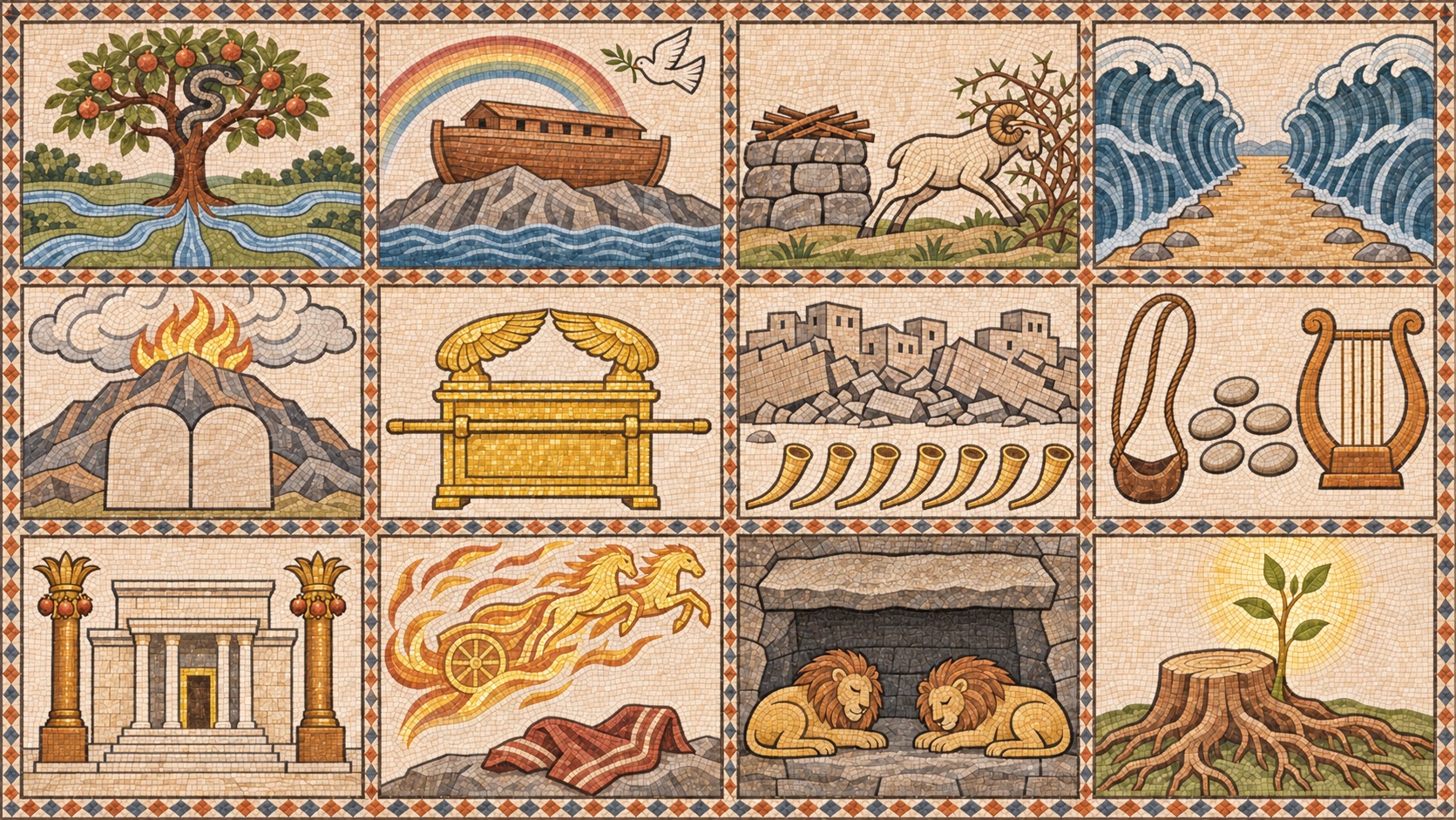
What's in this picture
- The tree with a serpent in it, and the river parting below it, are the garden of Eden: “a river went out of Eden to water the garden; and from thence it was parted, and became into four heads” (Gen. 2:10; Gen. 3:1).
- The ark on the mountain under a rainbow, and the dove, are the end of the flood and God’s covenant with Noah: “lo, in her mouth was an olive leaf plucked off” and “I do set my bow in the cloud” (Gen. 8:11; Gen. 9:13).
- The altar and the ram caught in the thicket are Abraham’s offering of Isaac, and the ram the Lord provided in his place: “behold behind him a ram caught in a thicket by his horns” (Gen. 22:13).
- The sea parted into two walls is Israel’s deliverance from Egypt: “the waters were a wall unto them on their right hand, and on their left” (Ex. 14:22).
- The mountain in fire and cloud, and the two stone tablets, are the covenant at Sinai: “I will give thee tables of stone, and a law, and commandments” (Ex. 19:18; Ex. 24:12).
- The golden ark with wings over its lid is the ark of the covenant, where the Lord met His people: “the cherubims shall stretch forth their wings on high, covering the mercy seat” (Ex. 25:20).
- The fallen walls and the seven ram’s horns are Jericho, the first city Israel took in the promised land: “seven trumpets of rams’ horns” and “the wall fell down flat” (Josh. 6:4; Josh. 6:20).
- The sling, the bag, the five stones and the harp are David, the shepherd who became king: “five smooth stones out of the brook,” and “David took an harp, and played with his hand” (1 Sam. 17:40; 1 Sam. 16:23).
- The temple between two bronze pillars is the house Solomon built for the Lord: “he set up the pillars in the porch of the temple,” with “lily work” on their tops (1 Kgs. 7:21–22).
- The chariot of fire, and the cloak fallen below it, are Elijah’s going up into heaven, and the mantle he left for Elisha: “there appeared a chariot of fire, and horses of fire … and Elijah went up by a whirlwind into heaven” (2 Kgs. 2:11; 2 Kgs. 2:13).
- The lions lying quietly in a sealed den are Daniel, faithful in exile in Babylon: “a stone was brought, and laid upon the mouth of the den,” and God “hath shut the lions’ mouths” (Dan. 6:17; Dan. 6:22).
- The shoot growing from a cut-down stump is the promise of the Messiah, a king from David’s fallen line: “there shall come forth a rod out of the stem of Jesse, and a Branch shall grow out of his roots” (Isa. 11:1).
Books
The Law
- Genesis50 chaptersThe book of beginnings, from the Creation to the family of Abraham, Isaac, Jacob, and Joseph.
- Exodus40 chaptersIsrael brought out of Egypt by the blood of a lamb and through the sea, the covenant and the commandments at Sinai, and the tabernacle built so that the Lord could dwell among His people.
- Leviticus27 chaptersThe law given from the tabernacle at Sinai. It covers the offerings and the priests, the clean and the unclean, and the Day of Atonement, and it calls Israel to be holy because the Lord is holy. Its offerings pointed to the sacrifice of Jesus Christ.
- Numbers36 chaptersIsrael's forty years between Sinai and the Jordan. The people are counted twice, a generation that will not enter the land is replaced by its children, and the Lord leads them by the cloud. The book holds the priestly blessing, the brass serpent the Savior compared to Himself, and Balaam's star out of Jacob.
- Deuteronomy34 chaptersMoses' farewell to Israel on the plains of Moab. He retells the journey, repeats the law, and renews the covenant with a new generation. The book holds the commandment the Savior called the first and great one, and Moses' promise of a prophet like unto him.
History
- Joshua24 chaptersIsrael enters the promised land under Moses' successor. The Jordan parts, the walls of Jericho fall, the land is divided among the tribes, and Joshua calls on Israel to choose whom they will serve.
- Judges21 chaptersIsrael in the land after Joshua. The people forget the Lord and fall to their enemies, cry to Him, and are delivered by judges such as Deborah, Gideon, Jephthah and Samson, again and again, until there is no king in Israel and every man does what is right in his own eyes.
- Ruth4 chaptersIn the days of the judges, a Moabite widow follows her mother-in-law to Bethlehem, gleans in the field of a kinsman, and becomes the great-grandmother of King David.
- 1 Samuel31 chaptersHannah's son becomes the prophet who anoints Israel's first two kings, Saul, who is rejected, and David, the shepherd the LORD chose for his heart.
- 2 Samuel24 chaptersDavid reigns over all Israel, receives the promise of a throne for ever, falls with Bath-sheba and Uriah, and lives to see his sin's cost in his own house.
- 1 Kings22 chaptersSolomon builds and dedicates the temple and turns from the LORD, the kingdom divides, and Elijah stands against Ahab and Baal.
- 2 Kings25 chaptersElisha takes up Elijah's mantle, Assyria carries the ten tribes away, Hezekiah and Josiah turn Judah back to the LORD, and Babylon destroys Jerusalem.
- 1 Chronicles29 chaptersThe history from Adam to David retold for the people who came back from exile, with the ark brought to Jerusalem and David preparing the temple.
- 2 Chronicles36 chaptersSolomon's temple and the kings of Judah, from the glory that filled the house to its burning, Manasseh's repentance, and Cyrus's word to go up and build again.
- Ezra10 chaptersThe return from Babylon, the rebuilding of the Lord’s house in Jerusalem, and the scribe who “prepared his heart to seek the law of the LORD, and to do it, and to teach” it.
- Nehemiah13 chaptersThe cupbearer who wept over Jerusalem’s broken wall, rebuilt it with a tool in one hand and a weapon in the other, and stood by while Ezra read the law to a people who learned that “the joy of the LORD is your strength.”
- Esther10 chaptersThe queen who hid her people until the day she had to name them, the decree that could not be revoked, and a book that never names God yet shows His hand in a sleepless night and a fast of three days.
Poetry and wisdom
- Job42 chaptersA righteous man loses his children, his wealth and his health, and his friends are sure it is punishment for sin. Job will not say so, and from the ash heap he testifies, “I know that my redeemer liveth.”
- Psalms150 psalmsIsrael’s book of praises, a hundred and fifty prayers and songs sung at the temple, quoted in the New Testament more than any other book of the Old, and on the Savior’s lips at the cross.
- Proverbs31 chaptersIsrael's book of wisdom, gathered over centuries under Solomon's name. A father teaches his son, Wisdom calls in the streets, and hundreds of two-line sayings weigh the wise against the fool, all resting on “the fear of the LORD.”
- Ecclesiastes12 chaptersThe Preacher's search for what lasts “under the sun.” Pleasure, great works, riches and wisdom all pass like a breath, and the book ends with “the whole duty of man”: fear God, and keep His commandments.
- Song of Solomon8 chaptersLove poems under Solomon's name, which the Joseph Smith Translation manuscript calls “not inspired writings.” A woman and a man long for each other, search, and praise each other, and the book ends with love “strong as death.”
The major prophets
- Isaiah66 chaptersThe prophet the Savior told us to search diligently, one phrase at a time.
- Jeremiah52 chaptersThe prophet of Jerusalem’s last forty years, who preached in the city Lehi left.
- Lamentations5 chaptersFive poems of grief over the fall of Jerusalem, with hope in the Lord’s mercies at their center.
- Ezekiel48 chaptersThe priest among the captives in Babylon, who saw the glory of the Lord leave the temple and return.
- Daniel12 chaptersA captive who served the kings of Babylon and kept faith with his God, and who was shown the kingdoms of the world giving way to the kingdom of God.
The minor prophets
- Hosea14 chaptersA prophet of the northern kingdom in its last years, whose marriage became a picture of the Lord’s love for a people who had left Him.
- Joel3 chaptersA prophet of Judah who saw the day of the Lord in a plague of locusts, and whose promise of the Spirit poured out on all flesh was quoted by Peter at Pentecost and by Moroni to Joseph Smith.
- Amos9 chaptersA herdsman from Judah sent to the prosperous northern kingdom. He charged it with crushing the poor while its shrines were full, and he taught that the Lord does nothing without revealing His secret to His servants the prophets.
- Obadiah1 chapterThe shortest book in the Old Testament. Obadiah foretold the fall of Edom, which joined in when Jerusalem fell. His last verse, of saviours on mount Zion, is one Joseph Smith taught is fulfilled in ordinances for the dead.
- Jonah4 chaptersA prophet of Israel sent to preach to Nineveh, the city of Israel’s enemies. He ran, was swallowed by a great fish, and was angry when the city repented. The Lord asked him why He should not spare it.
- Micah7 chaptersA prophet from the Judean countryside, Isaiah’s contemporary, who warned that Jerusalem would be plowed as a field, foretold a ruler born in Bethlehem, and summed up what the Lord requires.
- Nahum3 chaptersA prophet of Judah who foretold the fall of Nineveh, the capital of Assyria, a century after Jonah preached there. His name means “comforter,” and his comfort to Judah was that its oppressor would trouble it no more.
- Habakkuk3 chaptersA prophet who questioned the Lord. Why does violence go unpunished, and why use the Babylonians to punish Judah? The answer was “the just shall live by his faith,” and the book ends in a psalm of joy when the fig tree does not blossom.
- Zephaniah3 chaptersA prophet of Judah in the reign of Josiah who foretold the great day of the LORD, called the meek to seek Him, and ended with the Lord rejoicing over Zion with singing.
- Haggai2 chaptersA prophet of the return from exile who called the people of Jerusalem to stop waiting and build the Lord’s house, and promised that its glory would be greater than that of Solomon’s temple.
- Zechariah14 chaptersA priest and prophet of the return, who urged the rebuilding of the temple, saw eight visions in one night, and foretold the King riding upon an ass, the thirty pieces of silver, and the Lord's feet upon the Mount of Olives.
- Malachi4 chaptersThe last book of the Old Testament, in which the Lord answers His people’s questions and promises to send Elijah.
Guides
Background that holds for more than one book of the Old Testament.
Women and Marriage in the Old TestamentWhat God designed for men and women, how He regarded the women of the Old Testament, what the law provided for them, the customs they lived under, the passages that are hard to read, and what latter-day revelation teaches.A Timeline of the Old TestamentIsrael's story on one timeline, from Adam to the Persian period: the empires that shaped it, where many of the books belong, and how sure the dates are.Hebrew Poetry and the Prophets' SpeechHow a Hebrew verse is built (parallelism and its kinds, chiasmus, acrostics), the kinds of psalm and the shape of a lament, and the forms the prophets speak in: “Thus saith the LORD,” the burden, the woe, the lawsuit, the call, the sign act, and the dirge. With what a reader of the King James text should know.The Law, the Covenant and the TempleWhat a covenant is and the covenants in order; what the law of Moses was for; the tabernacle and the temples, the priests and Levites, sacrifice, the feasts and worship; clean and unclean; the covenant renewed; and the temple Ezekiel saw.The LandThe shape of the land from the coast to the Jordan and beyond, its rains and its size, the peoples around it, the roads that crossed it, places the books name and what happened there, and the land as the covenant's inheritance.
Context
The world of each period, from the patriarchs to the return from exile: its map, its rulers and events, and the nations around Israel. Each chapter's Context link opens its period.
The PatriarchsAbraham, Isaac, Jacob and Joseph, from Ur and Haran through Canaan to Egypt, and the books that tell their story.Egypt and the WildernessIsrael in Egypt, the Exodus, Sinai and forty years in the wilderness, to the plains of Moab, and the four books that tell it.The Conquest, the Judges, and One KingdomIsrael's settlement of the land under Joshua and the judges, the united kingdom of Saul, David and Solomon, the nations around them, and the books that tell it.Two Kingdoms and AssyriaThe divided kingdoms of Israel and Judah from Rehoboam to Hezekiah, the Assyrian empire that ended the north, the nations around them, and the books written in those years.Babylon and the ExileJudah from Manasseh to its fall to Babylon, the exile, and the books written in those years.Persia and the ReturnJudah under the Persian kings, from Cyrus's decree to Malachi: the return, the rebuilt temple and walls, and the books written in those years.