This guide covers Israel's descendants in Egypt and their bondage, the Lord's deliverance through Moses, the covenant at Sinai, the forty years in the wilderness, and Moses's death on the plains of Moab. Exodus opens the account in Egypt, and Deuteronomy closes it. For where this period sits in the whole Old Testament, see A Timeline of the Old Testament.
No date is certain. One reading makes Seti I and Ramses II the Pharaohs of oppression; Merneptah is generally believed to have been the Pharaoh of the Exodus, though later discoveries have thrown doubt on this.1 “The question of the date of the Exodus cannot be settled decisively. Yet the weight of evidence is strong, and almost all scholars today agree upon Ramses II or possibly his father.”2 The text never names the Pharaoh; Ramesses II “may well have been” that Pharaoh, though it is “difficult to be completely sure.”3 One dating places Abraham in Egypt's Middle Kingdom, under the Twelfth Dynasty (about 1950–1750), and gives 1250 as “a nice, round date for the Exodus,” while calling it “speculative.”4
The map
For the regions and roads, see The Land.
The events
| Event | What happened | Read |
|---|---|---|
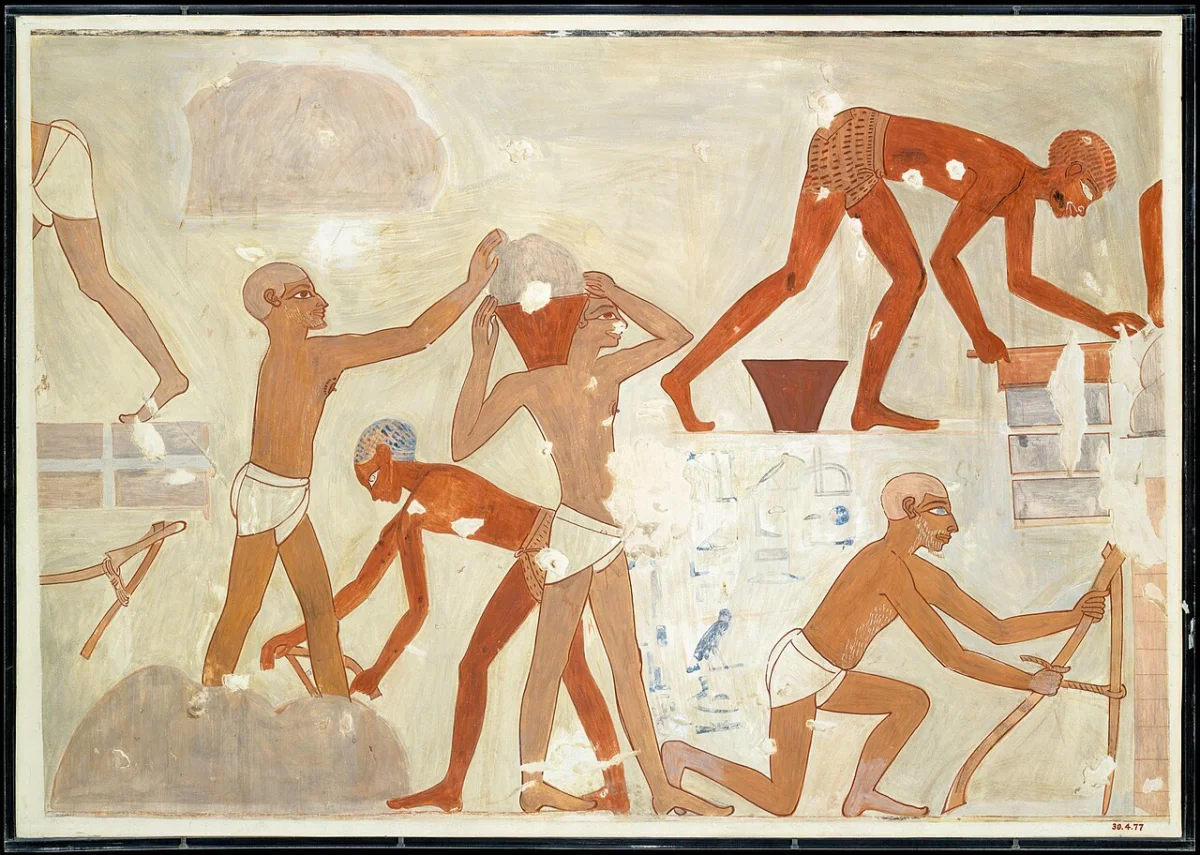
| The bondage | “there arose up a new king over Egypt, which knew not Joseph” (Ex. 1:8). A new dynasty may have overthrown the foreign Hyksos rulers.9 “They made their lives bitter with hard bondage, in mortar, and in brick” (Ex. 1:14) | Ex. 1; Ex. 5 |
| Moses | “she called his name Moses: and she said, Because I drew him out of the water” (Ex. 2:10). He fled to Midian and kept the flock of Jethro, “the priest of Midian,” and led it “to the backside of the desert, and came to the mountain of God, even to Horeb” (Ex. 3:1), where “the bush burned with fire, and the bush was not consumed” (Ex. 3:2). Horeb is also called Mount Sinai9 | Ex. 2–4 |
| Plagues and Passover | “against all the gods of Egypt I will execute judgment: I am the LORD” (Ex. 12:12). The plagues showed that Jehovah was more powerful than the gods of Egypt10 | Ex. 7–12 |
| The sea | “the waters were divided” (Ex. 14:21). God led them “through the way of the wilderness of the Red sea” (Ex. 13:18); the Hebrew can also be translated “Reed Sea,” and the exact camp is unclear. Other evidence suggests that the Red Sea is meant, and that the sea crossed was a large body of water11 | Ex. 13–15 |
| Sinai | “the same day came they into the wilderness of Sinai” (Ex. 19:1). Israel stayed nearly a year;6 “All the words which the LORD hath said will we do” (Ex. 24:3), yet “Up, make us gods” (Ex. 32:1) | Ex. 19–34 |
| The tabernacle | “the glory of the LORD filled the tabernacle” (Ex. 40:34). It was built so the Lord could “dwell among” His people12 | Ex. 35–40; Lev. 1:1 |
| The spies and Kadesh | The adults who followed the report of ten spies were told, “your children shall wander in the wilderness forty years” (Num. 14:33)13 | Num. 13–14 |
| The forty years | “Miriam died there” at Kadesh (Num. 20:1); Moses and Aaron were barred from the promised land;13 Aaron died on Mount Hor “in the fortieth year” (Num. 33:38). Thirty-eight of the years are not described14 | Num. 20; Num. 33 |
| The bronze serpent | “fiery serpents” bit the people (Num. 21:6–9); Jesus taught that it symbolized His atoning sacrifice13 | Num. 21 |
| Sihon and Og | Moses conquered Sihon, “king of the Amorites” (Num. 21:21),15 and Og, “the king of Bashan” (Num. 21:33),16 and their lands | Num. 21:21–35 |
| Balaam | Balak bribed him to curse Israel; he blessed instead17 | Num. 22–24 |
| The plains of Moab | Israel “pitched in the plains of Moab” (Num. 22:1). Moses gave three sermons to a new generation18 | Deut. 1–30 |
| Moses's death | “Moses went up from the plains of Moab unto the mountain of Nebo” (Deut. 34:1), and “Moses the servant of the LORD died there in the land of Moab” (Deut. 34:5). The Joseph Smith Translation says the Lord took Moses unto his fathers; the Book of Mormon says the Lord took him unto himself18 | Deut. 34 |
The nations
| Nation | Who and where | With Israel |
|---|---|---|
| Egypt | The store cities Pithom and Pa-Ramses are dated to Ramses II; Israelite slaves were employed in building them19 | “they built for Pharaoh treasure cities, Pithom and Raamses” (Ex. 1:11) |
| Midian | Wandering Arab tribes, akin to the Hebrews20; Jethro was a descendant of Abraham and Keturah9 | Moses fled there (Ex. 2:15) |
| Amalek | Lived in the desert of Paran21; they “may have been descendants of Esau”2 | “Then came Amalek, and fought with Israel in Rephidim” (Ex. 17:8) |
| Edom | South of the Dead Sea; kin through Esau22 | Israel was told, “Meddle not with them” (Deut. 2:5) |
| Moab | East of the Dead Sea; akin to the Israelites23 | “Distress not the Moabites” (Deut. 2:9) |
| Ammon | Descended from Lot24 | “distress them not” (Deut. 2:19) |
| The Amorites | Sihon and Og, “the two kings of the Amorites” (Deut. 3:8), whom Moses conquered15,16 | Num. 21:21–35 |
| The Canaanites | Sometimes a general name for all the non-Israelite inhabitants west of the Jordan25 | “thou shalt smite them, and utterly destroy them; thou shalt make no covenant with them, nor shew mercy unto them” (Deut. 7:2). Moses explained that they were to be driven out because of their wickedness18 |
The books of this period
- Exodus: slavery in Egypt, the departure under Moses, and Israel's dedication to God's service.26
- Leviticus: sacrifices, the consecration of priests, uncleanness, the Day of Atonement and the law of holiness.27
- Numbers: Sinai to the plains of Moab, named for its two censuses.28
- Deuteronomy: the last discourses of Moses; its name means “repetition of the law.”29
For the covenant and the worship, see The Law and the Covenant and The Law, the Covenant and the Temple.
Sources
- “Pharaoh”, Bible Dictionary. a
- Exodus 11–19: The Passover and the Exodus, Old Testament Student Manual: Genesis–2 Samuel (Church Educational System, 2003). a b
- Scripture Central, “Why Does Contextualizing the Exodus Story Matter?”, KnoWhy #847, Apr. 7, 2026. a
- Kerry Muhlestein, “Israel, Egypt, and Canaan”, In From Creation to Sinai: The Old Testament through the Lens of the Restoration, ed. Daniel L. Belnap and Aaron P. Schade (Provo, UT: Religious Studies Center, Brigham Young University; Salt Lake City: Deseret Book), 193–222. a b
- “Sinai”, Bible Dictionary. a
- Exodus 19–20; 24; 31–34, Scripture Helps: Old Testament (2025). a b
- Kerry Muhlestein, “Egypt in the Bible”, Religious Educator 11, no. 3 (2010): 79–93 (Provo, UT: Religious Studies Center, Brigham Young University). a
- 2. Israel’s Exodus from Egypt and Entry into Canaan, Bible Maps. a
- Exodus 1–6, Scripture Helps: Old Testament (2025). a b c
- Exodus 7–13, Scripture Helps: Old Testament (2025). a
- Exodus 14–18, Scripture Helps: Old Testament (2025). a
- Exodus 35–40; Leviticus 1; 4; 16; 19, Scripture Helps: Old Testament (2025). a
- Numbers 11–14; 20–24; 27, Scripture Helps: Old Testament (2025). a b c
- Numbers 13–36: Wilderness Wanderings, Part 2, Old Testament Student Manual: Genesis–2 Samuel. a
- “Sihon”, Bible Dictionary. a b
- “Og”, Bible Dictionary. a b
- “Balaam”, Bible Dictionary. a
- Deuteronomy 6–8; 15; 18; 29–30; 34, Scripture Helps: Old Testament (2025). a b c
- “Egypt”, Bible Dictionary. a
- “Midianites”, Bible Dictionary. a
- “Amalek, Amalekites”, Bible Dictionary. a
- “Edom”, Bible Dictionary. a
- “Moab”, Bible Dictionary. a
- “Ammon, Ammonites”, Bible Dictionary. a
- “Canaan”, Bible Dictionary. a
- “Exodus”, Guide to the Scriptures. a
- “Leviticus”, Bible Dictionary. a
- “Numbers”, Bible Dictionary. a
- “Deuteronomy”, Bible Dictionary. a