Amos
“Seek the LORD, and ye shall live.” Amos to the house of Joseph, Amos 5:6
Amos was a herdsman from Tekoa, in Judah, whom the Lord “took” as he “followed the flock” and sent north to prophesy to the kingdom of Israel (Amos 7:15). His book dates itself to the reigns of Uzziah of Judah and Jeroboam II of Israel, in the eighth century B.C., a generation before Assyria ended the northern kingdom. The kingdom was prosperous. Samaria had winter houses and summer houses and beds of ivory, and the shrines at Beth-el and Gilgal were busy.
Amos said that the worship was worthless while the poor were sold “for a pair of shoes” (Amos 2:6). Israel alone had been known by the Lord, and for that reason it would be held to a stricter account (Amos 3:2). He taught that the Lord warns before He acts: “Surely the Lord GOD will do nothing, but he revealeth his secret unto his servants the prophets” (Amos 3:7). He foretold a famine “of hearing the words of the LORD” (Amos 8:11), and the book ends with the Lord raising “the tabernacle of David that is fallen” (Amos 9:11). This companion goes through all nine chapters and tries to anticipate the questions a careful reader would ask.
For the wider setting of the northern kingdom and Assyria, see A Timeline of the Old Testament.
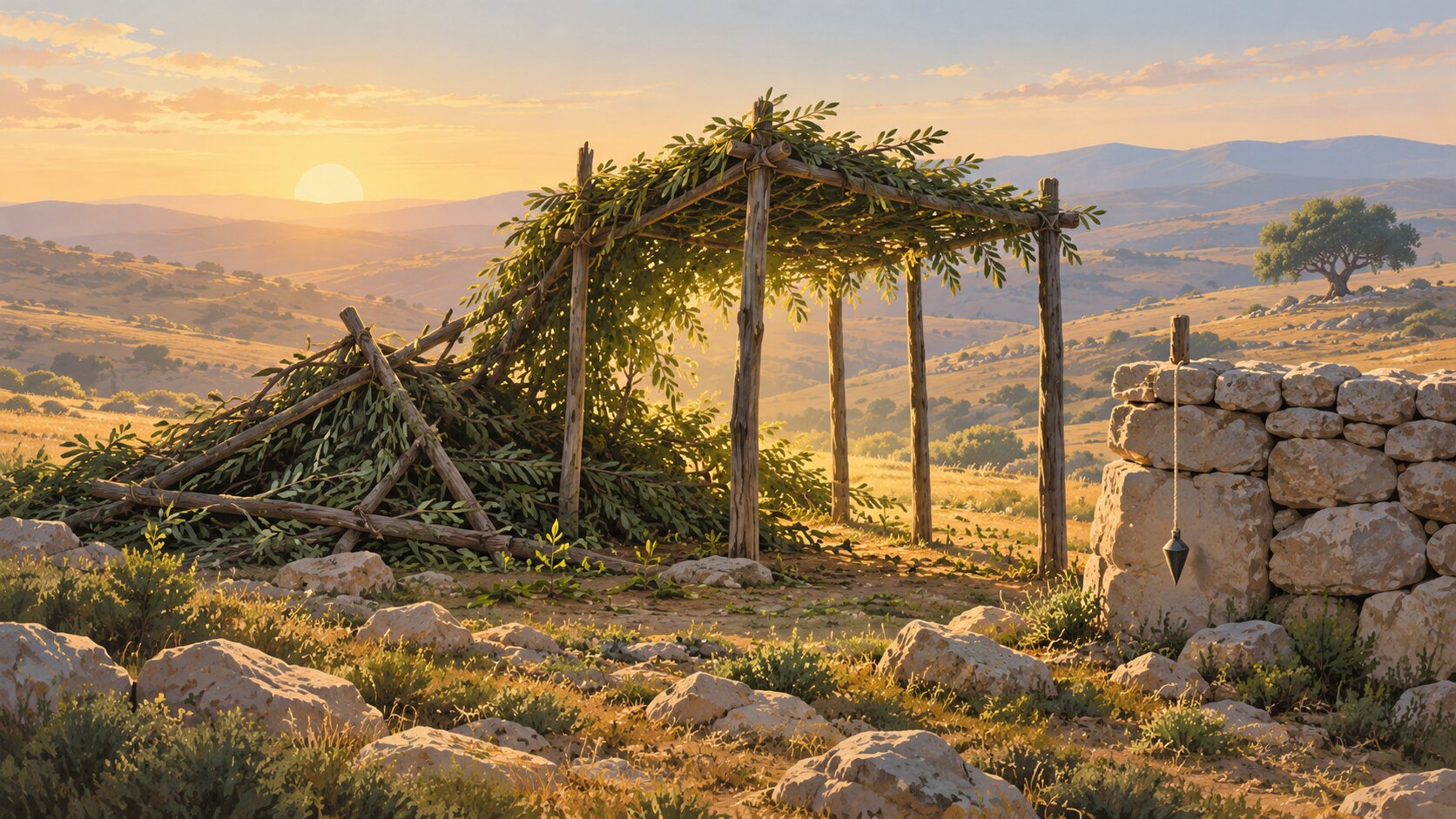
What's in this picture
- The booth, half fallen and half raised again, is “the tabernacle of David that is fallen,” which the Lord promises to raise up and build “as in the days of old” (Amos 9:11). The book’s last word is hope.
- The plumbline on the wall is the builder’s line the Lord set “in the midst of my people Israel” to measure how far they had strayed (Amos 7:7–8). It still hangs beside the booth: the house is rebuilt true.
- The sycomore on the far hill is Amos’s own trade. He was “an herdman, and a gatherer of sycomore fruit” when the Lord took him from the flock (Amos 7:14–15).
The chapters
Nine chapters in three movements. Judgment circles through Israel’s neighbors and lands on Israel. Amos then argues the case against a prosperous people and pleads with them to seek the Lord. Five visions close the book, and its last verses promise the fallen house of David raised again.
For Three Transgressions, and for Four
The Lord roars from Zion. Judgment falls on Damascus, Gaza, Tyre, Edom, Ammon and Moab for their cruelty, then on Judah, and last and longest on Israel, which sold the poor and silenced its prophets.
- 1 The LORD Will Roar from Zion A shepherd from Judah opens his message to Israel with the Lord’s roar from Jerusalem, and with sentence passed on five of Israel’s neighbors for cruelty in war and for selling people.
- 2 The List Reaches Israel Amos finishes his round of the nations with Moab, turns to Judah, and then pronounces the same sentence on Israel. Israel’s charge is the longest of the eight, and it is about what the comfortable are doing to the poor.
Hear This Word
Because the Lord has known Israel alone, He will hold it to account. He has sent famine, drought and pestilence, and the people have not returned. He despises their feast days and asks for justice. Woe to those at ease in Zion.
- 3 The Lion Has Roared Israel is the one family the Lord has known, and that is the charge against it. A run of questions shows why a prophet who has heard the Lord cannot keep silent, and then the sentence falls on Samaria’s palaces, on the altar at Beth-el, and on the houses of ivory.
- 4 Yet Have Ye Not Returned unto Me Samaria’s wealthy women call for drink and its pilgrims crowd the shrines. The Lord counts five warnings He has already sent, each ending in the same words, and then tells Israel to get ready to meet Him.
- 5 Seek Me, and Ye Shall Live Amos sings a funeral song over a kingdom at the height of its prosperity and three times names the way out, which is to seek the Lord. The shrines are busy and the courts are for sale, and the Lord refuses the offerings of people who sell justice in the gate.
- 6 At Ease in Zion The leading men of Samaria feast on ivory couches and feel safe on their hill. Amos pronounces a woe on them, the Lord swears to give up the city, and the chapter ends with a nation on its way.
Thus Hath the Lord God Shewed unto Me
Visions of locusts, fire, a plumbline, a basket of summer fruit, and the Lord standing upon the altar. A priest orders Amos out of Beth-el, a famine of the word is foretold, and the Lord promises to raise the fallen house of David.
- 7 A Plumbline in the Midst of Israel Amos sees locusts and then fire, and pleads both away. He sees a plumbline and says one word. Then the priest of Beth-el orders him home, and Amos tells how he was called.
- 8 A Basket of Summer Fruit Amos is shown ripe fruit and hears that Israel’s end has come. The grain merchants are charged in their own words, the Lord swears to remember, and the last thing He takes away is His word.
- 9 The Sieve and the Fallen Booth Amos sees the Lord at the altar, ordering the sanctuary brought down on its worshippers, and no hiding place is left. Then the sentence is limited to the sinful kingdom, and the book ends with the fallen house of David raised and Israel planted in its land.
Themes
Ideas that run through many chapters, gathered in one place.
Beloved passages
- “Can two walk together, except they be agreed?”Amos 3:3
- “he revealeth his secret unto his servants the prophets”Amos 3:7
- “prepare to meet thy God, O Israel”Amos 4:12
- “let judgment run down as waters, and righteousness as a mighty stream”Amos 5:24
- “Woe to them that are at ease in Zion”Amos 6:1
- “not a famine of bread, nor a thirst for water, but of hearing the words of the LORD”Amos 8:11
- “I raise up the tabernacle of David that is fallen”Amos 9:11
Most-used sources
Every note cites its sources. These are the ones this commentary leans on most.
- “Amos”, Bible Dictionary.
- Amos; Obadiah; Jonah, Scripture Helps: Old Testament (2025).
- Joshua M. Matson, “Covenants, Kinship, and Caring for the Destitute in the Book of Amos”, Religious Educator 23, no. 3 (2022): 46–63.
- Joshua M. Sears, ““O Lord God, Forgive!” Prophetic Intercession in Amos”, In Prophets and Prophecies of the Old Testament, ed. Aaron P. Schade, Brian M. Hauglid, and Kerry Muhlestein (Provo, UT: Religious Studies Center; Salt Lake City: Deseret Book, 2017), 185–204.