This guide covers Abraham's call and journey from Ur and Haran into Canaan, the covenant with him and his seed, Isaac, Jacob (Israel) and his twelve sons, Joseph in Egypt, and the family's going down to Goshen. For the period's place in the whole Old Testament, see A Timeline of the Old Testament.
No date is certain. The Church's Bible Chronology gives no B.C. date from Abram to Joshua,1 and for the earliest history “we rely entirely on the scripture itself.”2 Isaac's birth is estimated at “approximately 1900 B.C.”3 Abraham's life is “usually” placed in the Middle Bronze Age, about 2100–1750 B.C.;4 one scheme has him born “in about 1943 BC.”5 This guide chooses none.
The map
For the regions and roads, see The Land.
The events
| Who | What happened | Read |
|---|---|---|
| Abraham | “Terah took Abram his son … and they went forth with them from Ur of the Chaldees, to go into the land of Canaan; and they came unto Haran, and dwelt there” (Gen. 11:31). Abraham tells of a famine: “Haran, my brother, died” (Abr. 2:1). The Lord: “I have heard thee, and have come down to deliver thee” (Abr. 1:16) | Gen. 11; Abr. 1–2 |
| The call | “Get thee out of thy country, and from thy kindred, and from thy father’s house, unto a land that I will shew thee” (Gen. 12:1). “And the Canaanite was then in the land” (Gen. 12:6) | Gen. 12:1–9; Abr. 2 |
| Egypt | “there was a famine in the land: and Abram went down into Egypt to sojourn there” (Gen. 12:10). The Pharaoh was “probably one of the Hyksos or Shepherd kings”8 | Gen. 12:10–20; Abr. 2:21–25 |
| Lot; Melchizedek | Abram “dwelt in the plain of Mamre, which is in Hebron” (Gen. 13:18). Melchizedek, dated to “about 2000 B.C.,”9 “brought forth bread and wine: and he was the priest of the most high God” (Gen. 14:18) | Gen. 13–14 |
| The covenant | “he believed in the LORD; and he counted it to him for righteousness” (Gen. 15:6); “thy name shall be Abraham” (Gen. 17:5). It was renewed with Isaac and Jacob10 | Gen. 15; Gen. 17 |
| Hagar and Ishmael | “Abram was fourscore and six years old, when Hagar bare Ishmael” (Gen. 16:16) | Gen. 16; Gen. 21 |
| Sodom | Lot's older daughter's son “is the father of the Moabites unto this day” (Gen. 19:37) | Gen. 18–19 |
| Isaac | “Abraham was an hundred years old, when his son Isaac was born” (Gen. 21:5). “Get thee into the land of Moriah” (Gen. 22:2); “in thy seed shall all the nations of the earth be blessed” (Gen. 22:18). Identifying Moriah with the temple hill is “a tradition first recorded by the Jewish historian Josephus”;11 one scholar thinks it “unlikely that Moriah was at Jerusalem”4 | Gen. 21–22 |
| Sarah and Rebekah | “Abraham buried Sarah his wife in the cave of the field of Machpelah before Mamre” (Gen. 23:19). “thou shalt not take a wife unto my son of the daughters of the Canaanites” (Gen. 24:3). Isaac took “Rebekah to wife, the daughter of Bethuel the Syrian of Padan-aram” (Gen. 25:20) | Gen. 23–24; for the women, see Women and Marriage |
| Jacob and Esau | “thus Esau despised his birthright” (Gen. 25:34). “Arise, go to Padan-aram” (Gen. 28:2). At Bethel: “a ladder set up on the earth, and the top of it reached to heaven” (Gen. 28:12) | Gen. 25–28 |
| Haran | “I will serve thee seven years for Rachel thy younger daughter” (Gen. 29:18); “This twenty years have I been with thee” (Gen. 31:38) | Gen. 29–31 |
| Israel | “Thy name shall be called no more Jacob, but Israel” (Gen. 32:28). “Esau ran to meet him, and embraced him” (Gen. 33:4). “Now the sons of Jacob were twelve” (Gen. 35:22) | Gen. 32–35 |
| Joseph | “Joseph, being seventeen years old” (Gen. 37:2). A company of “Ishmeelites” took him to Egypt (Gen. 37:25–28); “the Midianites sold him into Egypt unto Potiphar” (Gen. 37:36) | Gen. 37; Gen. 39 |
| Joseph in Egypt | “Joseph was thirty years old when he stood before Pharaoh king of Egypt” (Gen. 41:46); “all countries came into Egypt to Joseph for to buy corn” (Gen. 41:57). This Pharaoh too was “one of the Hyksos.”8 “We cannot date Joseph precisely, but the most likely setting for Joseph is when the Hyksos began to take control of all of Egypt,” about 1650 B.C.5 | Gen. 41–45 |
| Goshen | “Fear not to go down into Egypt; for I will there make of thee a great nation” (Gen. 46:3). “dwell in the land of Goshen” (Gen. 46:34). Goshen was “probably in the eastern part of the delta of the Nile”12 | Gen. 46–47 |
| Deaths | Jacob's sons “buried him in the cave of the field of Machpelah” (Gen. 50:13). Joseph, “an hundred and ten years old” (Gen. 50:26), said, “God will surely visit you, and bring you out of this land” (Gen. 50:24) | Gen. 49–50 |
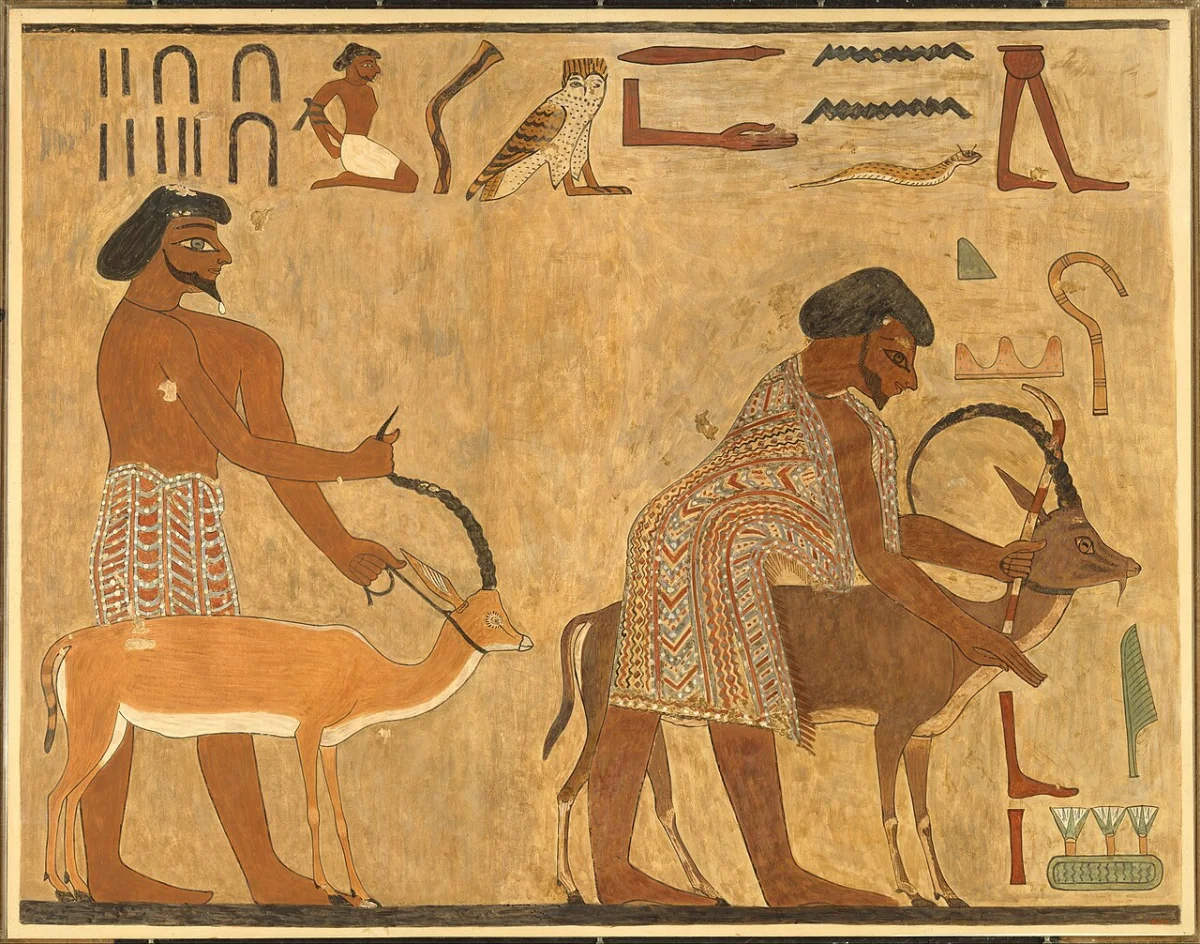
The peoples
| People | Who and where | With the patriarchs |
|---|---|---|
| Chaldeans | “The portion of Babylonia that lay south and east of Babylon.”14 The Hebrew word may not mean “the later tribe, the kaldu”4 | “Ur of the Chaldees” (Gen. 11:28) |
| Canaanites and Amorites | The name Canaan sometimes serves as “a general name for all the non-Israelite inhabitants of the country west of Jordan”;15 the Amorites were “northwest Semitic-speaking peoples who lived about the time of Abraham”16 | “the iniquity of the Amorites is not yet full” (Gen. 15:16) |
| Philistines | The Philistines held “the rich lowland on the Mediterranean coast”;17 Gerar is “near Gaza”18 | “Abimelech king of the Philistines unto Gerar” (Gen. 26:1) |
| Egypt | Known to the Hebrews as Mizraim;19 Pharaoh means “Great House”8 | “the Egyptians might not eat bread with the Hebrews” (Gen. 43:32) |
| The Hyksos | Canaanites in Egypt: by 1650 BC “there were so many of these Canaanites living in Egypt that they took over the northern part of that land”;13 “Egyptianized Semites” who “ruled the eastern part of the Nile Delta as Egyptian kings,”5 until “around 1550 BC” the rulers of Thebes threw off “Hyksos control”5 | Abraham's Pharaoh was “probably one of the Hyksos or Shepherd kings”;8 for Joseph, see the events above |
| Ishmaelites and Midianites | The Ishmaelites were “a wandering race”;20 the Midianites, “wandering Arab tribes, akin to the Hebrews”21 | Both carry Joseph to Egypt (Gen. 37:28; Gen. 37:36) |
| Edom | “Red,” the name of Esau, of his descendants and of their country in Mount Seir22 | “Thus dwelt Esau in mount Seir” (Gen. 36:8) |
| Moab and Ammon | Lot “was the ancestor of Moab and Ammon”23 | Gen. 19:37–38 |
| Aram | Laban's “branch of the family remained at Haran when Abraham moved on into Canaan”24; “The Arameans therefore had kinship with the Hebrews”25 | “Laban the Syrian” (Gen. 25:20) |
The books of this period
- Genesis 12–50: “the beginning of the Abrahamic family leading to the establishment of the house of Israel,” with Joseph's role as a preserver of Israel.26
- Abraham 1–2: Abraham's own account of Ur, the famine and the road to Egypt. For the facsimiles, see Facsimile 1, 2 and 3. “We don’t know how the facsimiles relate to the text. There is evidence that some Jewish authors during the era in which the papyri were created adapted and incorporated Egyptian drawings and stories into their own sacred texts, including those relating to Abraham.”27
The next period is Egypt and the Wilderness, which begins when “there arose up a new king over Egypt, which knew not Joseph” (Ex. 1:8).
Sources
- “Chronology of the Old Testament”, Bible Dictionary, “Bible Chronology”. a
- “Bible Chronology”, Bible Dictionary, “Bible Chronology” (introduction). a
- Genesis 24–36: The Covenant Line Continues with Isaac and Jacob, Old Testament Student Manual: Genesis–2 Samuel (Church Educational System, 2003). a
- John Gee, “The Wanderings of Abraham”, In From Creation to Sinai: The Old Testament through the Lens of the Restoration, ed. Daniel L. Belnap and Aaron P. Schade (Provo, UT: Religious Studies Center, Brigham Young University; Salt Lake City: Deseret Book), 251–78. a b c d
- Kerry Muhlestein, “Israel, Egypt, and Canaan”, In From Creation to Sinai: The Old Testament through the Lens of the Restoration, ed. Daniel L. Belnap and Aaron P. Schade (Provo, UT: Religious Studies Center, Brigham Young University; Salt Lake City: Deseret Book), 193–222. a b c d
- “Ur”, Bible Dictionary. a
- Paul Y. Hoskisson, “Where Was Ur of the Chaldees?”, In The Pearl of Great Price: Revelations from God, ed. H. Donl Peterson and Charles D. Tate Jr. (Provo: BYU Religious Studies Center, 1989). a
- “Pharaoh”, Bible Dictionary. a b c d
- “Melchizedek”, Bible Dictionary. a
- “Abraham, covenant of”, Bible Dictionary. a
- “Moriah”, Bible Dictionary. a
- “Goshen”, Bible Dictionary. a
- Scripture Central, “Why Were the Hebrews Allowed to Settle in Egypt?”, KnoWhy #844, Mar. 17, 2026. a b
- “Chaldea”, Bible Dictionary. a
- “Canaan”, Bible Dictionary. a
- “Amorites”, Bible Dictionary. a
- “Philistines”, Bible Dictionary. a
- “Gerar”, Bible Dictionary. a
- “Egypt”, Bible Dictionary. a
- “Ishmael”, Bible Dictionary. a
- “Midianites”, Bible Dictionary. a
- “Edom”, Bible Dictionary. a
- “Lot”, Bible Dictionary. a
- “Laban”, Bible Dictionary. a
- “Aram, Arameans”, Bible Dictionary. a
- “Genesis”, Bible Dictionary. a
- Genesis 12–17; Abraham 1–2, Scripture Helps: Old Testament (2025). a
Further reading
- “Abraham”, Bible Dictionary.
- The Holy Scriptures (Latter-day Saint editions), text and chapter headings, The Church of Jesus Christ of Latter-day Saints.