Abraham Facsimile 3
Abraham in the King’s Court
A court scene, explained as Abraham “reasoning upon the principles of Astronomy, in the king’s court.”
Last revised
About this facsimile
The explanation sets this scene in Egypt: its last line reads, “Abraham is reasoning upon the principles of Astronomy, in the king’s court.” In chapters 2 and 3 Abraham is on his way there. The Lord speaks to him as he comes near to Egypt (Abr. 2:22), and after showing him the stars says, “I show these things unto thee before ye go into Egypt, that ye may declare all these words” (Abr. 3:15).
As with the other two plates, the explanation was printed with the book in 1842. Most of what the explanations say differs from what Egyptologists say of the same figures, some parallels have been noted, and how the pictures relate to Abraham’s text is not known; the page for Facsimile 1 gives the Church’s words.
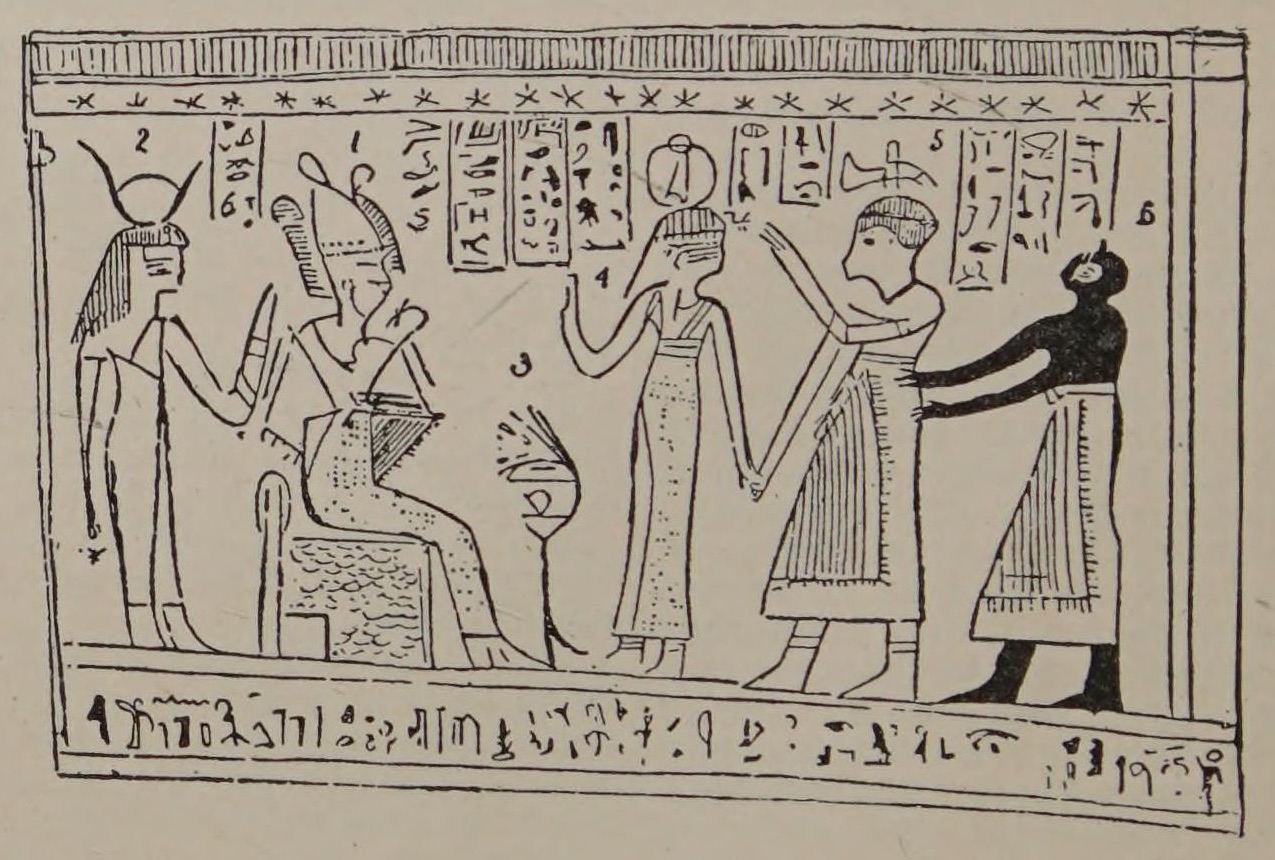
Tap any highlighted phrase to open a note beneath its figurein the margin.
Explanation of the Above Cut
1 Abraham sitting upon Pharaoh’s throne, by the politeness of the king, with a crown upon his head, representing the Priesthood, as emblematical of the grand Presidency in Heaven; with the scepter of justice and judgment in his hand.
2 King Pharaoh, whose name is given in the characters above his head.
3 Signifies Abraham in Egypt—referring to Abraham, as given in the ninth number of the Times and Seasons. (Also as given in the first facsimile of this book.)
The current edition reads “Signifies Abraham in Egypt as given also in Figure 10 of Facsimile No. 1.”
4 Prince of Pharaoh, King of Egypt, as written above the hand.
5 Shulem, one of the king’s principal waiters, as represented by the characters above his hand.
6 Olimlah, a slave belonging to the prince.
Abraham is reasoning upon the principles of Astronomy, in the king’s court.
Sources & further reading
- The Holy Scriptures (Latter-day Saint editions), text and chapter headings, The Church of Jesus Christ of Latter-day Saints.
- “Origins of the Book of Abraham”, Topics and Questions, Gospel Library.
- The Pearl of Great Price, Salt Lake City: The Church of Jesus Christ of Latter-day Saints, 1921 edition (1929 printing), scanned at the Internet Archive.
- Stephen O. Smoot, John Gee, Kerry Muhlestein, and John S. Thompson, “A Semitic View of the Facsimiles”, BYU Studies Quarterly 61, no. 4 (2022): 215.
- Stephen O. Smoot, John Gee, Kerry Muhlestein, and John S. Thompson, “Facsimile 3: Judgment Scene or Presentation Scene?”, BYU Studies Quarterly 61, no. 4 (2022): 264.
- Stephen O. Smoot, John Gee, Kerry Muhlestein, and John S. Thompson, “Abraham and Osiris (Facsimile 3, Figure 1)”, BYU Studies Quarterly 61, no. 4 (2022): 270.
- Stephen O. Smoot, John Gee, Kerry Muhlestein, and John S. Thompson, “Isis the Pharaoh (Facsimile 3, Figure 2)”, BYU Studies Quarterly 61, no. 4 (2022): 276.
- Stephen O. Smoot, John Gee, Kerry Muhlestein, and John S. Thompson, “Shulem, One of the King’s Principal Waiters (Facsimile 3, Figure 5)”, BYU Studies Quarterly 61, no. 4 (2022): 280.
- The Joseph Smith Papers, Book of Abraham and Facsimiles, 1 March–16 May 1842, Times and Seasons 3 (1842), p. 784 (explanation of Facsimile No. 3), Joseph Smith Papers.
- Times and Seasons, 1 March 1842, The Joseph Smith Papers, p. 703 (Vol. III, No. 9).